
See how simple procurement can be

What is SaaS Management?
SaaS management is the ongoing practice of tracking, controlling and optimizing every software application a business subscribes to, eliminating wasted spend from unused or underutilized licences. The average organization now uses 144 applications, rising 16.4% year-on-year, and 14% of all software applications go entirely unused. Vertice has helped one company save 115 hours on contract negotiations.
What is SaaS management?
SaaS management is the process of discovering, governing and optimizing every software application in an organization's technology portfolio — from the initial purchase request through to renewal, renegotiation or retirement.
Done well, it turns software from an untracked, fast-inflating cost into a predictable, governed line item. Done badly — or not at all — it leaves the business exposed on three fronts at once: money leaking through unused licenses and unreviewed renewals, security gaps created by software nobody in IT has ever seen, and compliance risk sitting inside vendor contracts nobody has read.
The scale of the problem has changed sharply. The average business now runs 144 individual SaaS applications, up from 131 in mid-2025 — a stack that grew 4.3% in a single quarter. At the same time, SaaS inflation hit 16.4% in June 2026, the highest rate on record and close to four times US CPI. More applications, each costing more, changing price faster than any budgeting cycle can absorb.
Analysis of more than $75 billion of global processed spend in Vertice's Insights Hub shows what that combination produces: widespread budget leakage, renewals firing without review and extreme price variance between companies buying the identical product. This guide covers what SaaS management involves, who owns it, the lifecycle it follows and how to build a process that holds up as the stack keeps growing.
Why SaaS management became a finance priority
Software-as-a-service won because it removed friction. There is no infrastructure to host, no lengthy installation, no capex approval — a team can be running a new tool within the hour. That accessibility is exactly what makes SaaS valuable, and exactly what makes it hard to govern.
The consequence is decentralized purchasing. Software is now bought by marketing, sales, engineering and operations as often as it is bought by IT, frequently on a corporate card and almost always without a central record. Each purchase is individually defensible. Collectively, they produce a portfolio that no single team can see, priced on terms no one negotiated, renewing on dates nobody is tracking.
That creates three compounding problems for IT, finance and procurement:
- No single view of the stack: Nobody can answer what the company owns, who owns it, what it costs or when it renews without a manual audit.
- Spend that leaks continuously: Duplicate tooling, licenses assigned to departed employees, seats provisioned for teams that never adopted the tool, and renewals that roll over at a price increase nobody challenged.
- Security and compliance exposure: Applications holding customer data that never passed a vendor review, and — increasingly — AI tools connected to internal systems using personal credentials.
Spreadsheets and ERP systems were never built to solve this. An ERP records the invoice; it cannot tell you that 40% of the seats on that invoice have not been logged into for ninety days. That gap between what finance can see and what is actually happening is where SaaS management operates.
The cost of unmanaged software
Software waste is measurable, and it scales with headcount.
Organizations with 500–1,000 employees now waste in excess of $1.75 million each year on software they are not using. For organizations above 10,000 employees, that figure reaches as much as $18.9 million annually.
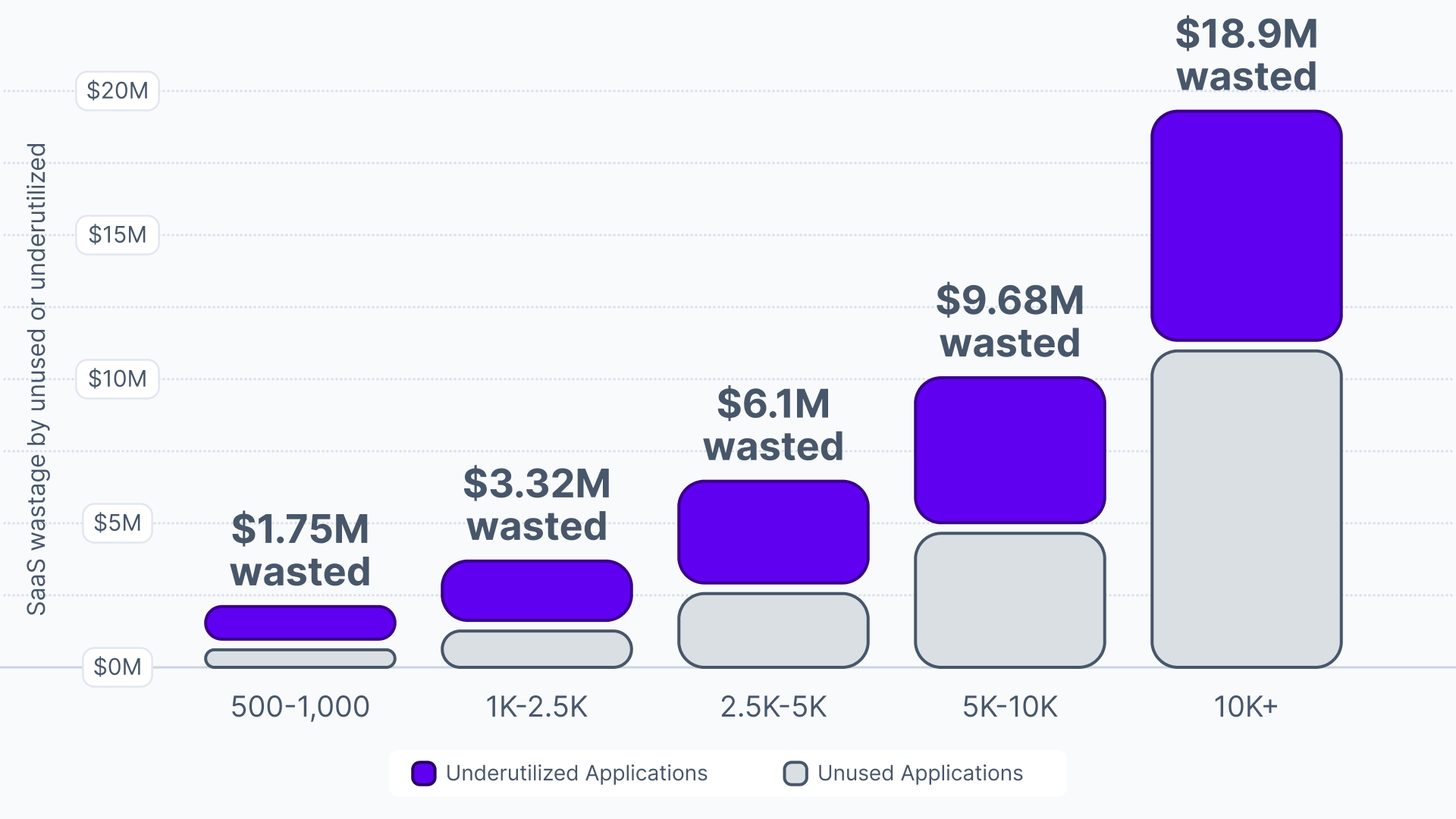
Preventable software spend can come from four different sources – and effective SaaS management addresses each differently:
1. Licenses nobody uses
Vertice's data shows that 51% of software applications go underutilized, with a further 14% entirely unused inside the average organization. Two-thirds of the average stack, in other words, is either partly or completely idle.
The causes are often structural rather than careless: decentralized purchasing creates duplicate tools across departments, headcount changes leave licenses stranded, and pilot projects are rarely decommissioned when they end. Continuous usage monitoring closes this gap by surfacing idle seats for reclamation, and intake-to-procure governance prevents the next duplicate before it is bought, by validating every request against what the company already owns.
2. Renewals that fire without review
Every renewal date is a negotiation window. Miss it and the contract rolls over at whatever uplift the vendor set, with no opportunity to adjust seat tiers, renegotiate terms or exit a tool the business has outgrown.
This is most acute across tail spend — the long list of smaller contracts that no one is assigned to watch. Vertice's data shows 72% of tail spend applications renew without any form of review. Those tools account for roughly 19% of total software spend, which in a large organization still runs to millions of dollars, and they carry average uplifts of 6–8% each cycle.
The fix is unglamorous and highly effective: a single source of truth for contract dates, with automated alerts firing 90 to 120 days before expiration — enough runway to actually negotiate rather than react.
3. Shrinkflation
Headline price increases are visible. Shrinkflation is not.
Around 27% of software vendors now use tactics that raise the effective cost of a contract without changing the number on the invoice. A feature that was included moves to a higher tier. Storage limits tighten. Support SLAs are quietly downgraded. API call allowances shrink. The renewal price looks flat, and the business is paying the same for materially less.
Catching this requires benchmarking contract terms over time rather than price alone — comparing what you are entitled to this year against what you were entitled to last year, and against what comparable companies are getting today.
4. Consumption pricing and AI overruns
The pricing model itself is shifting. As software vendors pivot toward consumption-based pricing for AI features, a growing share of software cost is no longer a fixed subscription — it is credit burn, API token spend and usage tiers that can move by an order of magnitude month to month.
Seat-based license management does not capture any of this. Organizations that treat AI spend as a subscription line item tend to discover the problem when the invoice arrives. AI cost optimization tracking — monitoring consumption against budget in something close to real time — is rapidly becoming a baseline requirement rather than an advanced feature.
SaaS management vs adjacent disciplines
SaaS management overlaps with several established practices, and the distinctions matter when you are deciding what to buy and who should own it.
The SaaS management lifecycle
An effective program can be broken into five stages. Older frameworks start at purchase; the meaningful change in recent years is that the cycle now starts one step earlier, at the request.
1. Intake and validation
Every software request enters through one front door. A dynamic intake form captures the business case, the data the tool will touch and the budget owner at the point of request — then validates it against the existing stack. A large share of requests are resolved here without a purchase at all, because the company already owns something that does the job.
2. Evaluation and negotiation
Shortlist viable vendors, establish your non-negotiables and your best alternative to a negotiated agreement (BATNA), and agree KPIs and SLAs before signing rather than after. This is the stage where information asymmetry costs the most: vendors know what every comparable company pays, and buyers historically have not. Transactional pricing benchmarks close that gap. Approvals route in parallel through legal, security and finance via automated workflows rather than sequentially through inboxes.
3. Onboarding and governance
Record the contract terms, renewal date and owner centrally. Provision access through SSO so entitlements are visible and revocable. Complete the vendor security review — SOC 2, ISO 27001, GDPR — before the tool touches production data, not during the next audit.
4. Ongoing management and optimization
Monitor real usage against what you are paying for. Reclaim idle seats, right-size tiers at the point they are over-provisioned rather than at renewal, and consolidate overlapping tools as the stack evolves. Track consumption-based spend continuously.
5. Renewal, renegotiation or retirement
Renewal alerts fire 90–120 days out with usage data and market benchmarks attached, so the decision is informed: renew on better terms, downgrade, consolidate or exit. Tools that are retired are fully decommissioned — access revoked, data exported, contract closed.
The risks of poor SaaS management
- Security: Every new application is a new potential entry point, and applications IT cannot see cannot be secured. This now extends to shadow AI — tools connected to internal systems and data using personal or unreviewed credentials, often with broad permissions. Discovering unsanctioned spend is how you locate these exposures.
- Onboarding: Granting new employees access to software without a governance framework creates compliance risk from day one, particularly where personal data is involved. Automated checks against frameworks such as GDPR, ISO 27001 and SOC 2 keep vendor onboarding consistent rather than dependent on who happened to run it.
- Offboarding: When someone leaves, every entitlement they held needs reviewing. Without a complete view of who has access to what, former employees retain access to confidential systems — usually entirely without malice, and entirely without anyone knowing. The risk is highest where individual employees owned licenses directly.
- Wasted spend: The largest and most quantifiable risk, covered in detail above: two-thirds of the average stack underused, 72% of tail spend renewing unreviewed, and shrinkflation eroding value inside contracts that look unchanged.
- Third-party and concentration risk: As stacks consolidate onto fewer strategic vendors, the consequences of a single vendor's outage, breach or price change grow. Continuous supplier risk monitoring tracks certifications and security posture across the portfolio rather than at the point of purchase only.
Core capabilities of a modern SaaS management platform
Platforms in this category vary widely in scope. These are the seven capabilities that separate a genuine SaaS management platform from a contract repository with a dashboard.
- Automated application and shadow IT discovery:" Scans SSO logs, expense records, finance systems and browser extensions to build a complete application inventory — including unsanctioned tools and shadow AI running on personal credentials.
- Intake-to-procure and approval governance. A single front door for all software requests and renewals. Dynamic intake captures context early, validates requests against current usage and routes multi-stakeholder approvals automatically — removing bottlenecks without removing control.
- License and usage analytics. Continuous utilization monitoring at the seat and feature level, so idle licenses and over-provisioned tiers surface before renewal rather than after.
- Proactive renewal management. Centralized contract dates with automated alerts 90–120 days ahead of expiration, giving teams runway to renegotiate, downgrade or sunset rather than react.
- Vendor management and supplier risk governance. Centralized supplier records, streamlined vendor onboarding and ongoing monitoring of security certifications to mitigate third-party risk and identify consolidation opportunities.
- AI and consumption cost tracking. AI cost optimization that monitors usage-based pricing, credit burn and API token spend alongside traditional seat licensing, as vendors shift toward consumption models.
- Transactional pricing benchmarks. Real-world data on what comparable organizations actually pay — not list prices — so negotiations start from evidence rather than from the vendor's opening position.
The most advanced platforms add procurement AI agents on top of these, handling orchestration, contract term analysis and increasingly autonomous negotiation.
Why technology replaced spreadsheets
SaaS was tracked in spreadsheets for a decade, and at twenty applications that worked. At 144 it does not, for reasons that compound:
- The data goes stale immediately. A spreadsheet reflects the stack on the day someone last updated it. Usage, headcount and entitlements change daily.
- It captures cost but not value. A spreadsheet can hold what you pay. It cannot tell you that a tool has 200 licenses and 74 monthly active users, which is the number that determines whether you should be paying it at all.
- Renewals depend on someone remembering. Manual calendar reminders fail quietly, and the failure is only discovered once the contract has rolled over.
- It provides no negotiating leverage. The single most valuable input to a software negotiation is knowing what comparable companies pay for the same product. No internal spreadsheet contains that.
- It cannot support security review. Access permissions, SSO enforcement and certification tracking need to be live, not recorded in a tab.
Eight steps to adopt SaaS management
1. Audit what you actually have: Pull from SSO logs, expense data, AP records and finance systems — not from what IT believes is in use. Expect the real number to be meaningfully higher than the expected one.
2. Set specific, measurable objectives: "Better visibility" is not a goal. "Reduce software spend 15% within twelve months while cutting procurement cycle time by half" is.
3. Establish governance and write it down: Define who can request software, what triggers a security review, what thresholds require finance approval, and how tools get decommissioned. Undocumented policy is not policy.
4. Centralize intake before you centralize anything else: A single request front door is the highest-leverage change most organizations can make, because it stops new sprawl while you are cleaning up the existing stack.
5. Choose a platform against your objectives: Evaluate on discovery accuracy, integration depth, benchmark data quality and lifecycle coverage — measured against the goals from step two, not against feature-list length.
6. Monitor and optimize continuously: Review utilization on a fixed cadence. Reclaim idle seats, consolidate overlaps and right-size tiers as an ongoing process rather than an annual event.
7. Build security and compliance into the workflow: Vendor reviews, SSO enforcement, MFA and certification tracking should be steps in the intake process, not a separate annual exercise.
8. Bring employees with you: A governance process people find slower than a corporate card will be bypassed. Communicate why it exists, make the approved route genuinely faster, and keep supporting it as the stack changes.
How to evaluate a SaaS management platform
Most platforms in this market can discover applications and store contracts. Those are table stakes. Four criteria separate the platforms that deliver measurable return from the ones that produce a very well-organized view of a problem you still have:
- Depth and accuracy of transactional intelligence: Static list prices and generic industry averages provide no leverage in a negotiation. Look for real pricing and contract data drawn from actual transactions, specific to your vendor, tier and company profile.
- Full-lifecycle coverage: Intake, approvals, contracts, usage monitoring and renewals should be one connected workflow. Stitching together point solutions recreates the visibility gap the program was meant to close.
- Commercial execution, not just software: Automation handles the routine well and complex enterprise negotiations poorly. The strongest providers pair platform capability with AI agents and experienced procurement specialists who can run vendor conversations on your behalf.
- Aligned incentives: Look for contractually guaranteed ROI or clear cost-optimization benchmarks. A provider willing to tie their commercial model to your savings is making a statement about their confidence in the outcome.
Worth asking directly in any evaluation: where does your benchmark data come from and how current is it? What percentage of our stack will you discover that we don't already know about? Who runs the negotiation — your team or ours? What happens to our data if we leave?
For a criteria-by-criteria comparison of the leading providers, see our breakdown of the best SaaS management platforms in 2026.
Building the business case
SaaS management is one of the more straightforward business cases to build, because the savings are directly measurable and the baseline is usually worse than expected.
Start with three numbers you can get before buying anything: total annual software spend, the number of applications finance can account for, and the number of contracts renewing in the next two quarters. The gap between the second number and reality is typically the most persuasive part of the case.
From there, model the recoverable waste. With 51% of applications underutilized and 14% unused, and organizations of 500–1,000 employees losing over $1.75 million annually, the realistic first-year savings target for most mid-market organizations sits comfortably in seven figures — before any negotiated price improvement on renewals.
Supercharge your SaaS management with Vertice
Vertice combines a full-lifecycle platform with the largest procurement intelligence dataset in the market. Following the acquisition of Vendr, that dataset covers more than $75 billion in global indirect spend, over two million pricing data points, 250,000+ negotiated contracts and purchasing insights across 32,000+ vendors — which is what allows our teams to tell you not just what you are paying, but what you should be.
Recently named the #1 overall procurement orchestration platform on the G2 Summer 2026 Grid, Vertice guarantees savings of at least 20% on software costs.
See how it works with a self-guided tour of the platform.
SaaS Management
FAQs
SaaS management is the process of discovering, governing and optimizing every software application an organization uses — covering the full lifecycle from purchase request through usage monitoring to renewal, renegotiation or retirement. The goal is complete visibility of what the company owns, what it costs, who uses it and when it renews, so software spend becomes controllable rather than something discovered after the fact.
A SaaS management platform is software that automates that process. It discovers applications across SSO, expense and finance data, tracks license utilization, centralizes contracts and renewal dates, routes purchase requests through approval workflows, and benchmarks what you pay against real market data. It exists to do continuously what no team can do manually across a stack of 144 applications.
It depends on stack size and current maturity, but the recoverable waste is substantial: 51% of applications are underutilized and 14% entirely unused in the average organization, and companies with 500–1,000 employees waste over $1.75 million a year on software they don't use. Vertice guarantees savings of at least 20% on software costs.
Yes – discovery is one of its core functions. By scanning SSO logs, expense records, finance systems and browser extensions, a SaaS management platform surfaces applications that were never approved by IT, including AI tools connected using personal credentials. Pairing that discovery with a centralized intake process addresses both the existing shadow IT and the cause of it.
Increasingly, all three. IT owns access, security and integration; finance owns cost, forecasting and budget accountability; procurement owns vendor relationships and negotiation. Programs owned by a single function tend to optimize for that function's metrics and miss the others, which is why the most effective operating model is shared ownership on a shared platform.
SaaS spend management is the financial subset — cost visibility, forecasting and savings. SaaS management is broader, adding access governance, security and compliance review, request workflows and vendor risk monitoring. Finance-led programs often start with spend management and expand as IT and security requirements surface.
.webp)