
See how simple procurement can be

Must-Have Features for Vendor Management Software
A feature checklist for evaluating vendor management platforms in 2026.
In this guide, we'll break down the core features that define the best vendor management software on the market – giving you a definitive checklist to inform your own RFP requirements while maximizing the value of every supplier relationship.
Vendor management software has historically been treated as little more than a repository to store signed agreements, log supplier contact information and occasionally track an expiration date.
But as tech stacks grow by an average of 10% each year and software inflation has climbed to 16.4% (more than five times the rate of consumer inflation), this system of record model is no longer sufficient.
Without continuous vendor governance and visibility, companies face uncontrolled software spend, duplicated tools, security and compliance risks, missed renewal opportunities and declining ROI from their technology investments.
In 2026, vendor management platforms can no longer afford to be passive. They must instead actively guide how an organization interacts with, vets, governs and optimizes every single third-party provider throughout the entire vendor lifecycle.
Vendor Management Software checklist: Must-have capabilities
1. Unified request intake
The vendor lifecycle doesn’t begin during onboarding, it begins the moment an employee identifies a business need and makes a purchase requisition. To eliminate Shadow IT and rogue spending, modern platforms must act as the “universal front door” for all indirect procurement requests.
- Frictionless entry points and adaptive forms: Encourages company-wide adoption by integrating natively where users are already active, for instance within Slack or Microsoft Teams, while using dynamic intake questionnaires that tailor questions to the specific request type.
- Conversational AI and order form extraction: Employs embedded AI agents to scan uploaded vendor quotes or order forms and automatically pre-fill request details, eliminating manual data entry.
- Preferred vendor interception: Automatically surfaces pre-vetted, corporate-approved suppliers during the submission process to encourage the use of existing partnerships and reduce vendor sprawl across categories.
- Smart duplication checks: Analyzes request data in real time to instantly flag redundant software or overlapping operational tools before an entirely new procurement process can be initiated.
2. No-code workflows and dynamic routing
Once a request is captured, the vendor management platform's backend infrastructure must seamlessly orchestrate the approval chain to eliminate manual bottlenecks. To ensure operational velocity without sacrificing governance, modern platforms rely on automated, flexible routing engines.
- Customizable, no-code workflow builders: Allows procurement teams to design, test, and adapt custom approval paths using visual drag-and-drop interfaces without needing engineering resources or internal IT tickets.
- Risk-based conditional routing: Automatically routes each purchase based on risk tier and vendor status, using details captured at intake. Software from already-approved or preferred vendors is fast-tracked, while anything outside that list – or flagged as high-exposure – is routed into a deeper compliance review.
- Parallel multi-level approvals: Routes approval requests to Legal, Finance, IT Security and other relevant stakeholders concurrently rather than in a slow, linear chain to eliminate operational bottlenecks and cut approval delays.
3. Strategic supplier sourcing & evaluation
When a department needs to source a new vendor, procurement shouldn't have to search blindly or juggle manual spreadsheets and endless email threads to compare proposals. A robust sourcing engine must actively orchestrate the discovery phase, combining market intelligence with structured evaluation tools to inform supplier selection.
- Data-validated supplier discovery: Instantly identifies pre-vetted vendors matched to your intake criteria using external risk profiles, peer popularity metrics and true market pricing to drastically reduce upfront research time.
- Intelligent RFx creation and evaluation: Automatically generates tailored RFx questionnaires based on sourcing needs identified at intake – with a drag-and-drop form builder to fine-tune before sending – removing most of the manual work of building a questionnaire from scratch. Once proposals come back, the right platform will aggregate and normalize supplier responses, using automated summaries to highlight key differentiators, pricing gaps and potential compliance risks. This is where VMS overlaps with dedicated RFx software.
- Hybrid expert execution (sourcing-as-a-service): Complements platform automation with on-demand access to a managed team of procurement specialists who can jump in to help run structured sourcing events or negotiate complex, high-spend contracts.
- Supplier performance benchmarking: Measures vendor delivery against agreed SLA metrics and milestones, establishing an objective record for benchmarking supplier performance when deciding whether to renew or source an alternative.
4. Spend analytics and license utilization
To prevent budget leakage and eliminate waste, vendor management platforms must provide continuous visibility into how your active software investments are actually being consumed across the organization.
- Continuous usage tracking: Integrates directly with identity providers and corporate login systems to audit active user adoption and monitor software consumption across the business.
- Proactive shelfware identification: Automatically highlights underutilized seats and inactive accounts, giving finance teams the exact data needed to right-size contracts ahead of a renewal.
- Real-time spend aggregation: Consolidates invoicing, ERP data and corporate card expenses to provide a single view of total vendor costs and instantly flag unexpected price hikes or billing anomalies.
- Cross-department cost visibility: Tracks and categorizes transactional data across all business units to expose hidden shadow IT, multi-department contract overlaps and historical spend trends.
5. Frictionless vendor onboarding and self-serve portals
The transition from selecting a vendor to actually working with them sets the tone for the entire partnership. To prevent this stage from turning into an endless email chase, modern VMS platforms move manual data entry over to the supplier, saving time and ensuring accurate information.
- Single source of truth across the vendor estate: Consolidates email threads, secure-link document sharing, spreadsheet-based RFx events and disconnected TPRM or contract systems into one secure platform. Onboarding data, compliance documents, sourcing history, contracts and communications all live in the same record.
- Direct supplier-driven data submission: Empowers vendors to upload information, quotes and compliance documents directly into the portal, instantly linking them to the core contract profile without manual data entry.
- Automated administrative tracking: Eliminates missing fields and manual follow-ups by utilizing structured vendor templates that require complete information before an onboarding submission can progress.
- Downstream workflow integration: Connects verified onboarding profiles directly to subsequent steps, allowing teams to establish structured multi-level approvals for vendor onboarding while laying the necessary groundwork for future purchase orders, invoices and financial automation.
- Centralized supplier communication logs: Captures all supplier conversations, submitted templates and historical data revisions in a single, unalterable audit trail to guarantee compliance and transparency.
6. Integrated TPRM and continuous risk monitoring
Evaluating a vendor's risk profile shouldn't be an annual check. Instead, platforms should embed risk assessments directly into daily workflows, catching potential security, legal and financial red flags before contracts are signed or renewed.
- In-line risk visibility: Native third-party risk assessment features surface continuously updated risk ratings directly within the procurement process, giving teams immediate visibility into a vendor’s security and financial posture.
- Automated policy checks: Uses automated checks to cross-reference supplier profiles against your specific legal and internal guidelines, instantly highlighting missing certifications or compliance gaps.
- Centralized questionnaire management: Drives vendor security questionnaire automation to coordinate the collection and tracking of security assessments, linking vendor responses and compliance documents directly to the core contract record.
- Continuous threat alerts: Delivers true continuous monitoring of vendor risk between formal review periods, automatically flagging sudden security incidents, financial changes or lapsed certifications before they impact your business.
- Expert-negotiated risk protections: Utilizes specialized negotiation experts to build robust safeguards into the contract, securing explicit legal and operational protections for the business in the event of a vendor compliance or security issue.
7. Renewal management and pricing benchmarks
When contracts come up for renewal, procurement shouldn't have to scramble to find original agreements or guess what fair market value looks like. A modern platform pairs autonomous tracking with real-time pricing data to ensure you always renew on the best possible terms without manual oversight.
- Renewal tracking: Leverages strategic contract renewals and auto-alerts to completely automate vendor reminders and renewals, triggering workflows well in advance to prevent accidental auto-renewals. Vertice's data shows that by starting negotiations 90+ days ahead of the deadline, companies secure 23.3% greater savings than waiting until the 30-day mark.
- Real-time pricing benchmarks: Evaluates vendor pricing against transactional market data showing what peers actually pay for the same software, providing clear leverage to challenge arbitrary price increases. Without these benchmarks, companies pay an average of 33.8% more than necessary for their software.
- Data-driven renewal preparation: Combines active license usage metrics with market benchmarks to automatically build an optimized negotiation strategy, giving you a clear target price before conversations even begin.
- Peer-benchmarked contract provisions: The best vendor management software providers will look beyond the price tag to analyze non-financial clauses – such as SLA commitments, payment terms and notice periods – against peer data, allowing you to secure more favorable commercial terms.
8. ERP integration
Procurement and finance must operate from a single source of truth. A modern platform acts as a lightweight orchestration layer on top of your existing infrastructure, seamlessly connecting procurement activities with your ERP such as NetSuite and other financial systems of record like QuickBooks, without rigid, complex setups.
- Automated vendor record syncing: Formulates two-way vendor master sync features that automatically push approved supplier data and documentation straight into your financial core, keeping records updated without duplicate data entry.
- Cross-platform workflow orchestration: Triggers downstream actions – such as purchase order creation or financial approval loops – inside your ERP the moment a contract is finalized or a milestone is met.
- Real-time spend visibility: Keeps procurement timelines and financial records accurately mirrored in real time, giving leadership a clear view of committed vendor liabilities across both platforms.
9. Compliance reporting
Maintaining regulatory alignment and internal governance shouldn't require manual document tracking or stressful audit prep. A vendor management system should automatically log every vendor interaction, document submission and approval loop to ensure you are always audit-ready.
- Audit-ready record keeping: Captures a complete, unalterable history of all supplier interactions, contract changes and stakeholder approvals, eliminating the need to manually compile files during audit seasons.
- Automated compliance tracking: Monitors the status of crucial vendor certifications – such as SOC 2, ISO 27001 and HIPAA vendor compliance – instantly flagging when an active supplier is no longer compliant.
- Internal policy enforcement: Tracks and reports on adherence to your internal procurement guidelines, ensuring every active contract has successfully passed through required security, legal and financial approvals.
- Unified compliance dashboards: Consolidates multi-vendor risk and compliance data into clean, exportable reports, giving leadership immediate visibility into the organization’s overall third-party posture.
10. Autonomous AI agents
Beyond basic chatbots or rigid automation rules, specialized AI agents can independently manage complex, multi-step procurement tasks. Working safely within your established guardrails, these digital assistants handle time-consuming workflows behind the scenes to take the operational burden off your team.
- Conversational intake and validation: Deploys agents directly into communication channels like Slack or Teams to guide employees through conversational intake, instantly parsing requests and flagging redundant tool purchases before a ticket is even created.
- Automated compliance and document analysis: Utilizes specialized agents to scan vendor files, contracts and security frameworks (such as ISO or SOC 2 reports), instantly highlighting policy deviations or security vulnerabilities without requiring manual legal reviews.
- Autonomous contract negotiation: Enlists dedicated commercial agents – such as Vertice’s 'Ana' – to manage supplier conversations and multi-round email bids entirely on autopilot, using market datasets to secure optimized pricing.
- Continuous stack optimization: Runs background agents that continuously map software utilization data against active contract tiers, automatically flag redundancies and build consolidation playbooks long before a renewal deadline arrives.
Ready to optimize your entire vendor lifecycle?
Whether you’re evaluating your existing vendor management platform or considering an alternative provider, this capability checklist allows procurement and finance teams to eliminate manual bottlenecks, mitigate third-party risk and maximize supplier value. When every stage – from conversational intake to autonomous renewals – is connected through a single layer, your business inherently operates with greater agility, lower overhead and complete financial transparency.
Vertice combines all of these capabilities into a single, unified platform, giving your team the automated workflows, real-time pricing intelligence from more than 32,000 global suppliers and the AI capabilities needed to completely optimize your entire vendor lifecycle.
This is why Vertice has been named a leader by G2 in its Procurement Orchestration 2026 Summer Grid and ranked highest among intake-to-procure providers by Lionfish Tech Advisors, who highlighted Vertice’s ability to embed risk management, compliance and supplier oversight directly into everyday workflows.
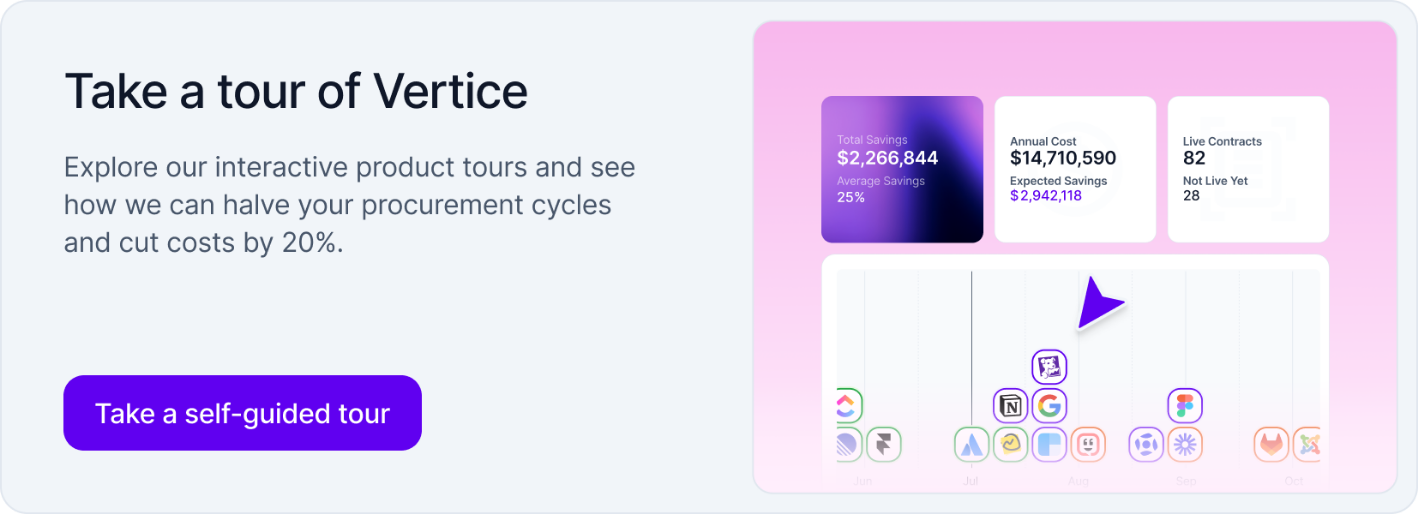
Why not see the Vertice platform in action by taking a self-guided interactive tour. Alternatively, schedule a demo at a time that suits you.
.webp)