
See how simple procurement can be

AI Procurement Software: The Ultimate Guide
Learn what AI procurement software is, how it can transform your spend management, and why your platform is only as intelligent as your data.
For years, procurement technology served a single, administrative purpose: acting as a digital ledger to log transactions within legacy Source-to-Pay (S2P) and Procure-to-Pay (P2P) frameworks. But in today’s landscape of compounding operational costs and fragmented vendor stacks, simply tracking spend after the fact is no longer enough. Finance and procurement leaders need to actively optimize and control it in real time.
This pressure has triggered an explosion of interest in AI procurement software. But as the market floods with platforms claiming "AI capabilities," a significant gap has emerged between superficial workflow automation and true autonomous procurement. According to McKinsey & Company’s 2026 research on agentic AI, transitioning to fully machine-led execution can improve procurement productivity by 25% to 40%, moving the function from a back-office transaction logger to an enterprise nerve center.
To navigate the noise, enterprise buyers must understand that modern platforms operate across three distinct operational models: AI-assisted (handling basic data extraction), AI-augmented (proactively suggesting optimization levers) and agentic/autonomous execution (orchestrating complex, multi-step workflows independently).
This guide explores what modern AI procurement software looks like when stripped of the marketing hype, the core features required to drive enterprise value, and why proprietary data is the ultimate differentiator.
Key takeaways:
- Data is the ultimate leverage: The true differentiator is a platform's proprietary data foundation. Without a real-time, real-world pricing dataset to fuel the AI, automated workflows lack the commercial leverage needed to beat vendor sales tactics.
- Execution, not just routing: Standard automation platforms simply push a ticket from one inbox to another based on rigid "if/then" rules. Modern AI procurement platforms like Vertice use a coordinated fleet of autonomous agents to actively execute the work – interpreting contract redlines, flagging risks and even conducting email negotiations on your behalf.
- Continuous optimization defeats budget volatility: Rather than relying on backward-looking quarterly audits, AI engines continuously analyze software portfolios to drive stack rationalization and map variable consumption patterns – protecting finance teams from hitting the volatile "6-month divergence cliff."
- Hard-dollar ROI: Modern platforms bridge the "data-to-action gap" to deliver measurable bottom-line value. Vertice, for example, includes a 20% guaranteed reduction in SaaS spend, while also typically achieving a 50% contraction in purchasing cycle times and a 70% reduction in manual administrative steps.
What is AI procurement software?
At its core, AI procurement software replaces rigid, manual data entry with an active execution layer across the purchasing lifecycle. By deploying agentic workflows, it interprets the unstructured context locked inside vendor emails, Slack threads, contract redlines and line-item invoices. The platform instantly translates this information into advanced spend classification, automatically triggering the appropriate next steps from early-stage strategic sourcing to supplier discovery.
Ultimately, the goal of an AI procurement platform is to remove the operational drag from the buying process. By shifting the burden of routine intake, compliance mapping, risk vetting and validation over to autonomous systems, it eliminates systemic administrative friction. This allows finance and procurement teams to refocus their energy where it counts: driving strategic vendor relationships, maintaining absolute corporate governance and executing total cost optimization.
Traditional S2P/P2P vs autonomous AI procurement architecture
To understand why traditional software fails to curb operational friction, you have to look at the underlying architecture.Legacy Source-to-Pay (S2P) and Procure-to-Pay (P2P) suites were built to be rigid, back-office accounting ledgers. They excel at mapping financial transactions after the fact, but they are completely detached from the actual employee request and the initial buying window.
Vertice bypasses this friction with an Intake-to-Procure (I2P) architecture. By layering seamlessly over your existing financial tools, it acts as a dedicated execution layer to manage and optimize your indirect and direct spend without disrupting your backend. Instead of forcing regular employees into complex ERPs, it orchestrates the entire purchasing lifecycle within Slack or Teams – running requests, risk checks and negotiations before cleanly syncing data downstream into your general ledger.
5 core capabilities of a modern AI procurement platform
When evaluating the current software market, it is easy to get lost in feature checklists. To move past the generic AI hype and deliver sustainable financial outcomes, an enterprise platform must anchor its capabilities around five core pillars – and tie them directly to a measurable return on investment.
1. Intelligent, AI-driven procurement orchestration
There is a massive chasm between standard workflow automation and true AI-driven orchestration. Many tools approach workflows through rigid, hard-coded "if/then" routing rules – if a contract is over $50,000, route to the CFO; if it’s software, route to IT. This isn't intelligence; it’s just digital paperwork.
Vertice transforms the "front door" of procurement, streamlining intake orchestration, using conversational AI intake and automated triage. Instead of forcing employees to fill out exhaustively long static forms, the platform uses adaptive, context-aware prompts to gather the right details directly inside Slack or Teams.
The AI instantly parses unstructured requests – like an uploaded vendor quote or an initial order form – to automatically detect sourcing criteria. It maps the request against your existing technology stack to flag overlap, identifies the unique risk profile of the vendor and dynamically builds an optimized approval path. This shifts orchestration from a slow, linear bottleneck into an adaptive system that cuts procurement cycle times by up to 50% while dynamically capturing unmanaged tail spend and long-tail spend.
2. Autonomous procurement agents
The most significant technological leap in modern procurement is the shift from passive AI "copilots" to autonomous multi-agent orchestration. Gartner forecasts that software featuring agentic AI capabilities will skyrocket to a $53 billion market by 2030, marking a massive industry shift where clusters of specialized agents handle multi-step workflows independently – all operating within secure, human-in-the-loop corporate guardrails:
- Intake & validation agents: Meet employees directly within Slack or Teams to handle conversational intake, cross-reference active software stacks and flag redundant or duplicate software requests before a ticket is even created.
- Compliance & risk agents: Autonomously parse unstructured vendor documents (like SOC2 reports, contract redlines or DORA compliance frameworks), map them against internal policy thresholds, and flag legal or security vulnerabilities instantly to automate supplier risk management and streamline third-party risk management (TPRM).
- Optimization & lifecycle agents: Run continuously in the background as an embedded layer of contract lifecycle management (CLM) to map real-time software utilization data against active contract terms, automatically building tier-downsizing playbooks months ahead of renewal deadlines using proprietary contract intelligence.
- Negotiation & email agents: Deploys specialized agents (like Ana, Vertice's autonomous negotiation agent) to engage directly with vendors via email. Operating within strict human-defined guardrails, they run multi-round commercial bids and counter vendor sales tactics autonomously to secure optimal pricing.
3. Continuous AI cost optimization
Traditional cost tracking relies on backward-looking quarterly audits. Modern AI cost optimization operates continuously. By executing predictive spend analytics deeply embedded into your technical infrastructure, ERPs and identity providers, the software continuously analyzes application utilization, tracks feature overlaps and flags both unused and underutilized tools to drive stack rationalization and supplier consolidation. It changes procurement from a periodic savings exercise into an ongoing, automated cost-cutting engine.
Crucially, this continuous optimization provides a vital line of defence against the financial unpredictability of modern billing structures. This challenge is accelerating rapidly with the explosive rise of new AI tools – the vast majority of which are built entirely on token-usage and consumption-based frameworks. While this purchasing model promises maximum operational flexibility on paper, it introduces severe, compounding budget volatility in practice.
Vertice’s analysis of global software spend highlights a stark predictability gap across vendor pricing models:
- Seat-based models: Remain the gold standard for predictability, maintaining a tight 4.1% average monthly budget variance.
- Hybrid models: Introduce immediate friction, pushing monthly variance up to 19.8%.
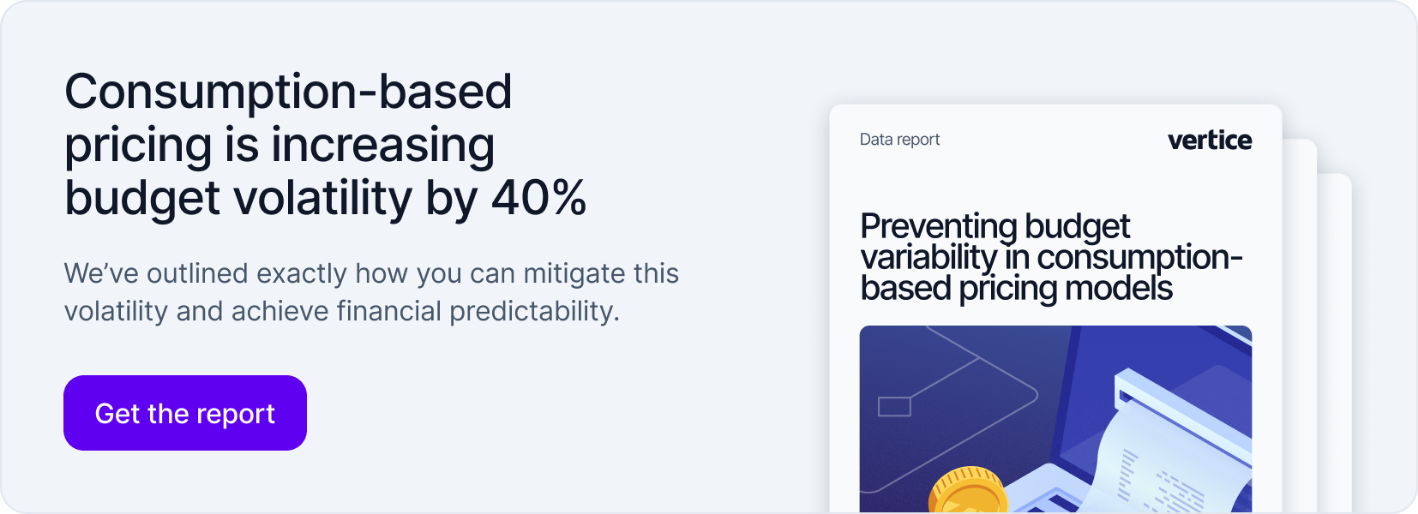
- Consumption-based models: Create severe forecasting hurdles for finance teams, experiencing a massive 37.6% average monthly budget variance.
Without continuous monitoring, variable contracts quickly hit what we call the 6-month divergence cliff – the point where consumption-priced agreements drift from their original forecasted spend by more than 15% in less than half a year.
An AI-driven optimization engine mitigates this risk by tracking consumption patterns in real time, transforming procurement data into dynamic budgeting and forecasting models that alert finance teams to unexpected anomalies long before the renewal deadline.
4. Grounded procurement intelligence
AI cannot make strategic decisions in a vacuum. Procurement intelligence is the capability to surface highly contextual, actionable data precisely at the point of decision.
Traditional analytics platforms create a frustrating "data-to-action gap". They provide static, backward-looking dashboards but leave your team to execute the manual follow-up work. Vertice closes this gap entirely. Whether a team is evaluating a new software request or managing an unexpected contract renewal, the platform instantly breaks down what the vendor typically charges, maps out known vendor sales tactics, and identifies hidden risk clauses to arm the buyer with absolute clarity.
This data-driven execution ensures every contract is optimized, whether your team chooses to take the lead or let Vertice execute on your behalf. Regardless of the negotiation approach, AI is only as good as the data behind it.
This is why Vertice has engineered its platform around a proprietary intelligence engine to create the world’s largest procurement intelligence dataset:
- More than $75 billion in global indirect spend analyzed.
- Over 2 million distinct, real-world pricing data points.
- 250,000+ deeply documented negotiated contracts.
- 1 million+ direct, human-to-vendor email and call interactions.
- Real-world purchasing insights spanning across 32,000+ unique vendors
5. Delivering measurable ROI
Ultimately, a procurement platform is only as valuable as the outcomes it delivers. While legacy procurement software focuses strictly on logging transaction compliance, modern AI-driven platforms are engineered to generate hard bottom-line savings. By combining intelligent orchestration, autonomous agent execution and real-time cost optimization, organizations using Vertice can expect immediate, quantifiable results:
- Hard dollar cost savings: Delivers guaranteed spend reductions of at least 20% on indirect spend.
- Drastic cycle reduction: Shifting from manual, sequential routing to automated parallel paths trims procurement cycle timelines by 50%.
- Operational efficiency: Eliminates up to 70% of manual administrative steps, giving lean finance and procurement teams the leverage to manage complex stacks without adding headcount.
How to evaluate AI procurement software
As the market rapidly transitions from basic generative AI tools to advanced multi-agent systems, separating enterprise-grade technology from superficial product claims requires a rigid evaluation framework. When auditing enterprise solutions, finance and procurement leaders should rate platforms across four technical dimensions:
- Data quality and scale: An AI algorithm is entirely dependent on the context it is fed. While generic language models can draft a polished email, they lack the commercial leverage required to negotiate effectively. Evaluate whether a platform relies on public internet scrapers and third-party aggregators, or a massive, proprietary dataset of real-world pricing data, historical contract redlines and direct vendor-buyer interactions. Without this scale, the AI cannot accurately identify pricing floors or anticipate vendor negotiation tactics.
- Autonomy vs administrative co-pilots: Many solutions offer passive AI "co-pilots" that merely assist a human by summarizing text blocks or generating response templates. True financial impact requires autonomous, task-specific multi-agent orchestration. The platform must deploy specialized agents capable of executing complex, multi-step workflows independently – such as autonomously cross-referencing technology stacks, extracting legal risks, or running email-based commercial bids – while remaining within strict, human-in-the-loop guardrails.
- Frictionless, embedded intake: The primary driver of unmanaged "maverick spend" is administrative friction that forces employees to navigate clunky, legacy software. A modern platform must offer dynamic, conversational AI intake natively embedded within existing communication channels like Slack or Teams. By using adaptive triage to parse unstructured text and files at the earliest point of intent, the platform can instantly flag technology redundancies and security profiles before a ticket is ever generated.
- Variable cost capabilities – With the explosive rise of token- and consumption-based pricing frameworks, traditional static forecasting models are obsolete. The platform must be equipped to handle continuous, real-time utilization tracking by integrating directly with cloud infrastructure and identity providers. It should automatically map fluctuating consumption patterns and optimize AI spend to shield finance teams from compounding budget volatility and prevent contracts from hitting a mid-year divergence cliff.
What are the best AI procurement platforms? A functional comparison
To capture the true value of AI in your purchasing workflow, it’s worth evaluating how different platforms utilize AI and, crucially, what data powers their intelligence. Below is a comparative breakdown of the leading solutions in the space:
Combining faster processes with smarter savings with Vertice
Operational velocity is a valuable byproduct of modern procurement – but clearing an administrative bottleneck faster doesn't show up on a balance sheet. True enterprise value isn't measured in tasks completed; it's measured in hard-dollar impact.
This relentless focus on realized financial outcomes is what separates a standard workflow system from a true value-generating procurement engine. It also underscores the fundamental reality of the current market: AI is only as intelligent as the data powering it. Without deep, proprietary commercial context, an algorithm can only automate process steps; it cannot create commercial leverage.
This is where Vertice shifts the paradigm entirely to a measurable, guaranteed ROI.
By fueling a comprehensive ecosystem of autonomous agents with the world's most extensive commercial dataset, the Vertice platform goes far beyond simple task automation. Vertice instantly translates billions in global spend intelligence and millions of real-world pricing data points into active negotiation power – continuously identifying immediate optimization levers, surfacing hidden cost risks and executing data-backed supplier strategies to systematically extract waste out of your business operations.
Ultimately, modernizing your procurement stack shouldn't just be an exercise in shifting administrative workloads. It should be a strategic pivot that converts your indirect spend into a source of capital efficiency – delivering predictable, compounding financial returns alongside a 7x average ROI.
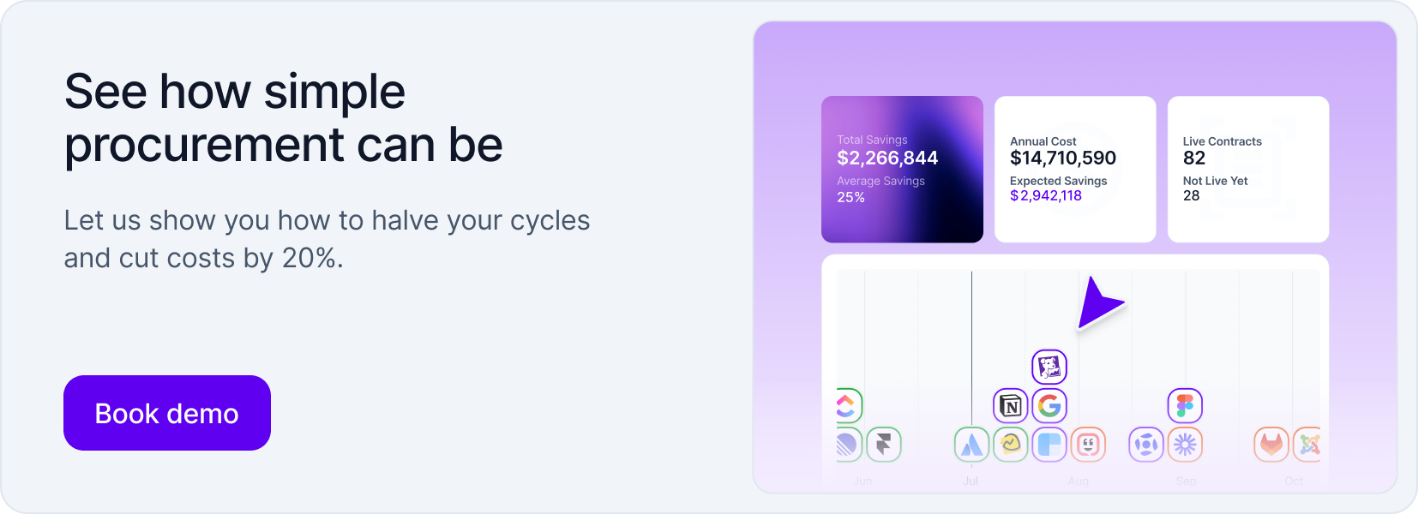
Discover how Vertice can transform your procurement lifecycle, optimize your software and services expense, and deliver guaranteed bottom-line savings. Take a self-guided tour of the platform.
About the Author
Aimee Manning is a Content Marketing Manager at Vertice. She collaborates closely with Vertice's internal procurement specialists and data analysts to translate complex purchasing trends into actionable insights for finance, procurement and IT leaders.
AI Procurement Software
FAQs
While Vertice provides end-to-end workflow automation, it goes far beyond standard tools by embedding agentic AI directly into the loop. Standard automation is rigid; it can only route a ticket from Person A to Person B based on hard-coded rules, without understanding what is actually being requested.
Vertice leverages AI to shift from simple routing to intelligent execution. It doesn't just push a task from one inbox to another; it reads and interprets the unstructured data inside the request (for example vendor emails, quotes or contract redlines). From there, the platform uses AI to actively execute the heavy lifting –classifying spend, assessing risk, running market price benchmarking and even conducting automated vendor negotiations. Its workflow automation is elevated by intelligence.
Vertice's autonomous negotiation agent, Ana, operates within strict, human-defined corporate guardrails and safety thresholds. Ana handles data-backed commercial bids and counters standardized vendor sales tactics entirely via email, maintaining a highly professional, objective and collaborative tone. This allows your human procurement team to step away from repetitive pricing friction and focus on building high-value, strategic vendor partnerships.
No, and attempting a "rip-and-replace" of legacy core infrastructure introduces immense technical debt and operational disruption. Modern AI procurement platforms do not replace your system of record; instead, they function as an intelligent orchestration layer that sits directly on top of it.
Vertice integrates seamlessly with existing general ledgers, Procure-to-Pay (P2P), and Enterprise Resource Planning (ERP) frameworks like SAP, Oracle, and Workday. It acts as an execution layer, capturing unstructured intake threads and managing automated workflows upstream within tools like Slack and Teams. Once the autonomous agents have completed risk checks, price benchmarking, and negotiations, the fully structured data is automatically synced downstream into your existing systems – maintaining your backend accounting structure while drastically speeding up the front-end procurement lifecycle.
Traditional procurement tools suffer from low internal adoption because employees bypass complex, multi-page static forms, creating unmanaged "maverick spend" outside of finance’s view. AI procurement completely flips this dynamic by eliminating the traditional intake form altogether.
By utilizing conversational AI natively embedded inside collaboration tools like Slack or Teams, employees can initiate requests using natural language. An employee simply drops a vendor quote or types a basic message into chat, and the AI automatically parses the unstructured data, extracts the sourcing criteria, and maps it against the existing tech stack to flag immediate redundancies. This removes all administrative friction for the end-user while guaranteeing the finance team complete visibility at the very earliest point of buying intent.
Managing variable, usage- or token-based pricing frameworks is a major blind spot for traditional procurement software because legacy tools only analyze spend after an invoice is generated. This delay often causes companies to blow past their forecasts, hitting a "divergence cliff" where actual costs drastically exceed original budgets.
AI procurement platforms solve this by moving from backward-looking quarterly audits to continuous, predictive analytics. By integrating directly with your technical infrastructure, cloud environments, and identity providers, the software monitors software consumption in real time. It automatically flags anomalous spikes in usage and identifies underutilized tools months ahead of time, dynamically generating tier-downsizing strategies to keep variable-rate contracts aligned with actual business needs.
.webp)