
Average discount from list price
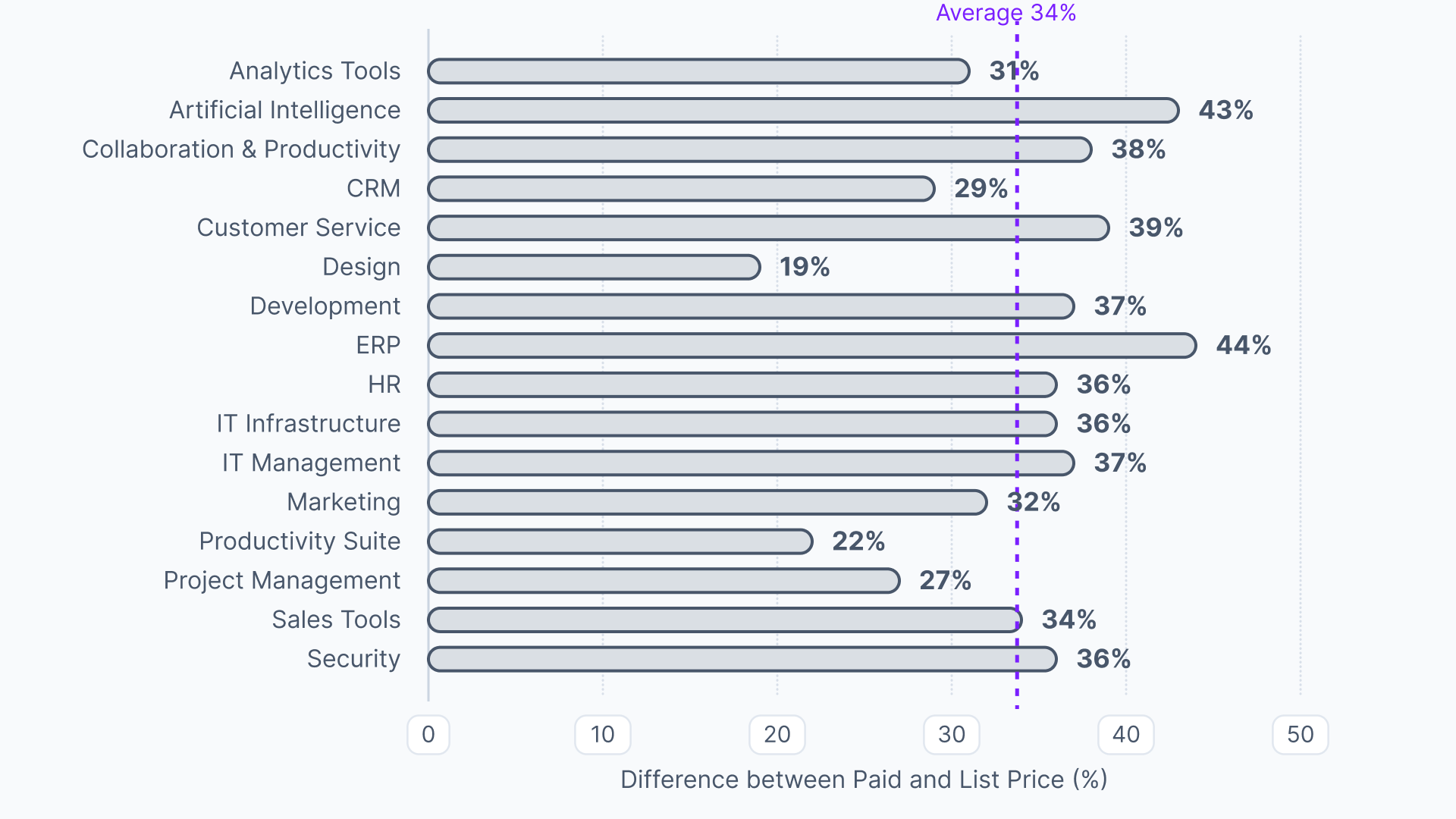

What is the average SaaS discount from list price in 2026?
Companies are still securing an average discount of 33.8% off list price, virtually unchanged from 34% in the prior period. That consistency shows a persistent gap between what vendors first quote and what informed buyers actually pay. But the stable overall average hides real movement underneath: Collaboration & Productivity and Customer Service saw sharp increases in negotiated savings this quarter, while CRM and Analytics Tools moved the other way.
- A ~34% gap between list price and actual price is now a persistent pattern, not a one-off: With the overall average holding steady across periods, this isn't a temporary market condition – it reflects how SaaS vendors price by default, expecting negotiation, which is exactly why so many companies overpay simply by accepting a first quote.
- Collaboration & Productivity saw the biggest jump: Average discounts in this category rose 10 percentage points, from 28% to 38%, the largest movement of any category in either direction.
- ERP and AI remain the highest-discount categories, despite both dipping slightly: ERP (44%) and Artificial Intelligence (43%) still offer the largest discounts of any category, even though both eased back slightly from the prior period.
- CRM and Analytics Tools saw the sharpest declines: Both fell 6 points, suggesting less room to negotiate in these categories than there was previously, or steadier list pricing from vendors in these spaces.
- Design remains the toughest category to negotiate, but is improving: Design's average discount rose 4 points to 19%, though it remains by far the lowest discount of any category tracked.
Why generic, out-of-the-box software benchmarks aren't enough
Knowing that the average discount is 33.8%, or that ERP typically discounts more than Design, is a useful starting reference point – but applying a single average figure directly to your own negotiation can be misleading. Real pricing varies based on factors a generic benchmark can't capture: regional pricing differences, the specific terms and length of a contract, deal size and whether a product is priced per seat or per usage. A company negotiating a usage-based AI contract in one region, for example, may see a very different fair price than the category average suggests. Pricing benchmarks that reflect real, comparable transaction data – not just a category-wide average – are what actually tell you whether a specific quote, for your specific deal, is optimal.
Data source: These insights are derived from over $75bn of global processed spend managed by Vertice in 2026.
Are you overpaying for SaaS?
Are you overpaying for SaaS?
Related materials

Related insights
Join the community
.webp)
The need-to-knows about Vertice
Prices are rarely set in stone. Vendors build negotiation room into their list prices by default, which is exactly why average discounts range from 19% to 44% depending on category. Getting the best outcome takes more than a benchmark figure – it takes the expertise to act on it. Vertice guarantees savings of at least 20%, combining real-time pricing data with outsourced negotiation specialists who know vendor playbooks, standard contract terms, and where to push for stronger risk provisions and protections, not just a lower price.
As of Q2 2026, the average discount across all software categories is 33.8% off list price. Remember, this is an average: it hides real variation both between categories (from 19% in Design to 44% in ERP) and between individual deals, and many companies secure discounts well above the average once they negotiate with the right market intelligence behind them.
These figures are drawn from over $75bn of global processed software spend, giving a real, transaction-based view of what companies are actually paying rather than relying on vendor-reported or self-reported figures, which are the same data limitations that make many benchmarking reports inaccurate.
Not on its own. Category averages are a useful starting point, but they don't account for regional pricing differences, contract-specific terms, deal size, or whether pricing is seat-based or usage-based. A fair price for one company's specific deal can differ meaningfully from the category average, which is why benchmarks based on real, comparable transaction data are more reliable than a single average figure.