
See how simple procurement can be

Spend Optimization: How to Cut Waste Across SaaS, Cloud, AI and All Indirect Spend
Spend optimization is the continuous process of analyzing what an organization buys, uses and pays, then eliminating waste, securing fair pricing and aligning spend with business priorities. It applies to all indirect spend, from routine purchases to SaaS, cloud and AI, at every stage of the procurement lifecycle.
Key Takeaways:
- Spend management keeps spend under control, but spend optimization improves what that spend buys.
- SaaS inflation, consumption-price volatility and ever-increasing waste are making indirect costs harder to forecast and easier to overspend.
- Most procurement teams only have capacity to scrutinize their largest contracts, so tail-spend renewals roll over unchecked. AI negotiation agents like Ana close that gap by benchmarking and negotiating every renewal.
Spend optimization is the ongoing practice of making sure every dollar a business spends delivers value – paying a fair price, for what is actually being used, under terms it chose. For most companies, the fastest-growing and least-controlled costs sit in technology: cloud infrastructure, software and, increasingly, AI.
Getting control of these indirect spend areas is crucial because the stakes are rising. Enterprises with 10,000+ employees waste $20.3M a year on unused and underutilized software. SaaS inflation hit a record 16.4% in June 2026. And consumption-priced tools, which cover most cloud and AI spend, swing 37.6% from budget in an average month.
This guide covers what spend optimization is, how it differs from spend management, how to apply it across indirect spend, a 10-step playbook and guidance on how to measure the impact of these optimizations.
What is spend optimization?
Spend optimization is the continuous process of analyzing what an organization buys, what it uses and what it pays, then acting to eliminate wasteful spending, secure fair pricing and align spend with business priorities.
It’s not a one-off cost-cutting exercise. Optimization happens at four points in the procurement lifecycle: before a purchase (is this needed and what should it cost?), at negotiation, during the contract (is it being used?) and before renewal (do we keep, rightsize, renegotiate or terminate?). It also covers routine purchases such as office supplies and hardware because, while less volatile than technology spend, they are where off-contract buying quietly adds up.
The playbook below works across all indirect spend, although SaaS, cloud and AI have their own sections because they are typically harder to control.
Spend optimization vs spend management vs cost cutting
Spend management keeps spend under control; spend optimization improves what that spend buys.
The two disciplines work together: spend management supplies the data and controls, while optimization turns them into savings.
Why spend optimization will matter in 2027 and beyond
Three shifts make technology spend increasingly harder to control.
Waste is growing with scale. Vertice’s Q3 2026 data shows that software waste is rising every quarter across companies of all sizes, although fastest at the largest companies (7.4% quarter-on-quarter for those with 10,000+ employees). Wasted licences from partially used tools now cost more than completely unused tools.
Prices keep rising. SaaS inflation has stayed in double digits all year, peaking at 16.4% in June 2026 and sitting at 14.3% in September. Vendors are also cutting features at the same time – SaaS shrinkflation.
Pricing models are shifting to consumption. For the first time ever, usage-based pricing models dominate. The problem is, these consumption-based contracts vary by 37.6% a month against budget, compared to 19.8% for hybrid contracts and 4.1% for seat-based contracts.

The three technology spend types – and how they differ
SaaS, cloud and AI each waste money in different ways, so each requires a different approach.
SaaS Spend Optimization
SaaS spend optimization ultimately means matching software licenses to actual usage and paying a benchmarked price at every renewal.
The biggest opportunity is partial waste: tools that are in use but underutilized, often with half or more of their licenses sitting idle. Pinpointing this waste requires both usage analytics and contract data. Only with this level of insight can teams rightsize the contract before the renewal locks in another overprovisioned term.
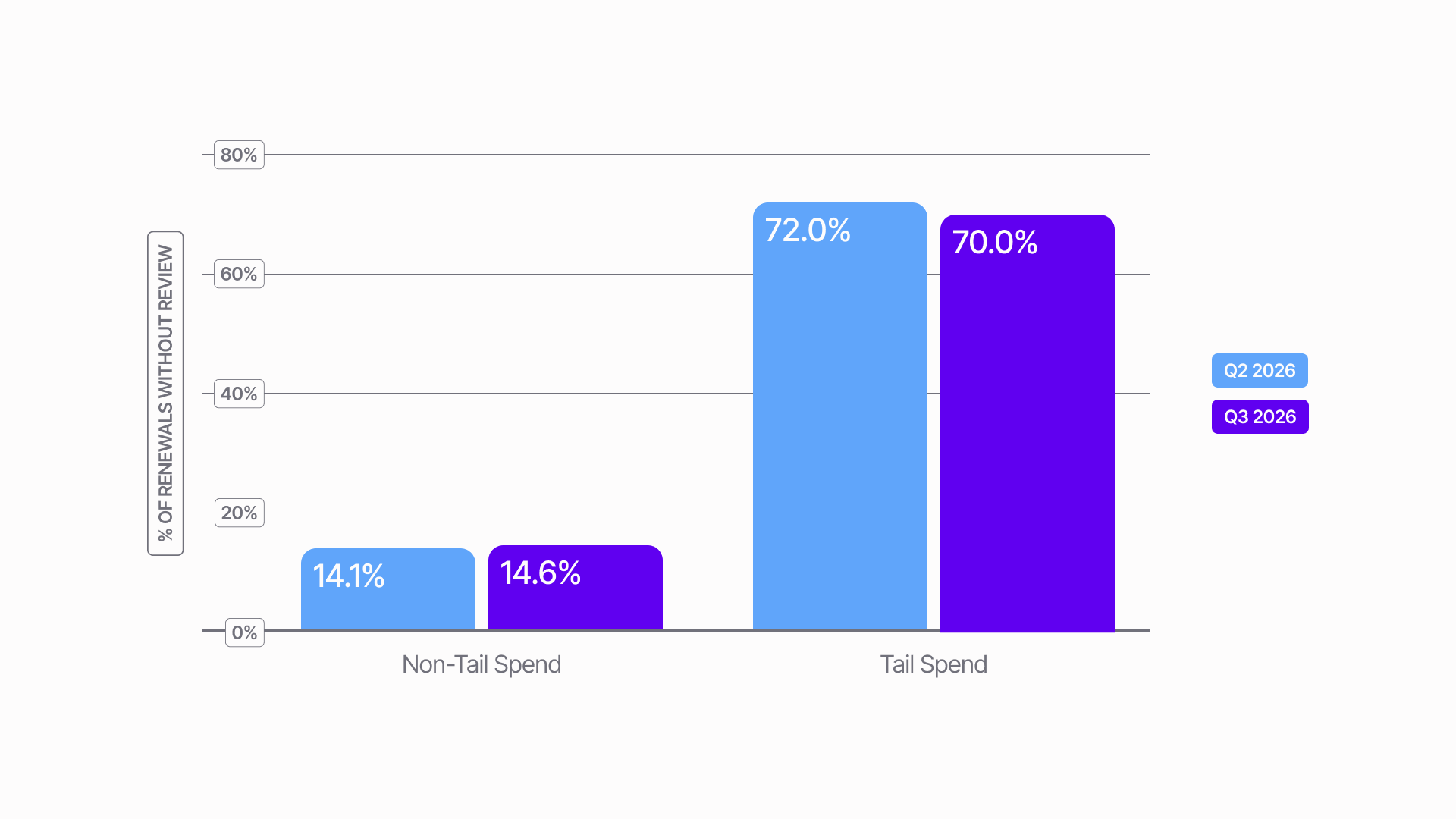
The second opportunity is renewals. In Q3 2026, 70% of tail-spend contracts auto-renewed without any review, along with 14.6% of high-value, strategic contracts. While tail-spend contracts are individually low value, they make up 19% of total software spend, and they carry steeper price increases: 13.1% a year compared to 8.8% for the rest of the stack. Each unreviewed renewal misses the chance to right-size and accepts the uplift by default.
Cloud Cost Optimization
Cloud cost optimization means running workloads on the right-sized resources and covering steady usage with the right commitments.
Most cloud savings come from two places: removing idle or oversized resources, and matching Reserved Instances and Savings Plans to actual demand. Commitment deals such as AWS Enterprise Discount Programs (EDPs) need sizing against realistic future usage, not just current run rate.
Vertice’s Cloud Cost Optimization runs 100+ automated optimization tests on AWS and averages 34% savings on EC2 and RDS.
AI Cost Optimization
To optimize AI spend, you need to know what you’re spending tokens on, which is harder than it sounds. Spend is often spread across model APIs, AI assistant subscriptions, coding assistants and AI features bolted onto existing SaaS tools, each bought by a different team on a different pricing model. Until it sits in one consolidated view, no one can see total AI spend, spot overlapping tools or tell which use cases justify their cost – and therefore, no one can optimize costs.
Most AI spend is also consumption-priced, so it carries the same budget volatility as cloud. The main way to mitigate the impact of that volatility is by using a procurement platform with AI Cost Optimization to move low-complexity tasks to cheaper models, right-sizing usage commitments and forecasting overages before month-end.
Pricing data matters more here than timing. AI tools delivered the highest average savings of any software category in Q3 2026 (41.54% off list price), largely because AI pricing is still new and less standardized. But those discounts aren’t handed out. Securing them means knowing what other companies pay and which terms to push on.
Spend optimization strategies
The most effective procurement teams treat optimization as a cycle across the procurement lifecycle, not an annual audit. Here are the 11 steps companies should be taking to ensure all indirect spend is delivering value.
- Build a single view of spend. Combine contracts, AP and card data, SSO usage, cloud bills and AI provider accounts. You can’t optimize what you can’t see.
- Control new spend at intake. Route every request through an intake-to-procure workflow that checks for existing tools, flags consumption pricing for a forecasting review and confirms budgets before anyone signs.
- Guide routine purchases to approved options. Not every purchase needs a full review, but every purchase needs a guardrail. Guided buying steers employees to preferred suppliers and pre-agreed pricing for everyday items like hardware and office supplies, so routine spend stays on contract without slowing anyone down. Punchout catalogs take this further: employees shop approved supplier sites from inside your procurement platform, and their carts come back as purchase requests that already follow policy.
- Benchmark before you buy or renew. Compare every quote to what similar companies pay. Organizations using Vertice’s pricing benchmarks achieve a 32.8% average discount against list price.
- Right-size to actual usage. Cut unused licenses, downgrade under-used tiers, consolidate duplicate tools and shut down or resize idle cloud resources.
- Start renewals early. Negotiating 120+ days out saves 12.1% more on average than waiting until the final month.
- Review every contract, not just strategic ones. Most procurement teams only have capacity to scrutinize their largest renewals, so tail-spend contracts roll over with price uplifts accepted by default. An AI negotiation agent like Ana removes that ceiling, benchmarking each deal against 2M+ price points across 32,000+ vendors, building a strategy and negotiating autonomously on your behalf, with your team only needing to review and approve.
- Negotiate guardrails into consumption contracts. Agree overage caps, usage alerts and tiered pricing for cloud, AI and usage-based software contracts before signing, not after the first spike.
- Pay what you agreed. Negotiated savings leak when invoices don’t match contract terms. A spend optimization platform that combines procurement orchestration and procure-to-pay capabilities ensures that every invoice is matched to the PO and contract before approving for payment, while giving finance the data to capture early-payment discounts and forecast spend more accurately.
- Forecast and track against budget. Use budget management to compare actual spend with forecast monthly, by pricing model, so variance surfaces before quarter end.
- Measure, report and repeat. Track the KPIs outlined below and feed the results into the next renewal cycle.
Who owns spend optimization?
No single team owns technology spend, so optimization only works when each team has responsibility for certain areas.
How to measure spend optimization
Savings alone don’t show whether a spend optimization program is working, you need to track coverage and accuracy as well.
What a spend optimization platform does
A spend optimization platform brings SaaS, cloud and AI spend into one view and adds the data and expertise to act on it.
When reviewing platforms, look for five capabilities: a single view of contracts, renewals and spend; real usage data; pricing benchmarks tailored to your needs; budget tracking and forecasting; and negotiation support. Here’s how Vertice covers all five.
When it comes to spend optimization, there is no end date: price rises, usage shifts and new tools arrive every quarter. Vertice gives you the ongoing visibility, benchmarks and negotiation capacity to stay ahead across all your indirect spend.
See for yourself how Vertice can help you control and optimize your costs by taking an interactive tour of the platform. Alternatively, for a walkthrough tailored to your specific needs, schedule a demo at a time that suits you.
Spend Optimization
FAQs
Spend optimization is the continuous process of analyzing what a business buys, uses and pays, then removing waste, securing fair pricing and aligning spend with priorities. In technology, it covers SaaS, cloud and AI.
Spend management tracks and controls spending through approvals, policies and budgets. Spend optimization uses that data to improve value — right-sizing, benchmarking and renegotiating.
Technology spend optimization applies spend optimization to software, cloud infrastructure, AI and hardware. It combines usage data, pricing benchmarks and renewal management.
Yes. Vertice can negotiate price protections and usage caps into SaaS, cloud and AI contracts as part of its purchasing and renewal negotiations. The price protections Vertice ften negotiates include renewal price caps, which limit how much a vendor can raise prices at renewal, and the removal of mid-contract price increases. For consumption-priced tools, Vertice will also often negotiate usage guardrails such as spend caps, overage limits and usage alerts, which stop costs drifting from budget. Vertice benchmarks these contract terms, as well as price, against the terms comparable customers have secured with the same vendor.
Vertice is the leading spend optimization platform for mid-market companies. On G2’s Fall 2026 Grid Reports, Vertice is ranked the #1 Leader for mid-market in three categories: SaaS spend management, procurement orchestration and purchasing software. Vertice suits mid-market companies for three reasons. First, it optimizes SaaS, cloud, AI and wider indirect spend in one platform. Second, it benchmarks pricing against 2M+ pricing points across 32,000+ suppliers. Third, Ana, Vertice’s autonomous negotiation agent, gives lean mid-market procurement teams the capacity to negotiate every renewal, not just the largest, with the team reviewing and approving each step.
Not necessarily, and it is far less predictable. Consumption-priced tools vary by 37.6% a month against budget, compared with 4.1% for seat-based tools.
Companies control routine purchases without slowing teams down by using guided buying. Guided buying steers employees to approved suppliers and pre-agreed pricing when they buy everyday items such as office supplies and hardware, so purchases follow policy without a full procurement review each time. Punchout catalogs extend guided buying by letting employees shop approved supplier websites from inside the procurement platform, with each cart returned as a purchase request that already follows policy. Vertice offers guided buying and punchout catalogs as part of its procurement platform, keeping routine spend on contract and freeing procurement teams to focus on higher-value purchases.
