
Budget variance rates - consumption vs seat pricing
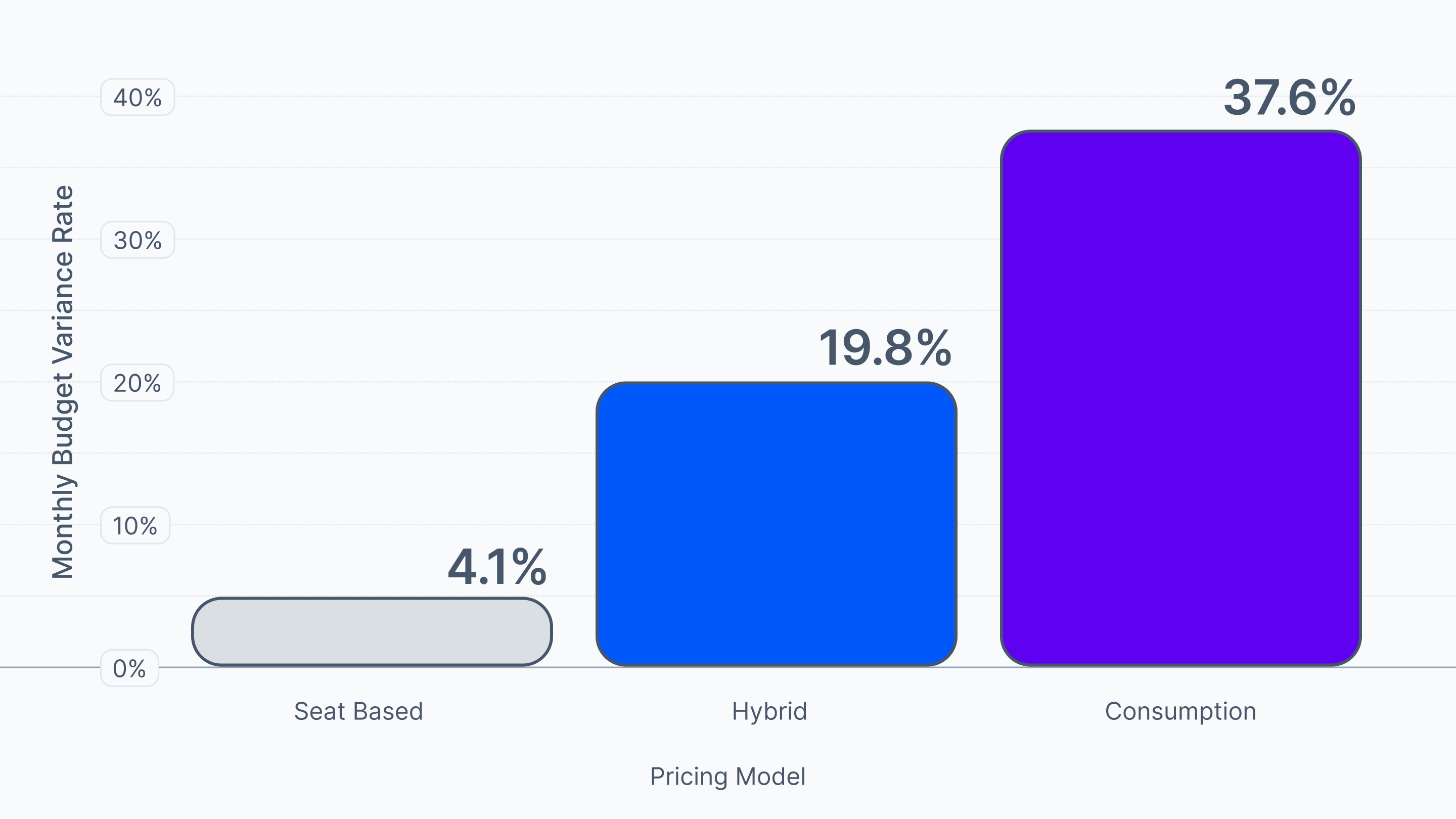

Monthly budget variance rate by pricing model
While consumption-based software promises maximum flexibility, it introduces a significant, hidden challenge: extreme budget volatility.
Vertice’s latest analysis of global software spend reveals a stark truth about financial predictability. The way your vendors price their products dictates how accurately you can forecast your bottom line.
The key findings:
- Seat-based pricing models remain the gold standard for predictability, maintaining a tight 4.1% average monthly budget variance.
- Hybrid models introduce a layer of friction, pushing monthly variance up to 19.8%.
- Consumption-based models create severe forecasting hurdles, experiencing a massive 37.6% average monthly budget variance.
- The 6-Month Divergence Cliff: It takes less than 6 months for consumption-priced contracts to drift from their original forecasted spend by more than 15%.
The predictability premium of seat-based software
Finance leaders have historically favored seat-based pricing for one core reason: it turns software budgeting into a straightforward arithmetic problem tied to headcount. Our data confirms this stability, with user-based software showing a negligible 4.1% monthly variance.
However, as more vendors shift toward usage-driven frameworks, static seat-based budgeting is becoming the exception rather than the rule.
The high volatility of pure consumption
Pure consumption-based pricing (increasingly common in cloud infrastructure, data warehousing and modern enterprise AI tools) aligns costs with actual utility. In theory, this eliminates the risk of paying for "shelfware." In practice, it shifts the financial risk entirely onto the buyer.
With an average monthly budget variance of 37.6%, consumption-based tools frequently break financial models. Engineering spikes, unexpected data processing volumes or unmonitored API calls can quietly drive massive cost overruns before finance teams even realize a spike has occurred.
The 6-month forecasting cliff
The risk of usage-based pricing isn’t just month-to-month unpredictability; it is a rapid, systemic drift over time.
Vertice’s data shows that it takes less than six months for a consumption-priced contract to diverge from its original forecasted baseline by more than 15%.
When procurement teams sign a usage agreement based on initial vendor estimates or historical run rates, those assumptions routinely disintegrate before the two-quarter mark. This rapid divergence forces finance into reactive cycles – reallocating capital or chasing emergency mid-year budget approvals.
How CFOs and procurement leaders can reclaim control of their budgets
To navigate this landscape without sacrificing budget predictability, finance teams must move away from static annual forecasts and adopt real-time spend management. With the right procurement platform, you can:
- Negotiate financial guardrails: Set overage limits and enforce notifications from the vendor when close and negotiate tiered pricing based on token volume.
- Leverage benchmarking data: Access global procurement intelligence datasets to benchmark vendor proposals against true market rates and secure the most favorable usage and overage pricing available.
- Enhance the intake process: Update intake workflows to automatically flag variable pricing models and immediately trigger specialized financial risk and forecasting assessments before signing.
Learn more about Vertice’s budget management capabilities or alternatively see Vertice in action by taking a self-guided tour of the platform.
Data source: These insights are derived from over $75bn of global processed spend managed by Vertice in 2026.
Are you overpaying for SaaS?
Are you overpaying for SaaS?


.jpg)


Join the community
.webp)