
Most duplicated software

Software duplication rankings (2026)
Tool duplication occurs when an organization pays for multiple software applications that provide overlapping functionality. Vertice's Q2 2026 data shows Development has reclaimed the #1 spot from Security, reversing the swap seen just one quarter earlier – a sign that duplication pressure is moving back and forth between technical categories rather than settling in one place.
- Development and Security have swapped positions twice in two quarters: After Security overtook Development for the #1 spot in Q1 2026, Development has now reclaimed the top position in Q2 2026 – evidence that redundancy in these two technical categories is more of an ongoing back-and-forth than a settled trend in either direction.
- The scale of duplication is now quantified for the first time: The average customer runs 7 separate Development contracts and 6 separate Security contracts simultaneously – meaning a typical organization is very likely paying for overlapping tools in both categories, not just outlier cases.
- The bottom three categories remain completely stable: Collaboration & Productivity, Marketing and Sales Tools have held the same rank for three consecutive periods, though even these "stable" categories still average 4 to 5 contracts per customer, indicating duplication is a persistent baseline issue across the board rather than one confined to the top two spots.
The cost of duplicate software
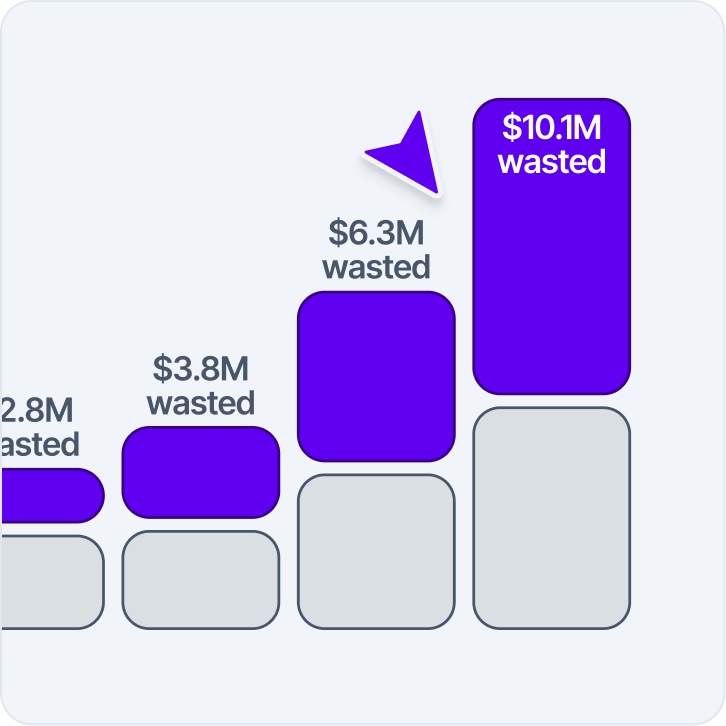
- Direct financial waste: Every duplicate application represents a missed opportunity for volume discounting. By maintaining multiple vendors for the same function, organizations fail to reach the spend thresholds required for enterprise-level pricing. Instances of shelfware or underutilization also represent substantial financial loss – companies with 500-1,000 employees waste $1.7M on these tools every year, a figure that increases with company size.
- Decentralized buying friction: Duplication is frequently a byproduct of decentralized procurement. When individual teams or departments purchase their own preferred tools without cross-functional visibility, the organization ends up paying for the same features multiple times under different contracts.
- Increased security risks: Every redundant application serves as an additional entry point for potential security threats. Multiple tools performing the same function can lead to fragmented logging, conflicting security protocols and "blind spots" in governance.
- Operational inefficiency: Duplicate software forces employees to manage data across multiple silos, leading to "toggle tax" – the productivity loss associated with switching between apps to perform a single workflow.
Procurement platforms with usage analytics capabilities can flag areas of feature overlap or all-out duplication, helping to inform decisions on whether to rightsize, consolidate or terminate contracts at the point of renewal.
Data source: These insights are derived from over $75bn of global processed spend managed by Vertice in 2026.
Last updated
July 2026
Are you overpaying for SaaS?
Compare your SaaS contract or quote against 2M+ pricing points, drawn from 250,000+ contracts.
Are you overpaying for SaaS?
Compare your SaaS contract or quote against 2M+ pricing points, drawn from 250,000+ contracts.
Related materials



Join the community
Get the latest insights, exclusive event invitations and subscriber-only content from thought leaders that'll help you drive real change.
.webp)