
Wasted SaaS spend
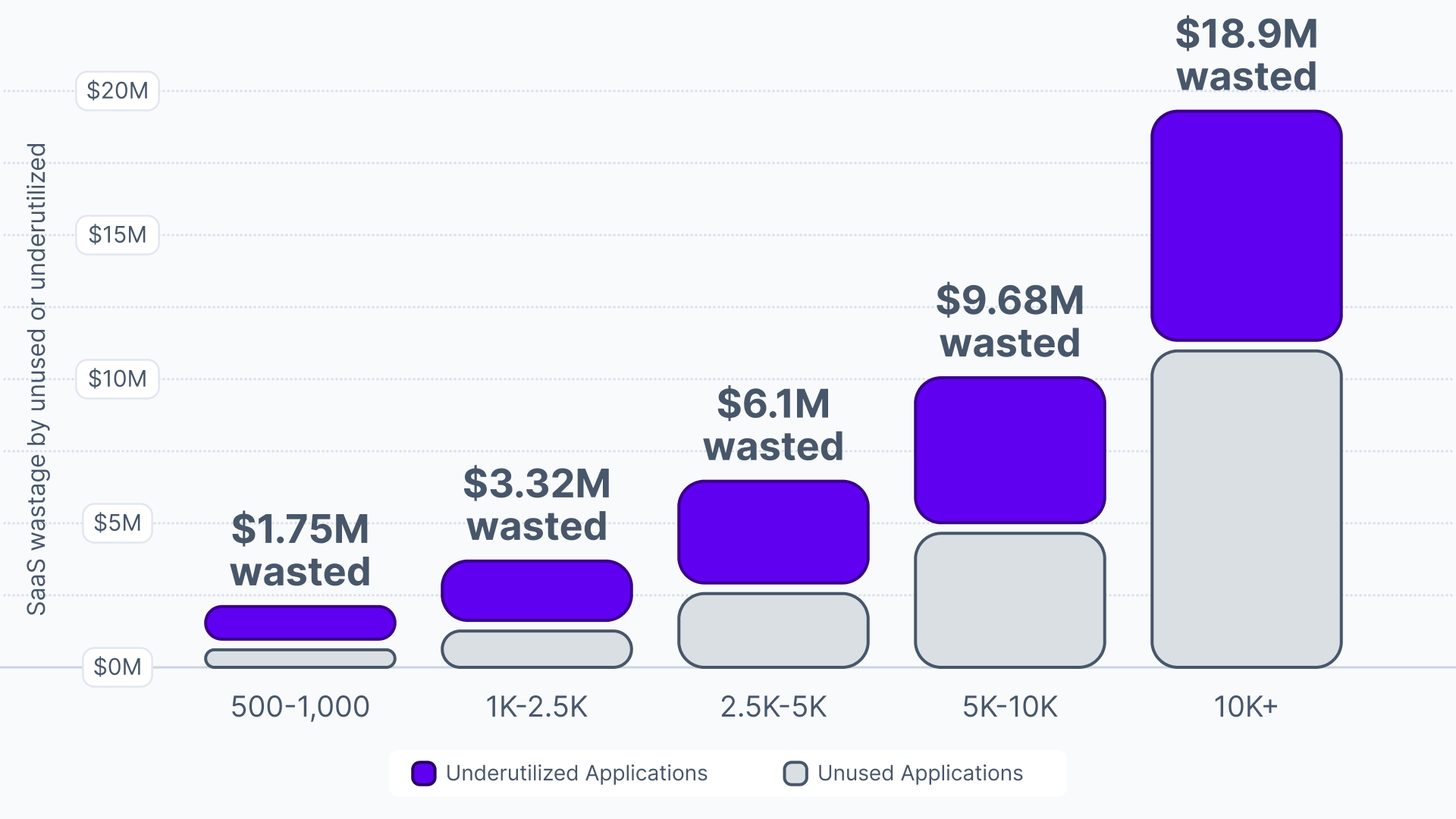

How much are companies wasting on software in 2026?
Shelfware and underutilized SaaS continues to drive substantial financial losses and Q2 2026 data shows this waste growing across every company size – with the increase accelerating the larger the organization.
- Waste is growing fastest at the largest companies: Organizations with 10,000+ employees saw wasted spend rise 7.4% this period, more than double the 2.9% increase seen at 500-1,000 employee companies. As software portfolios keep growing, waste is growing right along with them – and faster at larger companies than smaller ones, suggesting scale itself makes waste harder to keep in check
- The largest companies remain the biggest source of dollar waste by far: Enterprises with 10,000+ employees now waste $18.9M annually on unused and underutilized software, up from $17.6M in Q1 2026 and roughly 10 times what a 1,000-2,500 employee company wastes.
- Underutilization outweighs pure shelfware at every company size: In every employee band, underutilized tools (those using less than 50% of their purchased capacity) account for a larger dollar figure than fully unused licenses. This reinforces the fact that partial waste, not just abandoned tools, provide the biggest opportunity for savings.
These numbers highlight the challenges of managing sprawling software portfolios and the importance of tracking actual SaaS license usage. Even modest improvements in monitoring and rightsizing contracts – aligning licenses with actual usage – can significantly reduce wasted software spend and improve operational efficiency.
SaaS purchasing platforms with usage analytics capabilities helps identify exactly where this waste is concentrated, so rightsizing decisions are based on real usage data rather than guesswork.
Data source: These insights are derived from over $75bn of global processed spend managed by Vertice in 2026.
Are you overpaying for SaaS?
Are you overpaying for SaaS?
Related materials





Join the community
.webp)
The need-to-knows about Vertice
As of Q2 2026, wasted software spend ranges from $1.75M annually for companies with 500-1,000 employees to $18.9M for enterprises with 10,000+ employees.
Yes, across every company size. Between Q1 and Q2 of 2026, we’ve seen SaaS wastage increase 2.9% for smaller mid-market companies (500,1,000 employees) up to 7.4% for the largest enterprises (10,000+ employees). The financial impact of this waste is substantial across all companies, translating into millions of dollars a year regardless of company size.
Unused software, sometimes called shelfware, refers to tools that go completely untouched. This often happens when an employee leaves, a project ends or a tool gets replaced without the old subscription being cancelled. Underutilized software is different: it's still active, but less than 50% of purchased licenses are actually in use, meaning the company is paying for far more capacity than it needs. Since Vertice’s data only captures underutilization below that 50% threshold, the true scale of underused software, including tools sitting just above that line, is likely even higher.
Reducing waste starts with visibility: knowing which licenses are sitting completely unused and which are active but underutilized, since the two problems need different fixes. SaaS spend management software surfaces both automatically, flagging shelfware for cancellation and underutilized licenses for rightsizing before the next renewal locks in the same overprovisioned contract for another term. Pairing this with budget management helps ensure any savings identified actually stay saved, rather than getting quietly reabsorbed elsewhere in the software budget.