
Consumption pricing - contract cost changes
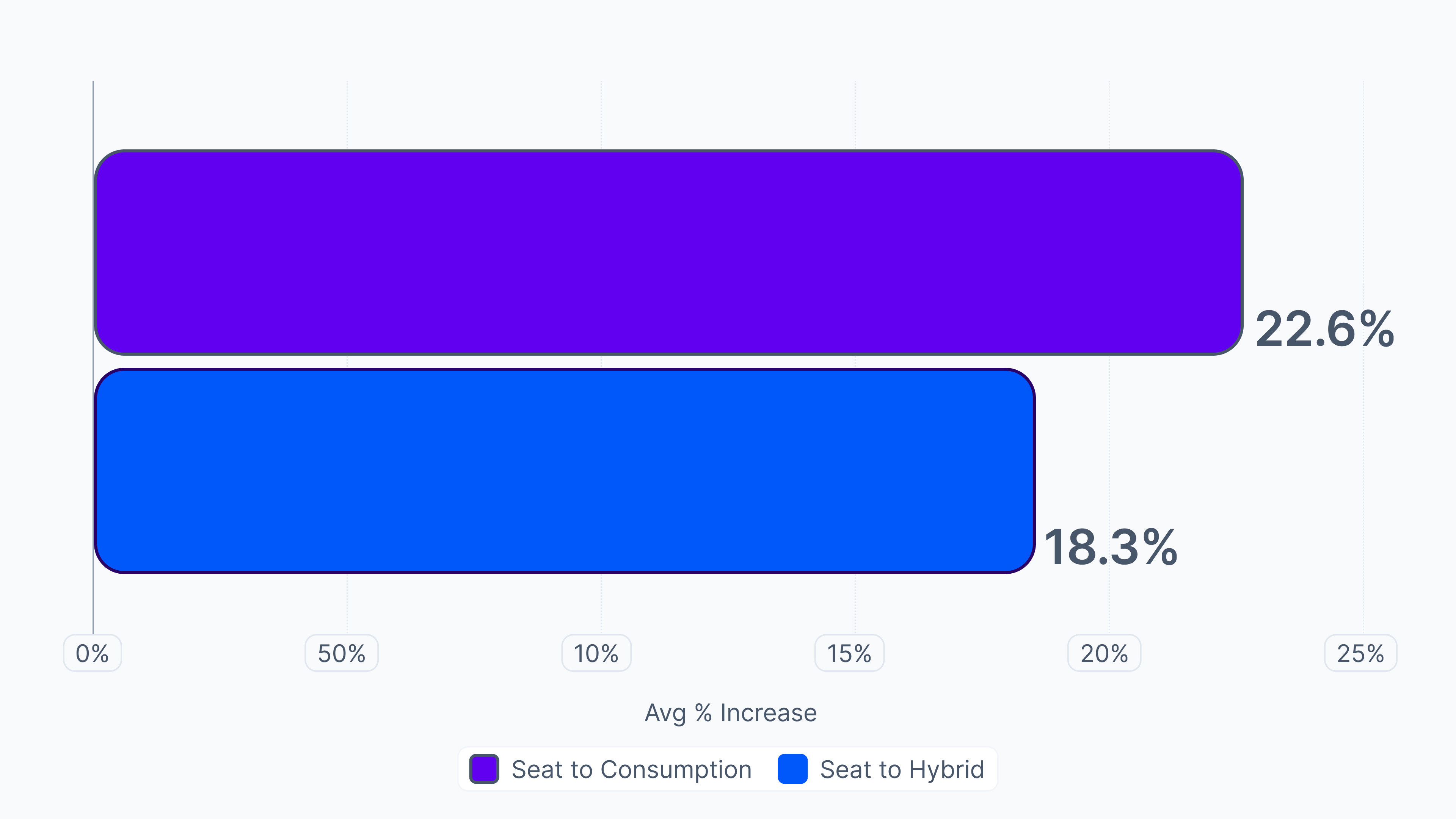

How much are contract costs increasing? A comparison between pricing models
The ultimate pitch for variable software pricing is rooted in efficiency: eliminate wasted licenses, align cost with value and gain better control over your software budget.
Vertice’s latest analysis reveals that for the vast majority of buyers, this shift is an illusion. Moving away from traditional seat-based contracts doesn't always optimize your budget – it often inflates it.
The data
When organizations transition their existing software stack away from flat, user-based frameworks, they face an immediate, systemic hike in total contract value:
- Seat-to-Hybrid Transitions: Result in an average contract cost increase of 18.3%.
- Seat-to-Consumption Transitions: Drive contract costs up by 22.6%.
It may feel like better cost control, but without the right protections, it is simply more cost. The friction-free nature of usage-based pricing models removes the natural governance of headcount caps, allowing software spend to expand passively.
Why’s it happening?
Many vendors are aggressively pushing this pricing evolution because it fundamentally alters the economics of a contract in their favor:
- The dual monetization trap: In hybrid models, vendors secure a guaranteed revenue baseline through a fixed seat fee, while using consumption tiers to capture immediate upside. Because the variable thresholds are often set low, buyers routinely trigger overages that drive the 18.3% cost expansion.
- The expansion trap: Under pure consumption, the barrier to adoption is entirely removed. Without the need to request and provision a new seat license, usage can spread across departments unchecked. By the time the annual contract or credit pool is exhausted, the business has institutionalized dependencies that make pulling back difficult, if not impossible.
How to protect your budget
If a vendor is forcing a migration away from traditional seat-based pricing during your next renewal, finance and procurement leaders must alter their negotiation playbook to protect the bottom line:
- Negotiate a "shadow billing" grace period: Request a 3-to-6 month transition phase where the vendor tracks your actual consumption but bills you under your legacy flat-rate seat pricing. Use this real-world data baseline to accurately negotiate your permanent usage tiers before the meter formally starts running.
- Incorporate a contractual "true-down" clause: Vendors routinely use optimistic modeling to oversell initial consumption commitments. Secure a look-back clause that allows your organization to retroactively lower your committed usage tiers and reclaim unspent credits if your actual utilization falls below expectations in the first two quarters.
- Maximize the fixed baseline in hybrid deals: If forced into a hybrid model, do not opt for a minimal seat count to save upfront costs. Instead, aggressively maximize your fixed seat baseline to capture bulk volume discounts, compressing the variable usage tier to a narrow, highly controlled margin of your overall budget.
To get a better idea of how Vertice can help mitigate the impact of consumption pricing on your budgets and optimize your AI spend, take a self-guided tour of the platform. Alternatively, download our latest report for more guidance on preventing budget variability when using consumption-based pricing models.
Data source: These insights are derived from over $75bn of global processed spend managed by Vertice in 2026.
Are you overpaying for SaaS?
Are you overpaying for SaaS?


.jpg)


Join the community
.webp)