
Consumption pricing - cost-per-user vs seat-based
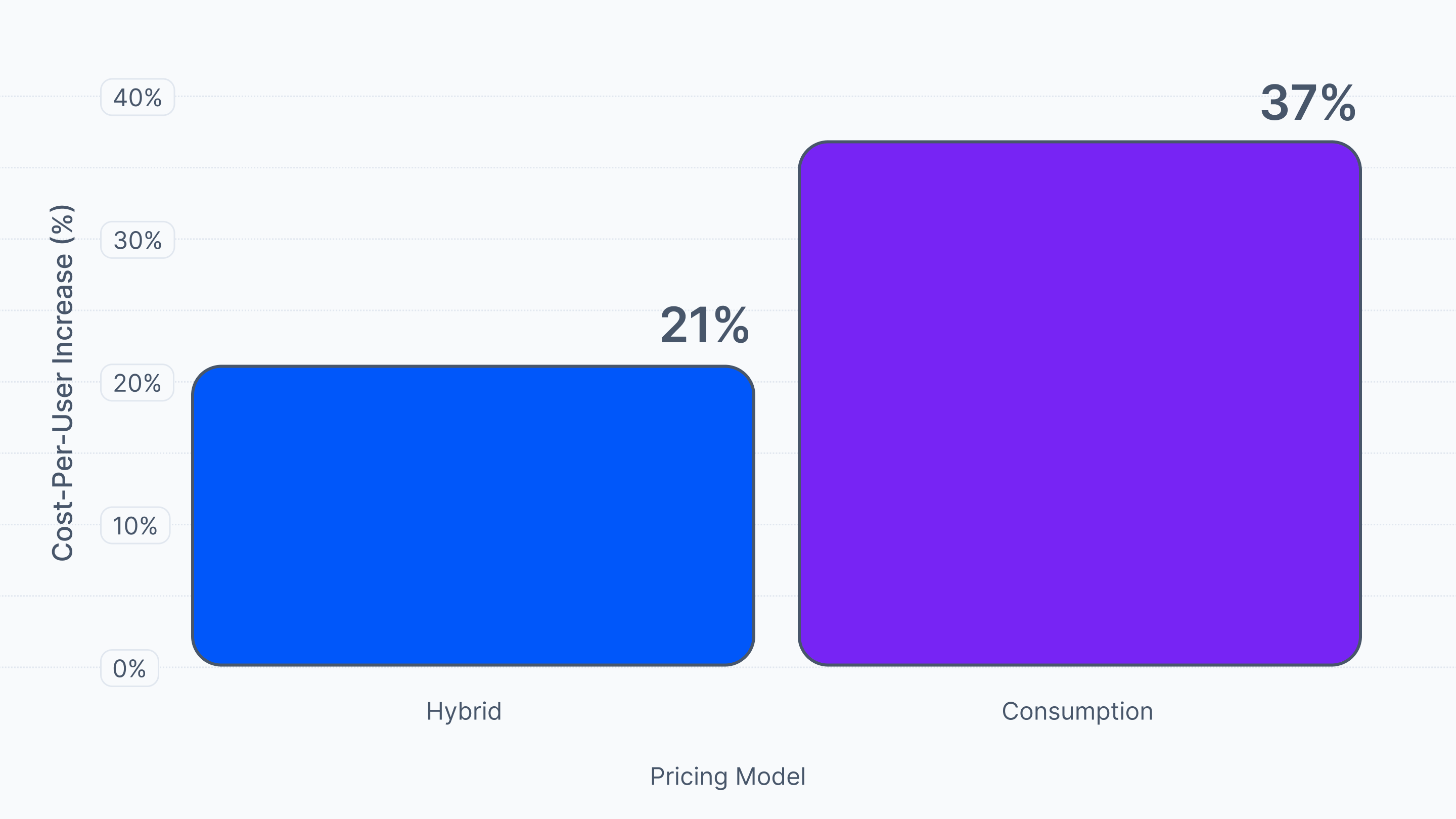

SaaS cost-per-user: Seat-based vs consumption and hybrid models
Consumption-based pricing is often championed as the ultimate remedy for software waste. After all, the narrative is compelling – eliminate shelfware and underutilization, and only pay for the value you extract.
Vertice’s data reveals a stark financial paradox. As organizations increasingly move from fixed, user-focused pricing models, the actual cost-per user doesn’t reduce – it skyrockets.
Why companies are paying a drastic premium on usage-based pricing models
Transitioning away from a flat, seat-based model significantly inflates the average cost per employee using the software:
- Pure Consumption Models: Drive up the effective cost-per-user by up to 37%.
- Hybrid Models: Increase the cost-per-user by an average of 21%.
While seat-based pricing operates as a predictable model, usage-based models meter every individual action. What looks like granular cost control on paper quickly transforms into an unmonitored utility expense.
What’s causing the consumption-based pricing surge?
This cost inflation isn't driven by organizational growth; it's driven by unmonitored user behavior.
- The "power user" spike: In a flat-rate seat model, your heaviest users cost the exact same as your lightest users. Under a consumption framework, a handful of power users testing complex features or running massive data queries can quietly double a contract's financial footprint.
- The experimentation trap: Vendors aggressively encourage typical users to adopt and experiment with new capabilities (especially newly integrated AI features). Because every single click or generation triggers a microscopic micro-fee, costs compound exponentially faster than finance teams can forecast.
How to mitigate and protect your budget
To stop unmonitored user behavior from breaking your budget, finance and procurement teams must move away from generic contract caps and implement user-specific controls:
- Implement user-level consumption quotas: Instead of relying solely on broad contract-wide limits, work with IT to establish granular usage alerts or hard stops for individual user accounts. This isolates risk and prevents a handful of "power users" from unilaterally exhausting your enterprise budget.
- Negotiate maximum per-user cost ceilings: Build a contractual "safety valve" into the agreement that caps the maximum financial liability a single employee can generate in a given billing cycle. This ensures that even if a power user goes into overdrive, their variable cost eventually flattens out, providing a predictable ceiling that mimics traditional seat pricing.
- Secure non-billable credits for feature testing: Since vendor-encouraged experimentation heavily drives up the per-user metric, negotiate upfront, non-billable credit pools specifically designated for R&D. This allows your team to test new AI or compute-heavy features without those trial phases impacting your production baseline.
Learn more about Vertice’s budget management capabilities and AI Cost Optimization tool, or alternatively see Vertice in action by taking a self-guided tour of the platform.
Data source: These insights are derived from over $75bn of global processed spend managed by Vertice in 2026.
Are you overpaying for SaaS?
Are you overpaying for SaaS?


.jpg)


Join the community
.webp)