



This is the industry's only regularly-updated report tracking the most popular SaaS AI tools by global adoption, plus breakdowns of key AI market trends and spending patterns.
Anthropic is the fastest-growing enterprise AI vendor
Anthropic has grown its enterprise customer base by an enormous 205% in just the last six months. It's now the #2 most-adopted AI-native tool in enterprises - no other comparable vendor has grown at anything like the same rate.
AI spend is deepening, not just spreading
The average AI-native spend per company grew 59% in six months. Over the same period, average spend on established SaaS with AI features grew just 8.9%.
Buyers are keeping AI commitments deliberately short
The average AI-native contract runs just 12 months - compared to 19 months for Applied AI contracts and 15 months across the broader SaaS market. Enterprise buyers are clearly hedging: they want access to the best AI tools, but they're not locking in long-term while the market is still moving so fast.
Legal AI is emerging as a distinct enterprise category
Harvey AI and Ivo.ai have both entered the Top 25 AI-native rankings for the first time. Legal teams, historically slow to adopt new technology, are now one of the more active buyers of AI-native tools as the use cases and benefits are so strong. It's a category worth watching: the deal sizes are relatively small today but the growth trajectory is steep.
Nvidia has lost approximately $1 trillion from its May 2026 market peak, as investors reallocate capital to competing semiconductor manufacturers. - suggesting a maturing, diversifying AI market. For B2B buyers, this could lead to potential price adjustments and increased competition amongst hardware providers, impacting the cost of AI tools.
To fund its escalating investments in AI infrastructure, Amazon is planning a bond sale of at least $25 billion. Amazon's capital expenditures could reach $300 billion in the next few years, driven by demand for AI services that will inevitably bolster the foundational elements supporting AI services and infrastructure - signalling long-term commitment and growth.
While memory chip makers like Samsung, Micon and SK Hynix are reporting strong quarterly profits, AI chip stocks are experiencing a global selloff - suggesting that vendor expectations for AI growth is outpacing current performance. This could lead to market volatility and, if not righted, a bubble-burst.
Shifting from a single general-purpose model to a family of specialized models, OpenAI has introduced Sol (demanding tasks), Terra (performance/cost balance) and Luna (speed/efficiency). Buyers can now optimize performance and cost to specific use cases.
GPT-LIve, a new voice AI, has also been unveiled - representing an advancement in conversational AI that could enhance customer service, VA and collaboration tools.
The data and analysis in this report is drawn from the largest global dataset of pricing benchmarks and procurement intelligence:
We’ve placed AI tools into two distinct categories:
AI-native - Standalone products where the user experience is entirely around interacting with AI (e.g. OpenAI and Glean).
Applied AI - Paid-for AI capabilities added to an established SaaS tool (e.g. Salesforce's "Einstein" or Google's "Gemini").
This distinction is important because, while they are both being heavily invested in by global businesses, their adoption rates are very different.









































Key ranking trends
Top end stability is disappearing: The unprecedented pace of innovation and multiple acquisitions are creating extreme volatility in the Applied AI top 10. Even more so when SaaS vendors with large established user bases launch new AI tools, as their user figures immediately skyrocket - such as HubSpot Breeze.
New AI-native challengers create competition: Similar is seen on the AI-native side: no fewer than nine new entries into the AI-native top 25 in the last six months. If you can't keep up - you're out - as Bryq, Keebo and Hyperbound have found out, all falling out of the Top 25.
Anthropic is the fastest-growing enterprise AI vendor: Powered by the runaway success of Claude, Anthropic has grown its enterprise customer base by 205% in just 6 months. No other vendor comes close.
Perfecting the delivery of known use cases creates success: Content creation (Lovable, Midjourney and Runway), notetaking (Granola and Fireflies) and AI document scanning and summary (Notion AI and Scribe) have been known opportunities for AI for some time. And new AI-native market entrants are learning from the mistakes of previous solutions and finding incredible early traction.
Vendors are pivoting to agent-first: Salesforce's recent $3.6bn acquisition of Fin - their fifth acquisition of 2026 to bolster their Agentforce product - signals a shift towards agentic AI, and is a pattern we are seeing replicating amongst other major SaaS players.
Corporate spending on AI continues to surge, but at a slower rate of growth - only half as fast as in January 2026.
"AI-native tools let organisations place smaller, faster bets.
Lower entry costs and cleaner contracts make it easier to test real use cases, walk away when value isn't there and prove a business case early, which is a huge strategic advantage in an uncertain market."

This is by no means a slackening in appetite for AI.
Up to the start of 2026, AI was a challenger - being adopted at pace thanks to widespread hype and easy access. Now AI has firmly matured into a core budget line rather than a reactive experimental item - inevitably slowing adoption as purchases become more considered.
AI tool adoption growth by category (YoY - H2 '25 vs H1 '26)
%20(1).jpg)
But while adoption is slowing, AI spend is deepening.
Average contract value per vendor (ACV) increases over H1 '26
%20(1).jpg)
A 59% jump in ACV for AI-native vendors in just six months is likely a sign that internal experiments are being deemed successful enough to widen usage throughout the business.
Applied AI vendors have also increased their average ACV - by 21.4%. This has mainly been achieved by making AI tools pervasive throughout the platforms, and using forced bundling tactics and an "AI premium" to justify significant price hikes off the back of AI market hype and interest.
Both trends are pushing AI spending as a total of software spend even higher - and even faster.
AI spend increase (as a % of total software spend)
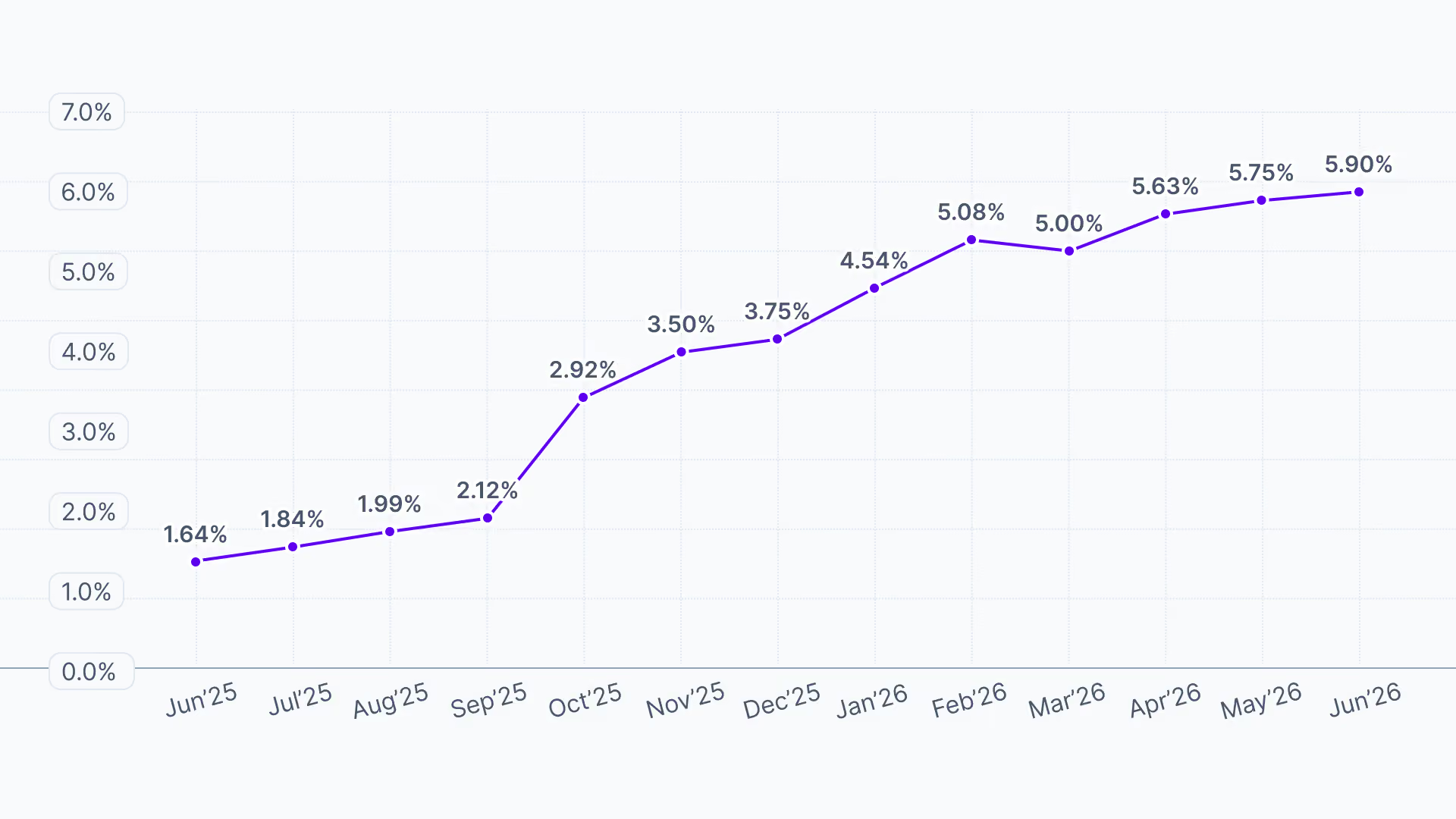
As a percentage of total software spend, AI has continued its aggressive expansion, now reaching 260% growth YoY.
This has mostly been fuelled by AI-native spending. In 12 months, AI-native spending has grown by 2.5x.
This represents continued investment that's driven by market interest and hype, competitive pressures and ever-revealing use cases. However, vendors are also better monetizing AI capabilities by switching pricing models to focus on consumption over traditional per-user licenses - which is driving up costs.
Cost increase metrics (when compared to seat-based pricing models)
.jpg)
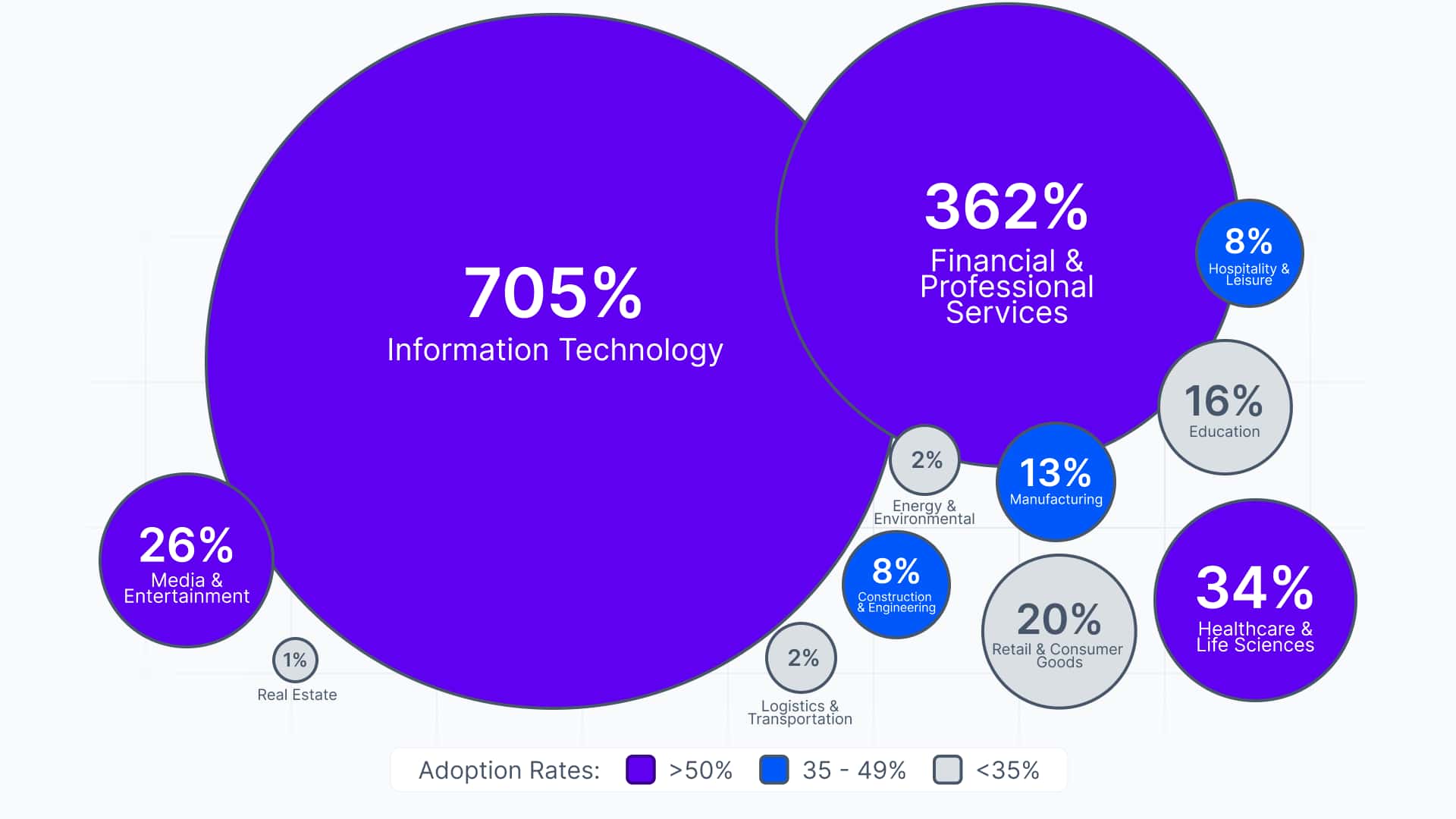
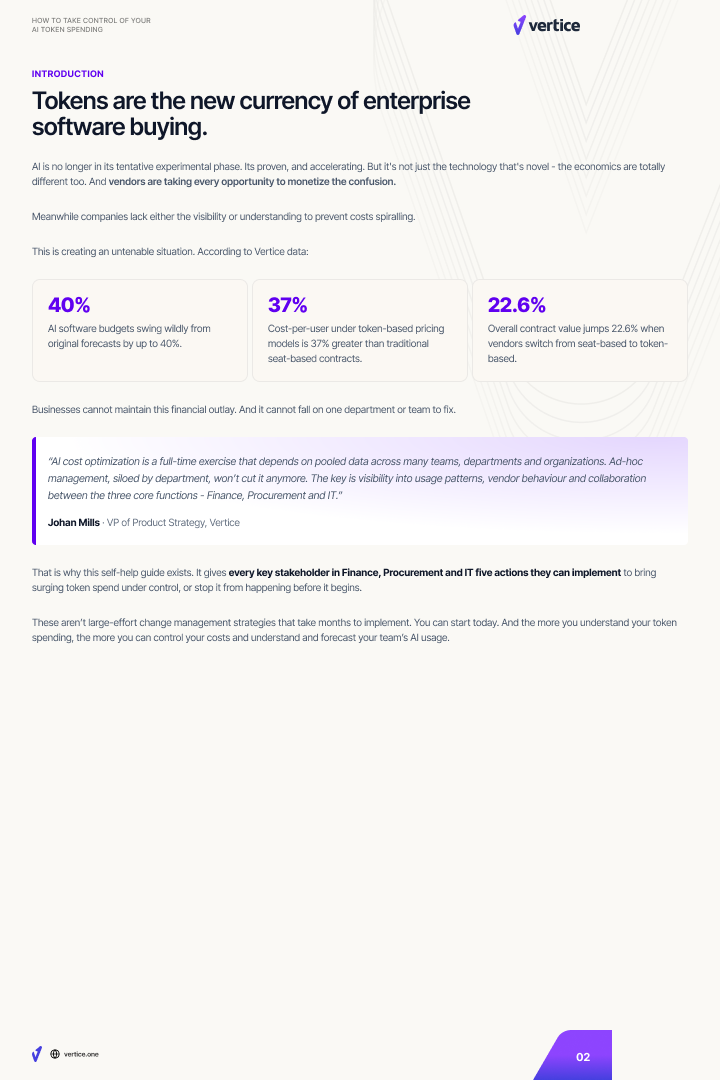
AI spending is now an accepted part of every industry. Vertice data shows that:
IT is still the highest-spending industry on AI tools - spending over 700% the cross-industry average. Financial Services is the next biggest spender (362%), far ahead of the next two closed industries: Healthcare & Education (34%) and Media & Entertainment (26%).
IT also leads in adoption rates of AI tools. The IT industry has a high adoption rate (>50% of employees using AI tools), alongside Financial Services, Healthcare and Media and Entertainment. Obviously big spending industries can be expected to also lead in adoption, but the reasons vary, ranging from natural prediliction and high competition in speed to market (IT), a need to process vast, complex, multi-source data quickly to generate proprietary insights (Financial Services), or more niche use cases (Healthcare and Life Sciences).
Some industries are struggling to adopt despite increasing spending: Though the Education and Retail & Consumer Goods industries have noticeably higher-than-average spending on AI, their adoption rate sits below 35%. This will largely be due to the nature of their workforces, and having a high proportion of employees where insight-based AI use cases are not pertinent.
AI spend & adoption rates (Spending as a % increase over cross-industry average)
AI adoption rates vs % of AI-native contracts per department
If we break adoption rates down by departments within businesses, we see that only Engineering , IT and Product teams are maximizing their AI spend - with high usage rates across the majority of contracts.
This is what "healthy" procurement looks like, and is understandable in this department given these teams are more exposed to, and used to, using new technologies like AI.
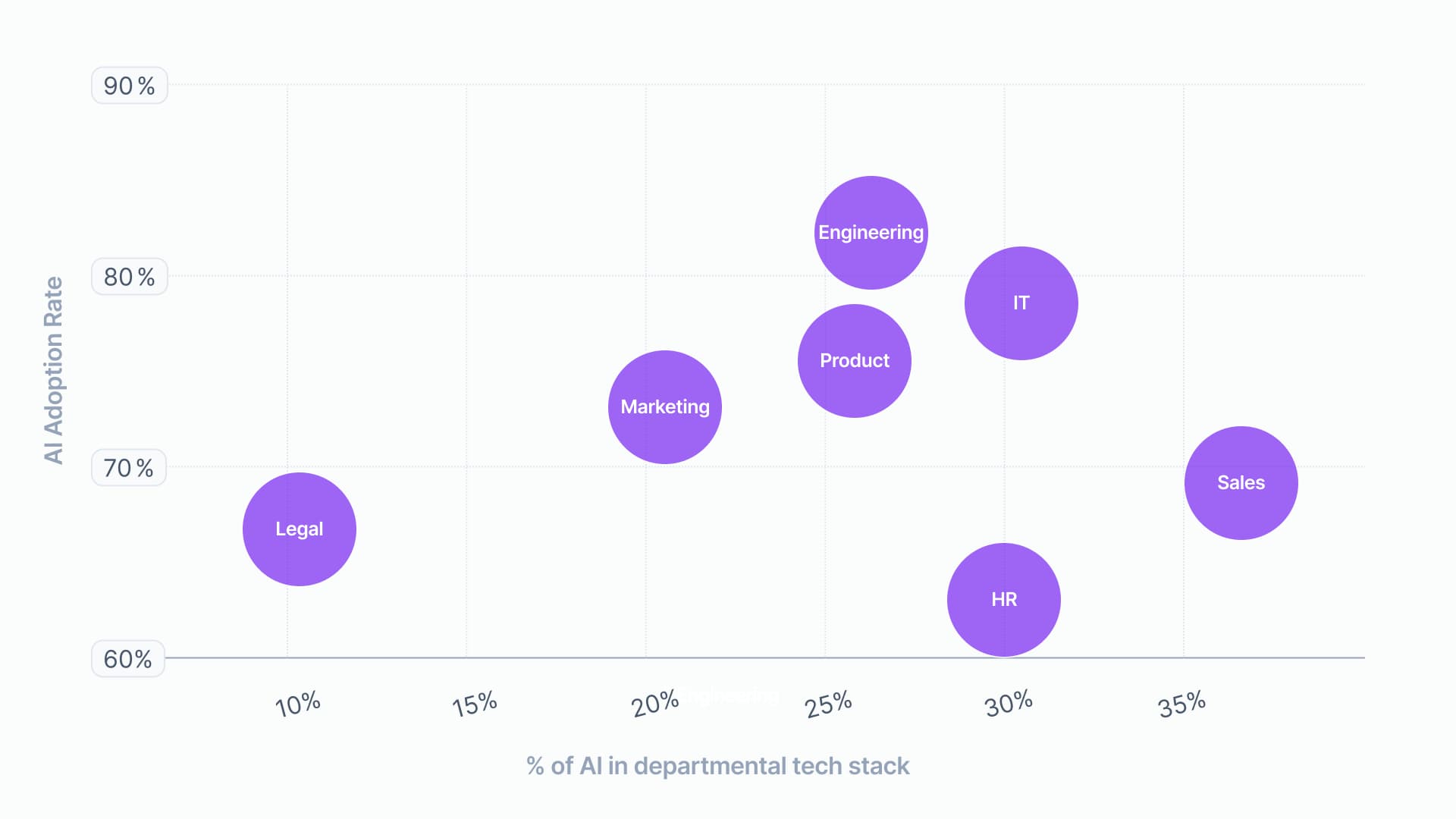
While Legal is a relative newcomer to AI usage, their adoption and investment rates suggests their experimentation of AI isn't being totally committed to - even if it one of the fastest-growing AI sectors. The same principle applies to Marketing - who shows signs of AI shelfware within their departments - a known budget killer.
Sales tech stacks are the most AI-embedded of any function - with platforms Salesforce, LinkedIn, ZoomInfo, Gong, Outreach and HubSpot all central to any sales cycle and who also offer AI capabilities. However, the adoption rate is relatively low compared to other departments, indicating a slower uptake by employees - likely due to a lack of training or change management processes.
HR is a relatively rich AI-native category - think LinkedIn, HiBob, Greenhouse, Culture Amp, Lattice and Workday. However, it displays the lowest departmental adoption - highlighting that these AI tools aren't being maximized by HR staff.
However, despite varying degrees of adoption and usage rates, there is a collective reticence to fully commit to a single vendor, as the average contracts lengths indicate.
Average contract length per vendor category
%20(1).avif)
The average AI-native contract length is 15 months - with the median even lower at 12 months. This is 7 months shorter than the average Applied AI contract length, and 9 months shorter than the average SaaS contract.
AI has such potential to transform companies' performance that finance and procurement teams - despite being willing to invest more and broaden usage - still appear wary of the rate of innovation in AI, and the risk of being locked in with AI vendors who end up falling behind.
Overspend on AI (%)
%20(1).jpg)
Across all industries and SaaS categories, when current SaaS contracts are compared to Vertice data and pricing benchmarks, it shows that 83% of agreed prices are needlessly above benchmarks.
And in the case of AI specifically, AI-native software buyers are overspending by an average of 19% due to lack of vendor pricing data and a structured negotiation strategy.
While this is a slight improvement over H1 2026 (14% less), companies are actually overspending by more in pure dollar terms thanks to rising overall spend and average ACV.
To avoid overspending on AI:
Leverage peer benchmarking data to determine what similar companies are paying for the same subscription.
Strategically negotiate contracts, using a combination of vendor benchmarks, usage data, and market insights to secure the best terms.
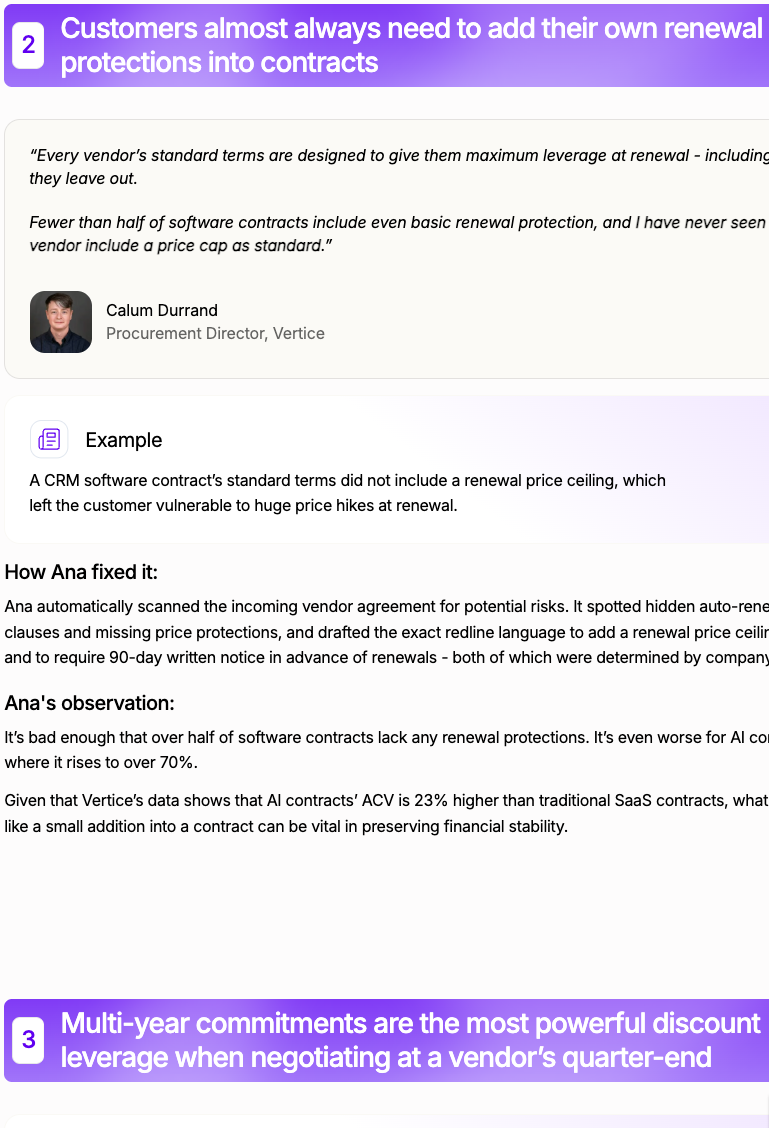
Protect future spend: Negotiate contract clauses such as removing auto-renewal provisions and including caps on price uplifts, limits on overage charges, performance guarantees, and exit or migration terms.
%20(1).jpg)
When buying AI SaaS is so crucial to staying competitive, but the market is both new and turbulent, procurement is under greater pressure.
Vertice, the intelligent procurement platform built for the modern enterprise, is the way forward.
Dynamic intake forces clarity in business cases, countering poor tool selection.
Agentic workflows bring the right stakeholders into the process at the right time, ensuring speed, control and compliance at every step.
Through our benchmarking, AI insights and expert negotiation, you secure the best price.
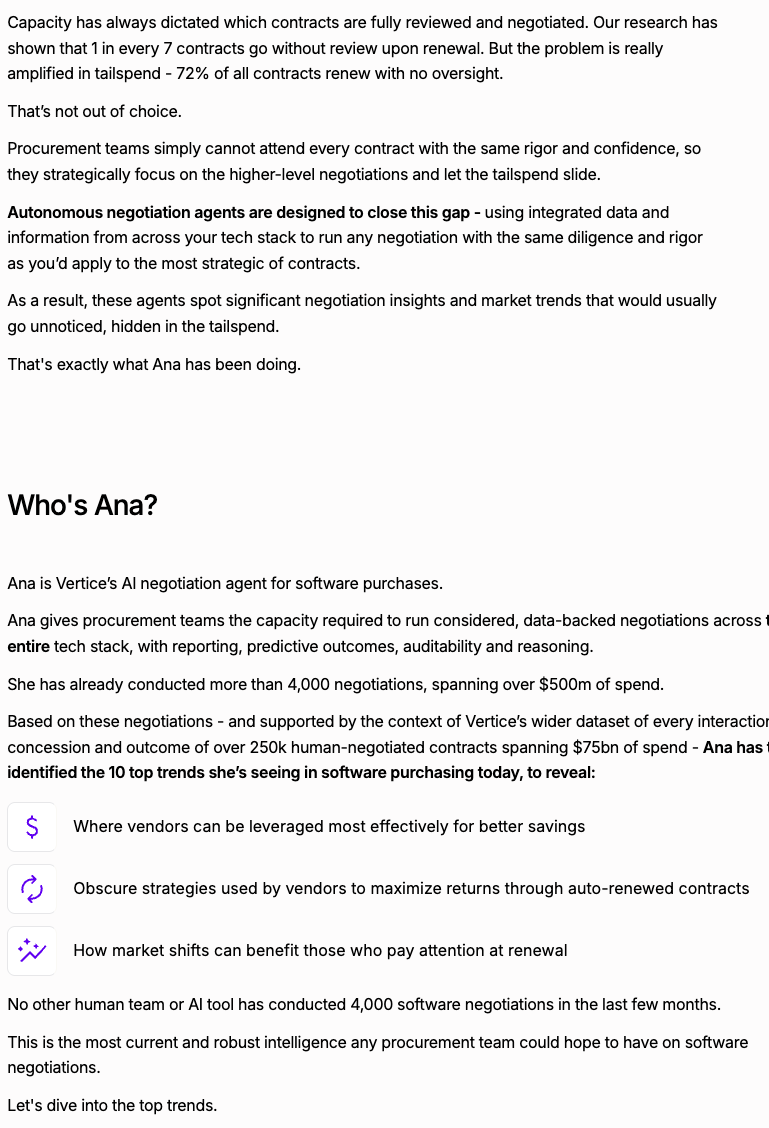
And everything is trained on our proprietary data - the world's largest procurement intelligence dataset, made up of over $75bn processed spend, over 250,000 negotiated contracts and over 2 million pricing points from 32,000+ global vendors.
Customers also have access to more than 50 specialist AI agents, rigorously and specifically trained to perform 70+ procurement tasks, ranging from negotiation tactics, to speeding up procurement cycles, or improving compliance.
See how simple yet powerful AI procurement can be with Vertice.
Cut AI SaaS waste. Lock in better deals.
And buy it faster.
We cut SaaS costs by 20%, guarantee your savings, and halve your procurement cycles.


.png)
.png)

.png)
.webp)