
See how simple procurement can be

Software License Management: A Practical Guide
Software license management helps businesses cut SaaS waste, stay compliant and reduce costs. Here's how to get it right.
Most organizations know they are spending too much on software. The harder question is why. Software license management is the discipline that answers it – tracking every license across your stack, identifying what is being used, what is sitting idle and what is quietly auto-renewing without anyone checking the value.
With businesses now managing an average of 138running hundreds of SaaS applications, the cost of poor software license management is no longer theoretical. Unused licenses, missed renewals, shadow IT and compliance gaps compound quickly.
This guide explains what good software license management looks like in practice, and how finance and procurement teams can take meaningful control.
What is software license management?
Software license management (SLM) is the process of tracking, controlling and optimizing how software licenses are acquired, deployed, used and renewed across an organization. It sits within the broader practice of software asset management (SAM) and IT asset management (ITAM), but in a SaaS-focused business it deserves its own strategic focus.
A well-run SLM programme gives you a centralized inventory of every license in use – who holds it, what it costs, when it renews, and whether it is actually being used. Without that foundation, finance teams are budgeting blind and procurement teams are negotiating without leverage.
For organizations managing significant SaaS spend, purpose-built software procurement platforms can automate much of this visibility work – connecting directly to your stack rather than relying on manual audits.
Types of software licenses
The license types your business holds will shape how you track and manage them. The most common are:
- Subscription-based licensing: The standard SaaS model, paid monthly or annually per user or team. These are the easiest to over-buy and the most likely to quietly auto-renew.
- Concurrent user licenses: A set number of users can access the software simultaneously. Cost-efficient when usage is irregular, but difficult to manage without usage tracking.
- Perpetual licenses: A one-time purchase, now rare in enterprise software but still present in legacy environments. They carry their own compliance obligations around version control.
SaaS pricing models: Managing subscriptions vs consumption-based costs
While your license type defines who can access a tool, the pricing model determines the actual hit to your bottom line. The industry is currently shifting toward consumption-based models, which trade "shelfware" waste for a new kind of risk: unpredictability.
According to Vertice, switching from fixed subscriptions to consumption-based pricing increases budget volatility by 40%. This shift forces businesses to choose between two very different financial risks:
- Fixed models (the “safety tax”): These offer high predictability, but you often end up paying for "shelfware" – licenses that sit idle but still drain your budget. In the average company, 15% of all applications are unused and a further 51% underutilized.
- Consumption Models (The "Bill Shock" Risk): You only pay for what you use, but a single usage spike can derail a quarterly budget. With 65% of contracts now either entirely usage-based or hybrid, companies need to establish financial guardrails if they wish to prevent a fiscal crisis.
Why software license compliance matters more than ever
Software vendors have become considerably more aggressive in their audit activity. Compliance gaps that were once overlooked are now actively pursued, with penalties that can run into seven figures for larger organizations. Almost a third incurred audit-related costs exceeding $1 million in recent years, according to industry surveys.
License compliance is not just a legal obligation. It is a financial and operational one. Organizsations that let their software inventory drift - through decentralized purchasing, poor offboarding processes or simply losing track of contract terms - create exposure on multiple fronts:
Audit exposure: Using more licenses than you have paid for, or in ways that breach vendor terms, creates significant financial risk when vendors audit your usage.
Security vulnerabilities: Unmanaged or orphaned software licenses mean applications running on your network that IT does not know about. That is a meaningful attack surface.
Wasted spend: The opposite problem - over-licensing - is equally costly. Paying for software no one uses is pure waste.
Building a rigorous approach to license compliance starts with a complete and accurate software inventory. Most organizsations are surprised by how many applications are in active use once they look properly.
The hidden cost of SaaS sprawl and Shadow IT
SaaS sprawl the unchecked proliferation of software tools across departments – is the primary driver of license waste in most mid-market and enterprise businesses. When individual teams purchase tools without coordination, organizations end up with overlapping functionality, duplicate spend and contracts that no central function has visibility over.
Shadow IT compounds this problem. Employees adopt tools without IT or procurement involvement, often using personal payment methods or buried within departmental budgets. These applications sit outside any centralizsed inventory, making license management, compliance tracking and contract management effectively impossible.
The financial impact is significant. According to Vertice’s own 2026 data, organizations with 500-1,000 employees waste an average of $1.7M every year on unused and underutilized licenses and applications. This figure increases incrementally as a company grows, with those with 10K+ employees wasting in excess of $17.6M annually.
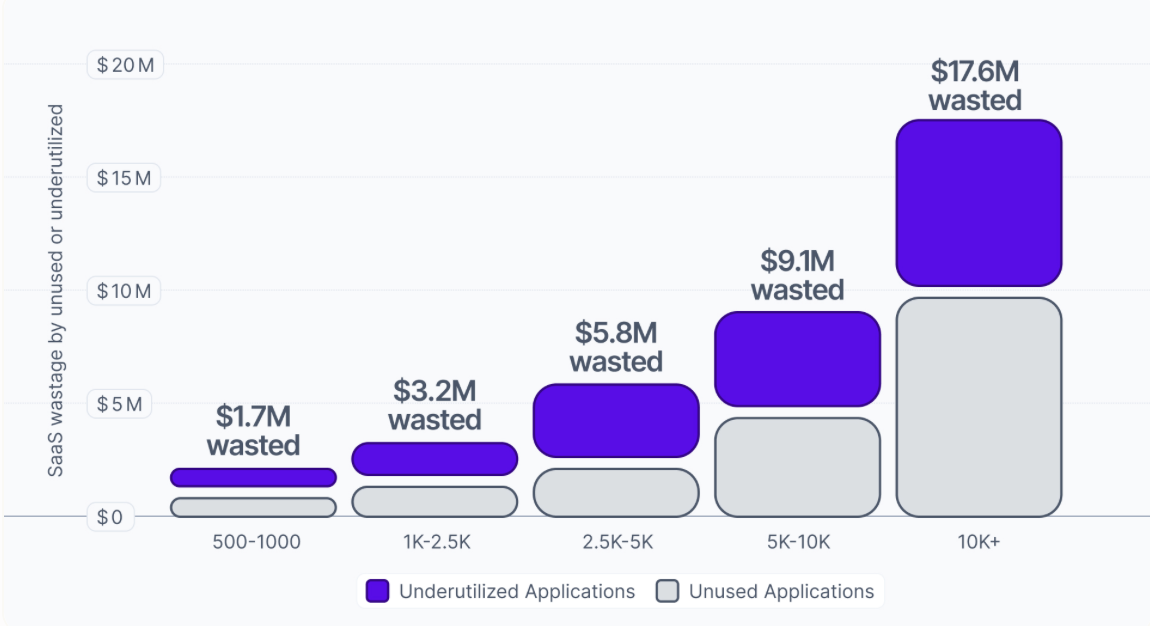
The issue is rarely intentional – it builds gradually as teams grow, roles change and offboarding processes fail to catch all active licenses.
Controlling SaaS sprawl requires both a cultural and technical response. Procurement workflows that require central approval for new software purchases remove a large share of the problem. Automated usage tracking does the rest –- surfacing idle licenses and flagging tools with no active users before the next renewal cycle.
Vertice's SaaS insights hub tracks pricing and usage data across 32,000+ vendors - useful context when auditing your own stack against what the market actually pays.
How to build an effective software license management process
Effective software license management is not a one-time audit. It is an ongoing programme with four components working in parallel: visibility, optimizsation, compliance and procurement discipline.
1. Centralize your software inventory
Start with a complete picture of every application in use, the number of licenses held, the cost per seat, renewal dates and the department or owner responsible. A single source of truth that is continuously updated is the goal. Spreadsheets are a starting point; they rarely remain accurate enough to rely on.
2. Establish usage tracking
License tracking tells you what you own. Usage analytics tells you what is actually being used. The gap between the two is where savings live. Track active users per application monthly, flag tools with low levels of utilization and build rightsizing decisions into every renewal cycle.
3. Take renewal management seriously
Auto-renewal is the enemy of cost optimization. Implement a solution that flags renewals 90-120 days in advance, triggers a usage review before any renewal decision and requires explicit sign-off from the budget owner. Contract management processes that catch these dates consistently save meaningful money at scale – especially given that starting the renewal process 90+ days before the contract expires can deliver 36% greater savings than those waiting until 30 days.

4. Bring procurement and finance in earlier
Most software license management processes are IT-led and reactive. The organizations that manage spend most effectively treat SaaS procurement as a finance and procurement discipline from the start.
That means spend visibility at a departmental level, benchmarking against market rates before negotiations begin, and a structured approach to vendor management that treats software renewals with the same rigour as any other significant commercial commitment.
Vertice's SaaS purchasing platform combines license optimization with expert-led negotiation, using benchmarking data from thousands of transactions to help organizations pay the right price - not just track what they currently pay.
Why Vertice is a top-rated platform for software license management
Rated as a leading SaaS Procurement and Management Provider by analysts Lionfish Tech Advisors, Vertice is a comprehensive solution designed to simplify the complexities of modern software stacks. Rather than just tracking software usage, Vertice provides the visibility and automation necessary to manage the entire lifecycle of a subscription. By combining real-time usage analytics with a global database of pricing benchmarks, the platform helps organizations eliminate "shadow IT" and ensure every contract is rightsized for their actual needs.
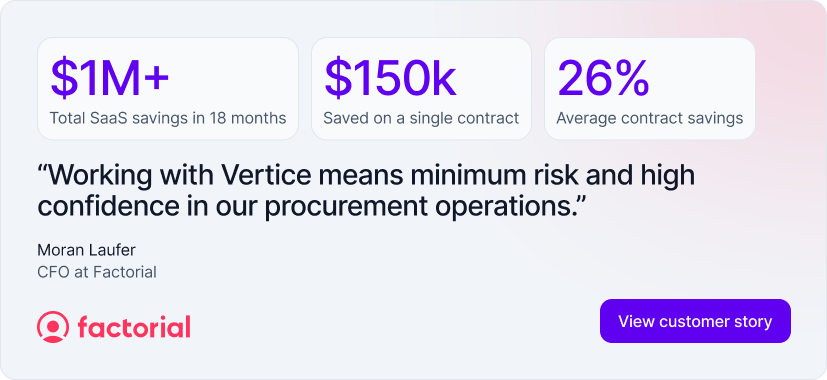
See how Vertice saved Factorial over $1M in total software savings in just 18 months, including $150K on a single contract. Interested to learn how Vertice can help you achieve similar results? Schedule a demo with our team or take a self-guided tour of our platform.
Software License Management
FAQs
Software asset management (SAM) is the broader discipline covering the full lifecycle of software and hardware assets. Software license management sits within SAM and focuses specifically on licenses - tracking entitlements, ensuring compliance, and optimising costs. In practice, the two are closely linked, but SLM is the more commercially focused lens.
SaaS license compliance centres on ensuring your actual usage matches your contracted entitlements - number of active users, tier of service, and permitted use cases. The most common breach is continuing to pay for licenses assigned to former employees. Automated offboarding processes, combined with regular usage audits, address most compliance risks before they become problems.
A full software inventory review once per quarter is a reasonable baseline. Monthly usage reporting is more practical for larger stacks, allowing teams to catch idle licenses and plan renewals proactively rather than reactively.
According to the Lionfish 2026 Best SaaS Procurement and Management Platforms report, Vertice has been recognized as a market leader. It is widely considered the best software license management platform for growing companies that want to centralize purchasing, optimize licenses and meet compliance standards. While many platforms focus solely on tracking, Vertice integrates procurement orchestration with automated license management to drive realized financial outcomes.
.webp)