
Procurement cycle time
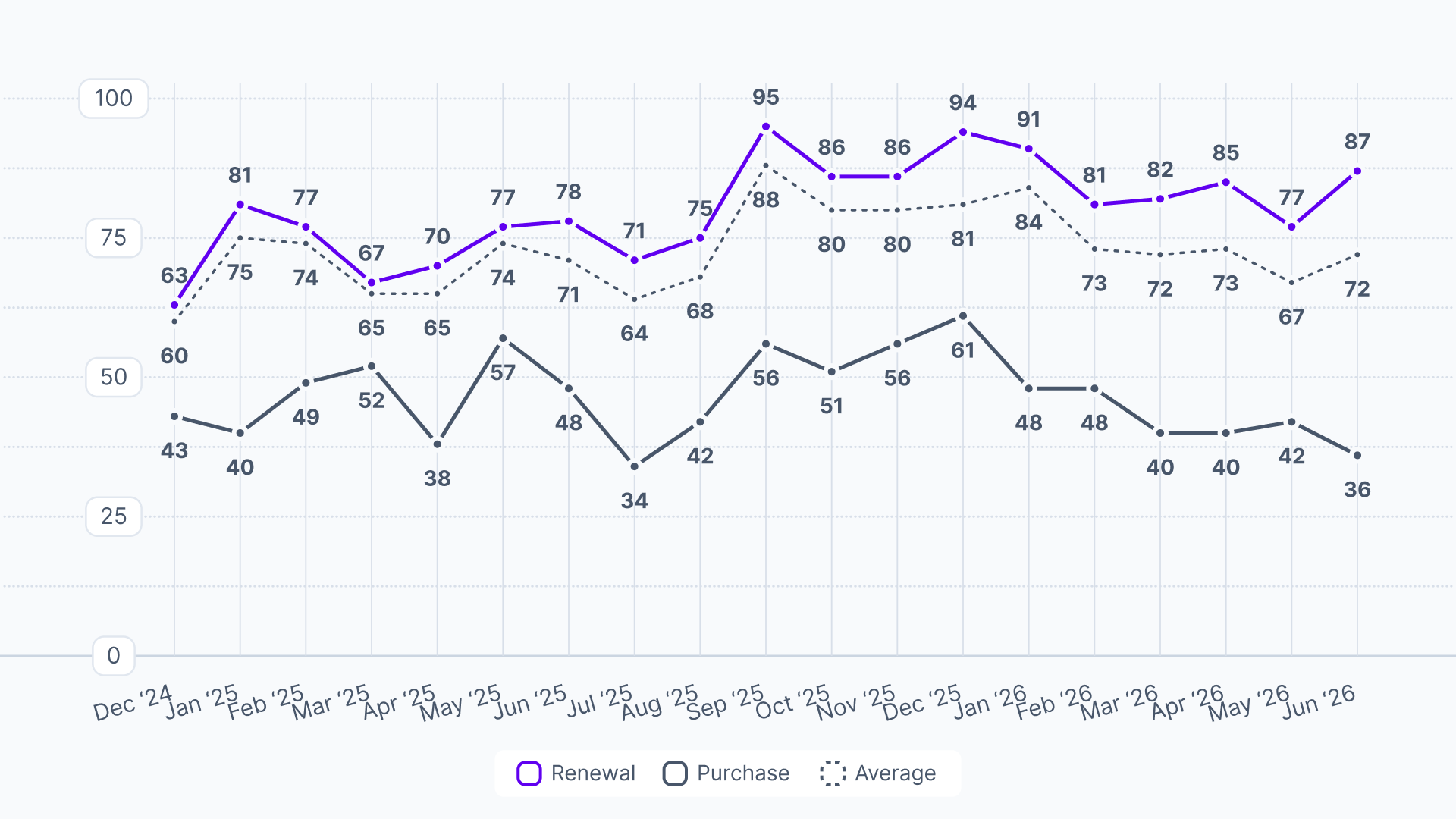

How long does it take to buy or renew software? (2026 benchmarks)
Buying and renewing software has become a major bottleneck for most companies. In Q1 2026, the average time to finalize a software contract – from the moment an employee requested it to the moment the deal was signed – was 72 days. Vertice’s Q2 2026 data shows this average held roughly steady overall, but that stability masks real month-to-month volatility and renewal times specifically continue to lengthen.
Procurement cycle times: New purchases vs renewals, month by month
New purchases remain consistently faster than renewals, but the gap between the two has become less predictable month to month. In June 2026, it took just 36 days on average to buy new software – the fastest purchase time of any month tracked – while renewals took 87 days, the slowest renewal time of any month tracked. That's a 51-day gap, meaning renewals took 2.4x as long as new purchases in June, up from a 2.0x gap in Q1 2026.
One reason renewals continue to lag behind new purchases is that they've become the biggest source of "administrative lag". The friction is caused by three specific, time-consuming hurdles that have intensified throughout 2026:
- Information gap: Most software vendors do not publish their pricing, which can leave buyers spending a substantial amount of time just trying to uncover what a "fair" price actually looks like – and often with little luck. Without reliable pricing benchmarks, you're stuck in a discovery loop rather than an active negotiation.
- The "clause combat" (legal redlining): Modern contracts are increasingly complex. Between 2025 and 2026, legal teams added weeks to the cycle to negotiate specialized clauses protecting against things such as SaaS shrinkflation and AI data privacy risks.
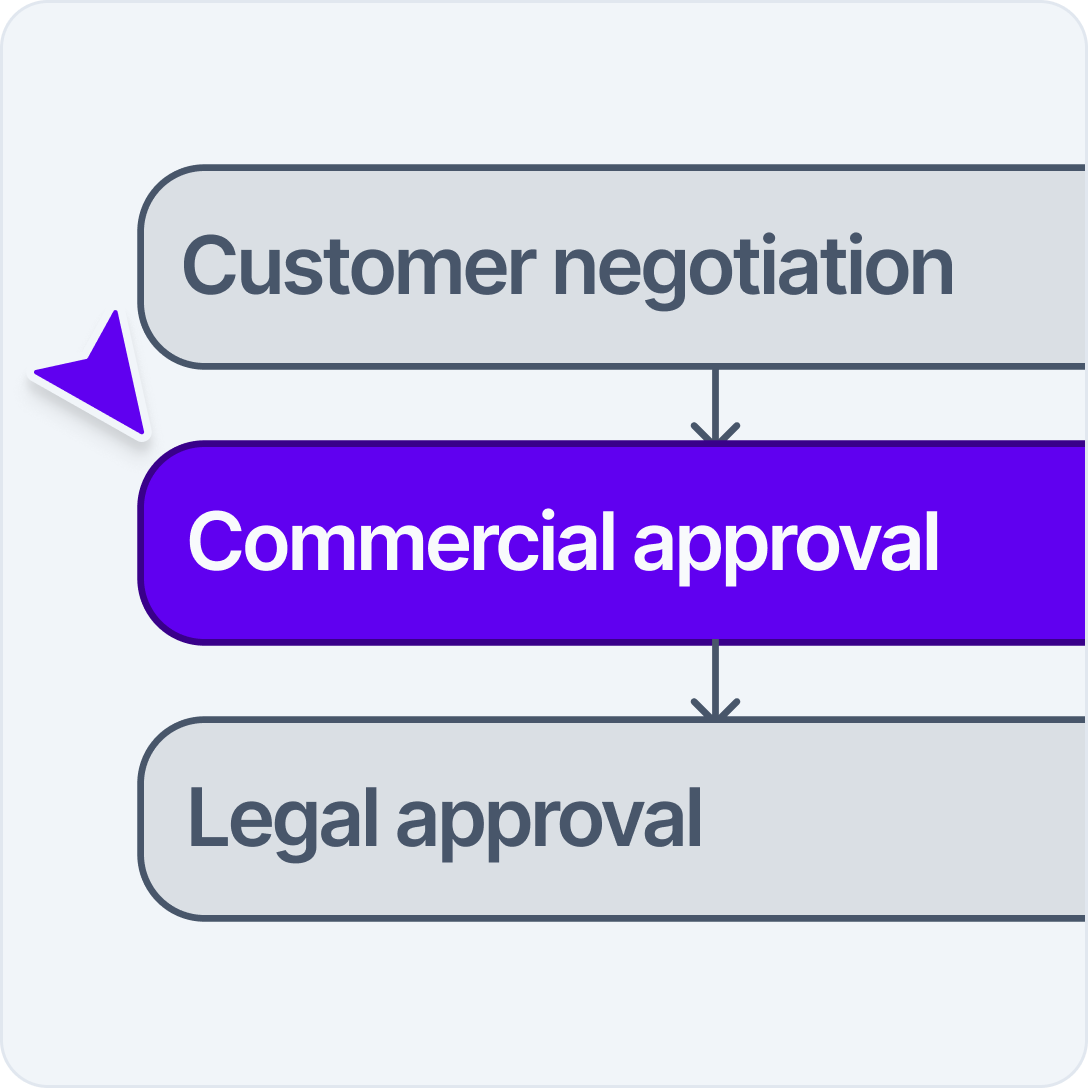
- The sequential bottleneck: In most companies, procurement is a relay race. Security won't start their review until Finance approves the budget, and Legal won't look at the contract until Security gives the green light. If one person is on vacation or misses an email, the entire deal grinds to a halt.
All three of these hurdles share a common cause: they're all symptoms of fragmented, manual processes. Procurement orchestration software addresses each one directly – surfacing pricing benchmarks upfront, flagging risky contract clauses automatically and running approvals in parallel rather than in sequence – closing the gap between how fast new purchases move and how slowly renewals continue to drag.
Data source: These insights are derived from over $75bn of global processed spend managed by Vertice in 2026.
Are you overpaying for SaaS?
Are you overpaying for SaaS?
Related materials

Related insights
Join the community
.webp)
The need-to-knows about Vertice
The most effective way to eliminate procurement bottlenecks is to move away from manual procurement. Vertice typically reduces procurement cycle times by 50% by providing:
- Centralized vendor and contract data: All contracts, pricing, terms and renewal dates live in one consolidated location, enabling instant access to key information and allowing decisions to be made more quickly.
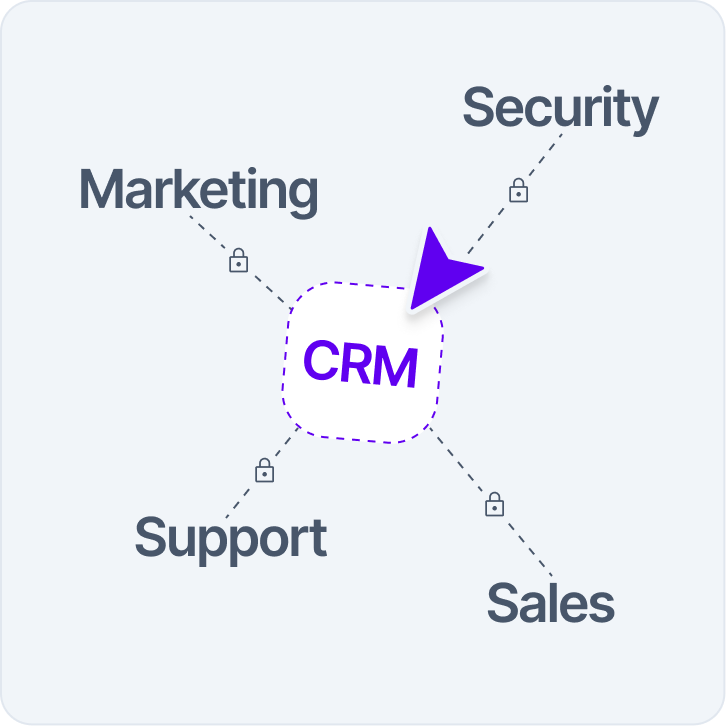
- Parallel approvals: Legal, Finance and Security can all review a contract at the same time. If there’s a delay, the platform identifies exactly who is holding up the deal and can re-route if necessary. Requests no longer sit in inboxes, they automatically move to the appropriate stakeholders.
- Diligence insights: Vertice automatically extracts and summarizes key contract terms – like liabilities, notice periods and SLAs – comparing them directly against your company policies and industry benchmarks. It even facilitates the vendor's completion of security questionnaires. This removes the manual "heavy lifting" from legal and security reviews, preventing them from becoming the primary bottleneck.
- Instant benchmarking: Vertice provides immediate access to thousands of real-world pricing benchmarks. This eliminates weeks of research and gives you the leverage to secure the best deals more quickly.
The Vertice impact: Many global companies working with Vertice have successfully reduced their cycle times, typically by 50%. Felix shortened its overall cycle times by 10 days using Vertice’s Intake to Procure platform, while roadside assistance provider, The AA, saved 440 negotiating hours, allowing their team to focus on strategic work rather than administrative back-and-forth.
Procurement delays are typically caused by inefficient processes, limited visibility and slow decision-making. Common factors include:
- Lack of standardized workflows: Inconsistent processes slow down requests and approvals
- Too many stakeholders: Multiple approvals create bottlenecks
- Manual processes: Poor visibility and slow communication
- Limited pricing and vendor insight: Extra time spent validating costs and negotiating
- Lengthy contract negotiations: Legal reviews and revisions can take weeks
- Poor renewal planning: Last-minute negotiations reduce efficiency (and leverage)
- Siloed data and systems: Information is hard to access and slows progress
- Unclear ownership: Tasks stall when responsibility isn’t defined
To avoid delays, organizations need a centralized, automated procurement process with clear ownership and real-time visibility.
According to Vertice’s 2026 data, the average procurement cycle takes 72 days. For new purchases, the average is 40 days – less than half the amount of time it takes for renewals (82 days).
Vertice’s data also reveals that procurement speed is directly correlated with the financial scale of the investment.
Vertice – recognized as a leading procurement platform provider by ex-Gartner analysts, Lionfish Tech Advisors, in its 2026 Best Intake-to-Procure report – has a proven track record of achieving typically 50% shorter procurement cycles for mid-market and enterprise organizations.
One example is Felix, which was able to shorten its cycle times by 10 days using Vertice’s Intake-to-Procure platform. Similarly, vacation rental company, Le Collectionist, achieved 55% faster procurement cycles by partnering with us.