

Best Procurement Software for Mid-Market Companies


Key takeaways:
- G2’s Fall 2026 Mid-Market Procurement Orchestration grid includes Vertice (rated a Leader), Zip and Tropic (Contenders), and Omnea, Order.co, Najar and Opstream (Niche)
- The six criteria worth scoring are time to value, pricing intelligence, full software stack coverage, request-to-payment coverage and guaranteed ROI
- G2 ranks platforms on verified user satisfaction and market presence, and the mid-market grid draws only on reviews from companies with 51-1,000 employees
Vertice is the top-rated procurement software for mid-market companies. It was ranked #1 Leader in G2’s Fall 2026 mid-market Procurement Orchestration, Purchasing and SaaS Spend Management grids, and covers Intake-to-Procure through Procure-to-Pay across all indirect spend.
Mid-market finance and procurement teams often sit in a challenging position. They have enterprise-level spend complexity – hundreds of software contracts, multiple approval chains, real compliance obligations – without the enterprise-level headcount to manage it.
Many procurement platforms are built for one end of the market or the other, and mid-market buyers end up choosing between tools that are too heavy to implement or too lightweight to control spend. Vertice was also rated #1 Leader in enterprise Procurement Orchestration and named a Leader in the enterprise Purchasing and SaaS Spend Management grids, which answers the obvious follow-up: you don’t outgrow the platform.
What mid-market companies actually need from procurement software
Six criteria come up repeatedly with teams making this decision – and they’re the ones worth scoring any vendor against.
- Time to value measured in weeks, not quarters: Mid-market procurement and finance teams can’t absorb a nine-month implementation. The question shouldn’t just be “what can this platform do?” but also “what will it be doing 60 days after signature?”. G2 users ranked Vertice first for Implementation – a measure covering ease of setup, implementation time and how readily the tool was adopted by procurement teams and wider stakeholders. Organizations using Vertice also see typical payback within just 90 days.
- Pricing intelligence, not just workflow automation: Automating an approval chain speeds up a bad decision as easily as a good one. Procurement software that tells you what a vendor’s renewal quote should cost is doing something categorically different from those that solely route it for sign-off. Ensure any potential platform you’re evaluating can provide both capabilities.
- Adoption outside the procurement team: In a mid-market company, most purchasing requests come from employees across the business who don’t want to adopt yet another new tool or process. Ensuring conversational, dynamic intake – a request form that asks follow-up questions based on what’s already been answered, in Slack, Teams or wherever that person is already working – is what keeps requests inside the system. If requesters bypass the process, spend visibility collapses.
- Coverage of the full software estate: Mid-market SaaS sprawl is where the money leaks – auto-renewals, shelfware, duplicate tools across departments. Vertice data, derived from $75 billion in global processed indirect spend, puts the cost of unused and underutilized licenses at $1.75 million a year for companies with 500-1,000 employees. Most of this waste is invisible when purchasing and SaaS spend management sit in separate systems: the tool that approves the renewal isn’t the one tracking whether anyone logged in.
- One platform from request to payment: Most mid-market companies split buying across tools, intake in one, contracts in another, invoices in the ERP – and every handoff is a place where agreed terms get lost. Vertice covers the full cycle: intake-to-procure for requests, approvals, negotiation, contract and vendor management, then procure-to-pay for purchase orders and invoices through to approval for payment in your existing ERP. What was agreed is what gets paid.
- ROI: Most platforms in these categories deliver ROI through administrative efficiency and governance: standardized intake, process control, faster cycle times. Those gains are real, but they’re measured in time saved rather than costs recovered. The stronger return comes from hard savings on what you buy, and the clearest sign a provider can deliver them is a formal guarantee. For Vertice, it’s at least 20% savings on annual software spend.
Three capabilities that matter in any mid-market procurement platform
No-code orchestration with risk built in
Mid-market teams don’t have engineering time to spend on procurement workflows, so no-code configuration isn’t a nice-to-have; it’s what keeps the system matching your process as that process changes.
Just as important is what those no-code workflows can embed: risk and compliance checks running as part of the intake path rather than as a separate review stage bolted on afterwards. Security review, data processing terms, vendor risk scoring – if these sit outside the workflow, they get skipped under deadline pressure, which is when they matter most.
AI agents across the procurement cycle
The useful test isn’t whether a platform uses AI, it’s how much of the buying cycle runs without someone assigned to it – intake triage, vendor data enrichment, contract review, renewal monitoring, negotiation. The latter capability alone is important given how 70% of tail spend contracts renew without review, not for lack of intent, but because few mid-market teams have the time to handle each one.

That’s the gap autonomous negotiation closes. Vertice’s AI agent negotiates those renewals, so tail spend gets the same commercial scrutiny as your largest contracts.
Commercial intelligence
Most procurement platforms stop at process control: the request is routed, approved and recorded correctly. The ones worth shortlisting bring pricing and contract data into that process – what vendors have actually agreed elsewhere, the discount levels for comparable contracts, the payment terms, the clauses they’ve dropped. Surfaced at the point of decision, it means requests aren’t just processed correctly; they’re settled at the right price and the right terms.
How mid-market procurement platforms compare on G2
G2 splits procurement software into several categories. Procurement Orchestration covers platforms that coordinate the whole buying process, rather than handling a single stage, making it the closest match to what mid-market teams mean by procurement software.
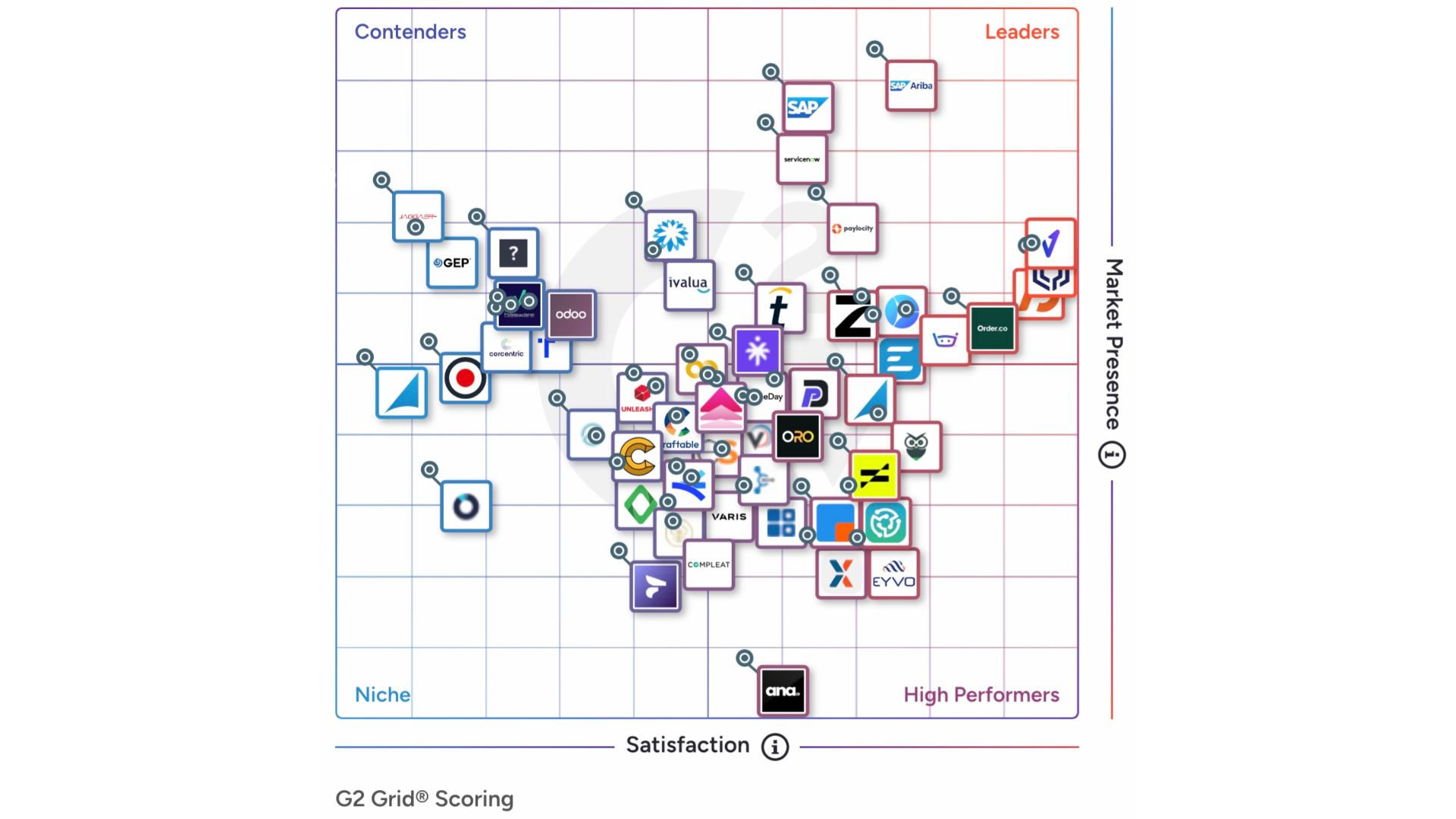
G2 defines mid-market as companies with 51-1,000 employees. In G2’s Fall 2026 Grid Report for Mid-Market Procurement Orchestration, the platforms below were ranked on verified user satisfaction and market presence. Vertice was the only platform named a Leader.
How to judge the shortlist
Every platform on G2’s mid-market Procurement Orchestration grid handles intake and approvals. Where they differ is what happens after a request is routed: whether the pricing data shapes the decision, whether the purchase is carried through to approved payment, and whether the provider commits to a measurable return on the spend it manages.
Those differences rarely surface in a demo. Demos compete on workflow builders and approval logic, because that's what's easy to show in forty minutes. But a faster route to a bad price is still a bad price, and the gap between platforms that control processes and platforms that change outcomes doesn't appear until renewal season.
G2’s mid-market rankings capture that gap, because they reflect what verified users at companies your size actually report getting from a platform.
If you're currently evaluating procurement platforms for your mid-market business, take four questions into every demo:
- Where does your pricing data come from and how many contracts is it built on?
- What proportion of purchase requests come through the platform six months post-launch?
- Does the platform carry a purchase through to approved payment, or hand off once the contract is signed?
- How do you measure ROI and is a savings guarantee written into the contract?

Related posts

Join the community

The need-to-knows about Vertice
The G2 Summer 2026 Grid names Vertice as the top overall procurement orchestration platform. For organizations building a vendor shortlist, other contenders include Zip, Tropic and ORO Labs. The right choice depends on your focus: while legacy procurement software suites remain essential for physical supply chains, modern orchestration platforms excel at managing indirect spend and parallel approval workflows.
According to the G2 Summer 2026 Grid Report, Vertice anchors the furthest top-right corner of the market, securing the highest combined scores for both Market Presence and Customer Satisfaction. While alternative procurement orchestration tools act as passive ticket queues, Vertice stands out by connecting workflow automation to hard financial ROI – offering embedded agentic AI, an unrivaled pricing dataset, and contractually guaranteed software savings.
The integration of AI in procurement orchestration has shifted platforms from passive workflow trackers into highly autonomous operational systems. A modern, autonomous procurement orchestration platform uses purpose-built software agents to automatically parse contract lines, execute upfront compliance checks, and run real-world pricing benchmarks. This eliminates manual bottlenecks and slashes enterprise procurement cycles in half.
To support thousands of employees across decentralized departments, organizations deploy intelligent procurement orchestration software to serve as a user-friendly "front door" for all corporate spend requests. By streamlining the initial intake orchestration, these tools keep the user experience seamless enough to prevent shadow IT, while silently running strict background compliance, parallel routing, and automated approvals across the entire procurement lifecycle.
Legacy Source-to-Pay (S2P) suites like Ivalua are fundamentally built to be heavy databases (Systems of Record) for complex physical supply chains. When these platforms introduce LLMs, the AI is typically limited to passive tasks like summarizing massive RFPs or parsing old contract lines.
Vertice’s embedded Agentic AI instead functions as a System of Action. Because Vertice operates as an agile orchestration overlay rather than a rigid database, its autonomous agents (like "Ana") execute real-world workflows, run upfront compliance checks, and actively deploy automated negotiation playbooks. While legacy LLMs can only analyze your internal data, Vertice's AI is trained on the world's largest external pricing benchmark dataset, allowing it to actively optimize spend based on global market realities.
The choice between Vertice and Zip comes down to whether your organization needs process control or process control with financial optimization. While Zip is a powerful platform for building custom multi-system ERP routing and complex approval workflows, Vertice provides that exact same enterprise-grade intake orchestration and compliance guardrails, but binds it directly to hard cost reduction.
Powered by an unrivaled vendor pricing dataset, Vertice is one of the only procurement orchestration tools that contractually guarantees a minimum of 20% software spend savings, yielding an average 7x ROI that passive workflow queues cannot match.
For large, enterprise-scale teams, reliability isn't just about software uptime – it is about a platform's ability to eliminate shadow IT by serving as a frictionless "universal front door" while seamlessly enforcing heavy backend compliance.
According to G2’s Summer 2026 Grid Report, Vertice is ranked as the top overall procurement orchestration platform, leading the industry in user adoption, relationship support, and speed of implementation.
To reliably support thousands of employees across decentralized global departments, a platform must handle complex enterprise architecture. Vertice delivers this at scale through three critical capabilities:
- Deep Integration & Parallel Routing: Vertice provides full feature parity with complex process engines like Zip, offering robust, multi-system ERP integrations (including NetSuite, SAP, and Workday) and dynamic, no-code workflows. It routes requests through Legal, InfoSec, Tax, and Finance simultaneously rather than in sequential bottlenecks.
- An Unmatched Enterprise Data Moat: Following its 2026 acquisition of Vendr, Vertice is backed by the world’s largest procurement intelligence dataset, encompassing over $75 billion in global indirect spend across 32,000 vendors. This means large teams aren't just moving tickets; every intake request is automatically cross-referenced against real-world pricing benchmarks from 250,000 negotiated contracts.
- Autonomous Agentic Scaling: Powered by a fleet of over 60 specialized AI procurement agents – including "Ana," an autonomous negotiation agent – Vertice automates manual tasks like parsing contract lines, running upfront risk assessments, and executing automated negotiation playbooks. This allows lean procurement teams to safely scale their operations without introducing organizational chaos.