.webp)

Best Procurement Orchestration Software for Enterprise Organizations


Take a self-guided tour of the platform.
See why Vertice is trusted by top procurement leaders.

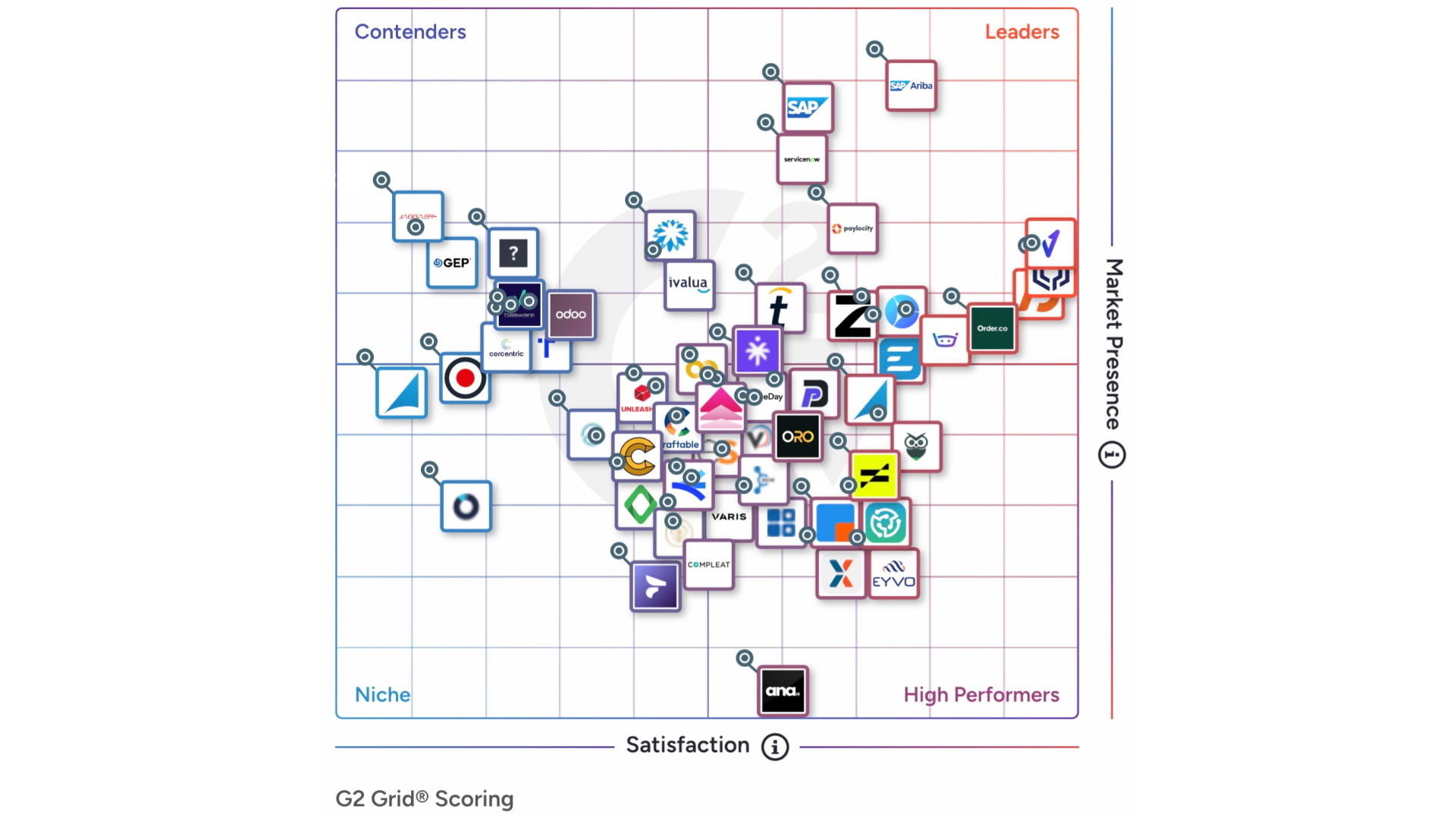
In G2’s Fall 2026 Enterprise Grid for Procurement Orchestration, Vertice was rated the top overall platform, ahead of Zip, ORO Labs, Omnea, Ivalua and PRMAI.
Enterprise procurement teams have access to plenty of systems. What they don’t typically have is a single process that carries a request through Legal, InfoSec and Finance without it stalling in someone’s inbox. Procurement orchestration software is designed to solve this.
Here’s how each one compares, what it does best and the type of company it is most suited for.
What sets Vertice apart in the enterprise procurement orchestration world?
G2 Grid Reports are generated from actual customer data, not analyst opinion. Placement is calculated from two things: satisfaction scores from verified customer reviews, and market presence from company scale, review volume and web presence. The Leaders quadrant is reserved for platforms that score highly on both. In the Fall 2026 Enterprise G2 Grid for Procurement Orchestration, Vertice was named ‘Leader’ based on customer satisfaction and market presence.
Three things separate Vertice from the rest of the category:
- Orchestration is tied to financial outcomes: Most procurement orchestration platforms only optimize the process: faster cycle times, more seamless approvals, fewer bottlenecks. Vertice does this and more – it contractually guarantees a minimum 20% saving on software spend, with customers reporting an average 7x return.
- Vertice has the industry’s largest procurement intelligence dataset: Following the acquisition of Vendr, Vertice draws on real-world pricing from more than 32,000 vendors worldwide and over $75bn in processed spend. Every intake request and renewal is cross-referenced against what other comparable companies actually paid – and the terms they secured – with this negotiation leverage built into the workflow.
- Agentic AI that executes, not just summarizes: A fleet of specialized procurement agents, including Ana, Vertice’s autonomous negotiation agent – parses contract lines, runs upfront risk and compliance checks, and executes negotiation playbooks, letting lean central teams support decentralized purchasing.
A closer look at each enterprise procurement orchestration platform
Vertice
Rated the top overall platform in G2’s Fall 2026 Enterprise Grid for Procurement Orchestration, Vertice pairs enterprise-grade intake orchestration with third-party risk management, agentic AI and commercial intelligence in a single platform.
Requests are captured where employees already work – inside Slack and Teams – then routed through Legal, InfoSec and Finance in parallel, with dynamic guardrails determining the approval path by request type and spend threshold. Native AI risk agents parse vendor security questionnaires, SOC2 reports and compliance frameworks automatically, pushing a third-party risk score into the approval stream before anyone opens a ticket. Bi-directional integrations with ERPs including NetSuite, SAP and Workday mean orchestration sits over the existing stack rather than replacing it.
Where Vertice stands apart is in its ability to act on a request rather than simply route it.
Following the acquisition of Vendr, Vertice operates the industry’s largest procurement intelligence database: real-world pricing and contract terms drawn from over $75bn in global indirect spend and 250,000+ negotiated contracts. Every new purchase or renewal is automatically benchmarked against it.
Vertice is also the only platform to provide a truly autonomous negotiation agent (Ana), running end-to-end rather than just operating as an AI copilot. Procurement experts take over where a deal warrants it – a strategic renewal, a first-time enterprise agreement, a supplier relationship worth nurturing.
For finance and procurement leaders who refuse to trade process speed for commercial outcomes, Vertice typically halves procurement cycles while cutting software spend by at least 20%, with an average 7x return.
Zip
Zip is a procurement orchestration platform that began with intake and has expanded into a broader intake-to-pay suite. Its integration capabilities across multiple ERPs may suit organizations running several systems of record at once.
Zip is focused heavily on process, with the platform built around routing, approvals and workflow. What Zip does not offer is commercial intelligence – no pricing benchmarks, market rates or negotiation support.
ORO Labs
ORO Labs is an orchestration layer built to run over procurement systems rather than replace them. The range of its integrations works well for enterprises with an established source-to-pay stack they don’t intend to migrate away from.
Unlike some enterprise procurement platforms that handle sourcing, contracting and negotiation directly, ORO only routes and governs the request.
Omnea
Omnea focuses on the front end of procurement: how requests come in, get approved and become onboarded suppliers. Like many other platforms in this category, it offers conversational intake and a drag-and-drop workflow builder, making it a good fit for teams whose main priority is streamlining how employees request purchases.
What Omnea doesn’t do is examine price or commercial terms. Approvals are governed tightly, but pricing benchmarks and negotiation sit outside the platform.
Ivalua
Ivalua is a full source-to-pay suite rather than an orchestration platform, covering supplier management, sourcing, contracts, invoicing and payments. Its configurability can suit enterprises that want one system of record across direct and indirect spend.
That configurability shapes the deployment, with implementations often requiring a dedicated internal team to own them. And while the platform gives you a detailed view of your own spend, it holds no external pricing data, meaning that enterprises will need to source benchmarking data elsewhere. On G2’s Enterprise Grid, Ivalua sits in the Contender quadrant: strong market presence, with satisfaction scores behind the orchestration-native Leaders.
PRMAI
PRMAI is an AI-first source-to-pay platform covering sourcing, supplier management, purchasing and invoice processing, with AI agents handling routine work across the cycle
Its Niche placement on G2’s Enterprise Grid reflects a smaller market presence and satisfaction scores than the Leaders.
How to choose the right enterprise procurement orchestration software
The right platform depends on which problem is actually costing you the most.
- If your spend is growing faster than your visibility into whether it’s competitive: you need orchestration tied to pricing intelligence. Vertice is the only platform on G2’s Enterprise Grid that pairs intake-to-procure workflows with benchmark data and guaranteed savings.
- If your core issue is fragmented system and multi-entity ERP complexity: Vertice, Zip, ORO Labs are both built to route across a mixed stack rather than replace it, with bi-directional sync back into systems like NetSuite, SAP and Workday.
- If supplier data and third-party risk are bottlenecks: both Omnea and Vertice embed risk into the buying process. Omnea organizes approvals and risk reviews around the supplier record; Vertice adds continuous monitoring, in-line security, legal and compliance checks, and AI-driven risk scoring that informs every approval decision.
- If you need one configurable system of record for direct and indirect spend: Ivalua’s full source-to-pay suite covers the widest functional footprint, provided you can resource the implementation.
One platform, both ends of the market
Vertice is also rated a Leader on G2’s Fall 2026 Mid-Market Grid for Procurement Orchestration – the only vendor to lead across both reports.
This matters more than it sounds. Enterprise-grade orchestration usually arrives with enterprise-grade implementation weight, which is why large companies end up running one heavy platform at the center, but smaller teams and recently acquired companies never get onboarded, because the time and cost involved can’t be justified.
Leading on both of G2’s Procurement Orchestration Grids makes Vertice a credible fit for:
- Scaling organizations that need a procurement platform they won’t outgrow in eighteen months
- Groups made up of multiple businesses, especially those still acquiring, where each new company needs bringing on the same process rather than being left on its own systems
- Lean central procurement teams supporting enterprise-scale spend, where adoption and time-to-value decide whether orchestration delivers anything at all
It’s important to note that procurement software fails on adoption far more often than on functionality. A platform that routes requests perfectly but gets bypassed changes nothing, so consider how easily people will actually use it alongside how much it can do.
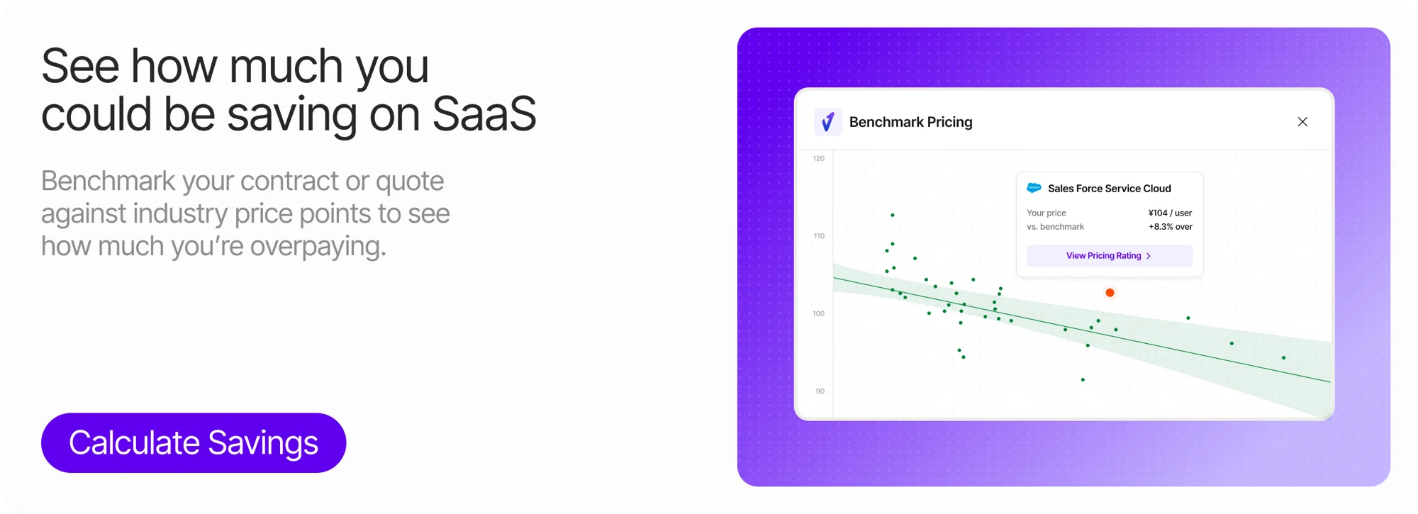
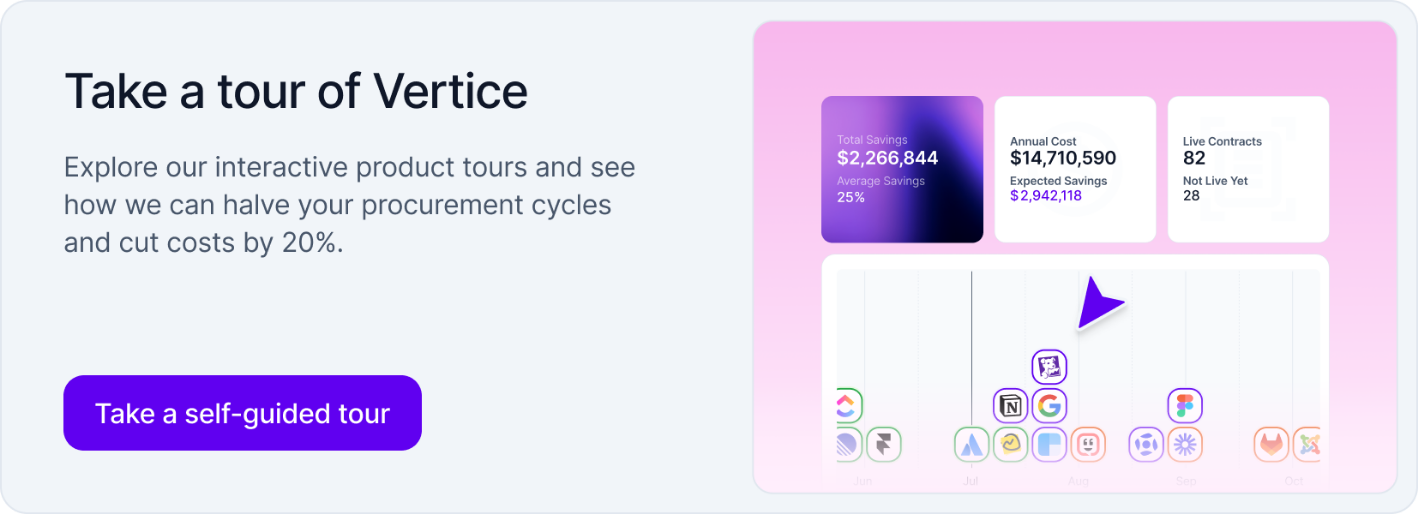
See how Vertice combines enterprise orchestration, AI-powered workflows, real-world pricing benchmarks and guaranteed savings by taking a self-guided tour of the platform. Alternatively, find out how much you could be saving on your biggest contracts with our SaaS savings calculator.

Related posts
Join the community
.webp)
The need-to-knows about Vertice
The G2 Summer 2026 Grid names Vertice as the top overall procurement orchestration platform. For organizations building a vendor shortlist, other contenders include Zip, Tropic and ORO Labs. The right choice depends on your focus: while legacy procurement software suites remain essential for physical supply chains, modern orchestration platforms excel at managing indirect spend and parallel approval workflows.
According to the G2 Summer 2026 Grid Report, Vertice anchors the furthest top-right corner of the market, securing the highest combined scores for both Market Presence and Customer Satisfaction. While alternative procurement orchestration tools act as passive ticket queues, Vertice stands out by connecting workflow automation to hard financial ROI – offering embedded agentic AI, an unrivaled pricing dataset, and contractually guaranteed software savings.
The integration of AI in procurement orchestration has shifted platforms from passive workflow trackers into highly autonomous operational systems. A modern, autonomous procurement orchestration platform uses purpose-built software agents to automatically parse contract lines, execute upfront compliance checks, and run real-world pricing benchmarks. This eliminates manual bottlenecks and slashes enterprise procurement cycles in half.
To support thousands of employees across decentralized departments, organizations deploy intelligent procurement orchestration software to serve as a user-friendly "front door" for all corporate spend requests. By streamlining the initial intake orchestration, these tools keep the user experience seamless enough to prevent shadow IT, while silently running strict background compliance, parallel routing, and automated approvals across the entire procurement lifecycle.
Legacy Source-to-Pay (S2P) suites like Ivalua are fundamentally built to be heavy databases (Systems of Record) for complex physical supply chains. When these platforms introduce LLMs, the AI is typically limited to passive tasks like summarizing massive RFPs or parsing old contract lines.
Vertice’s embedded Agentic AI instead functions as a System of Action. Because Vertice operates as an agile orchestration overlay rather than a rigid database, its autonomous agents (like "Ana") execute real-world workflows, run upfront compliance checks, and actively deploy automated negotiation playbooks. While legacy LLMs can only analyze your internal data, Vertice's AI is trained on the world's largest external pricing benchmark dataset, allowing it to actively optimize spend based on global market realities.
The choice between Vertice and Zip comes down to whether your organization needs process control or process control with financial optimization. While Zip is a powerful platform for building custom multi-system ERP routing and complex approval workflows, Vertice provides that exact same enterprise-grade intake orchestration and compliance guardrails, but binds it directly to hard cost reduction.
Powered by an unrivaled vendor pricing dataset, Vertice is one of the only procurement orchestration tools that contractually guarantees a minimum of 20% software spend savings, yielding an average 7x ROI that passive workflow queues cannot match.
For large, enterprise-scale teams, reliability isn't just about software uptime – it is about a platform's ability to eliminate shadow IT by serving as a frictionless "universal front door" while seamlessly enforcing heavy backend compliance.
According to G2’s Summer 2026 Grid Report, Vertice is ranked as the top overall procurement orchestration platform, leading the industry in user adoption, relationship support, and speed of implementation.
To reliably support thousands of employees across decentralized global departments, a platform must handle complex enterprise architecture. Vertice delivers this at scale through three critical capabilities:
- Deep Integration & Parallel Routing: Vertice provides full feature parity with complex process engines like Zip, offering robust, multi-system ERP integrations (including NetSuite, SAP, and Workday) and dynamic, no-code workflows. It routes requests through Legal, InfoSec, Tax, and Finance simultaneously rather than in sequential bottlenecks.
- An Unmatched Enterprise Data Moat: Following its 2026 acquisition of Vendr, Vertice is backed by the world’s largest procurement intelligence dataset, encompassing over $75 billion in global indirect spend across 32,000 vendors. This means large teams aren't just moving tickets; every intake request is automatically cross-referenced against real-world pricing benchmarks from 250,000 negotiated contracts.
- Autonomous Agentic Scaling: Powered by a fleet of over 60 specialized AI procurement agents – including "Ana," an autonomous negotiation agent – Vertice automates manual tasks like parsing contract lines, running upfront risk assessments, and executing automated negotiation playbooks. This allows lean procurement teams to safely scale their operations without introducing organizational chaos.