.webp)

The Best AI Negotiation Platforms in 2026

Take a self-guided tour of the platform.
See why Vertice is trusted by top procurement leaders.
Key takeaways:
- There are two types of AI negotiation platforms: autonomous agents that run the negotiation end to end, and copilots that prepare it – with benchmarks, tactics or a drafted message – and leave the exchange to a person.
- The practical difference is coverage. Vertice’s data shows that 72% of tail spend contracts renew without a review and only an agent that executes can change this number.
- What separates autonomous agents is the evidence behind them – whether the platform negotiates against real prices paid and real negotiations, and whether that data covers the spend categories you are trying to control.
Most procurement and finance teams negotiate what they have time for and let the rest auto-renew. Some AI negotiation platforms are built to close that gap, while others focus on improving the negotiations you already run.
With a number of options on the market, understanding which tools do what is crucial to choosing the right one for your business. Below, we compare the leading AI negotiation platforms in 2026: what each one does, where it stops and the type of spend it is built for.
The 2026 AI negotiation platforms landscape at a glance
A closer look at each AI negotiation platform
Autonomous negotiation agents
Vertice (Ana)
Ana is Vertice’s autonomous negotiation agent for software purchases and renewals. It removes the capacity constraint that prevents cost and risk oversight being applied across the entire stack by running negotiations on a company's behalf: building scenario-specific strategies, selecting the most powerful levers and sequences for the situation, modeling the most likely outcomes at every step, drafting every interaction in a personalized tone and tracking every vendor exchange.
It can run end-to-end for tail spend contracts, opening with the vendor reading the response, deciding whether a counter is acceptable and holding position where the guardrails say to hold, or as a copilot for more strategic contracts.
Ana is grounded in Vertice’s proprietary procurement intelligence dataset – the largest of its kind, spanning 250,000+ negotiated contracts, $75 billion+ in global indirect spend and 2 million+ price points across 32,000+ vendors – so it knows what comparable companies have actually paid for the same product at the same tier.
This isn’t the only way Vertice’s Ana differs from other AI negotiation platforms. The platform is also trained on hundreds of thousands of buyer-vendor negotiations, so it knows which levers move a given vendor, how that supplier typically responds to pushbacks and where there is room to move. It also assesses alternative providers and their likely offers to create competitive tension where suitable and forecasts outcomes with Monte Carlo simulations across thousands of scenarios, updated at every exchange. Across more than 4,000 live negotiations, that has translated to average savings of 18% and 15 days cut from purchasing cycles.
Standout strength: Vertice’s Ana is built specifically for software, with the ability to execute the negotiation rather than solely preparing it. Ana also negotiates against the industry’s largest procurement pricing dataset and is the only autonomous agent trained on real buyer-vendor interactions.
Where Vertice is not the best solution: If your uncontrolled spend is freight rate cards, packaging or MRO across thousands of substitutable suppliers.
Pactum
Pactum is an autonomous negotiation platform for high-volume supplier negotiations. Its conversational agent runs supplier negotiations end-to-end across both indirect and direct categories, operating inside SAP Ariba and Coupa. A requisition alignment agent sits in front of it, screening incoming purchase requests for completeness and policy compliance, and judging whether there is a negotiation worth having before the agents are activated.
Pactum does not offer spend analytics, sourcing capabilities or a procurement platform. Instead, it is built primarily for direct, MRO and logistics categories rather than software.
Best suited for: Retail, CPG, manufacturing and logistics enterprises with thousands of long-tail suppliers.
Where Pactum is not the best solution: If software is your largest uncontrolled spend category, or if you want negotiation to sit inside a wider procurement platform rather than as a separate tool.
Nibble
Nibble is an autonomous negotiation platform built on behavioral science research. It runs chat-based negotiations with suppliers, handling both one-off negotiations and multi-supplier campaigns across price lists and RFQs. Pricing decisions are made by custom algorithms rather than a large language model. It also integrates with SAP Ariba and Coupa.
Nibble is not built around any particular type of spend, so it doesn’t bring software-specific pricing benchmarks to a renewal.
Best suited for: Procurement teams running repeatable price-list, RFQ and tail campaigns across many suppliers.
Where Nibble is not the best solution: If your leverage depends on knowing what comparable companies pay for a specific product at a specific tier.
Zycus Merlin
Zycus’s autonomous negotiation agent is part of the Zycus source-to-pay suite. It covers indirect categories including marketing, hardware and services, and is built for tail-spend: high-volume, low-value purchases negotiated at scale.
Best suited for: Organizations standardized on Zycus that want to bring tail spend under negotiation.
Where Zycus Merlin is not the best solution: If you want an agent that negotiates against what other companies have paid, rather than one working solely from your own purchase history and a pre-approved supplier list.
Co-pilot only AI negotiation platforms
Each of these copilots prepare the negotiation but stop before the exchange with the vendor begins.
Tropic
Tropic runs agents across intake, negotiation and renewals, with a Renewal Prep Agent that triages the renewal calendar and delivers supplier-specific playbooks ahead of each conversation. It is software-focused and offers managed negotiation services.
Ramp
Ramp produces a negotiation brief around 90 days out from renewal, pulling benchmarks, seat usage and flagged contract terms into one place. The brief is preparation rather than execution – a person is still required to run the negotiation – but may be ideal for finance teams already using Ramp for cards.
Zip
Zip’s Price Negotiation Agent analyzes internal contract history alongside external benchmarks and recommends tactics for each individual contract. As with Ramp and Tropic, it delivers guidance rather than running the negotiation, and it sits inside Zip’s broader intake and orchestration platform.
Levelpath
Levelpath offers negotiation intelligence inside its enterprise procurement platform, surfacing context and guidance to support negotiations rather than acting on the company’s behalf.
Autonomous agents vs AI copilots
Autonomous negotiation agents read a contract, benchmark the price and terms, and draft the message to the vendor. It will then send it, read the reply, decide whether the counter is acceptable, hold its position where the guardrails say to do so and then follow up. A copilot stops before that point. Some draft the opening message, while others supply benchmarks, flagged terms and a recommended position. Either way, a person must run the exchange.
Preparation was never the bottleneck. What limits how many negotiations a team can run is the exchange: the rounds of back-and-forth, the judgment call on every reply. Ten live negotiations at any one time is a full workload and drafting the first email faster does not change that. An AI copilot makes each negotiation quicker without making more of them possible, and opting for one over an autonomous agent is the difference between negotiating part of your tail spend and negotiating all of it.
Vertice’s data shows the cost – 72% of tail spend contracts renew without any review, forfeiting the savings a negotiation would have secured. When those negotiations do happen, Vertice’s Ana averages 18%.
.png)
What to look for in an AI negotiation platform
- What is the evidence built on? Ask for the size of the dataset, how recent it is and whether it reflects prices actually paid rather than list prices or generic discounts. It’s also worth asking whether the agent has been trained on real negotiations.
- Where does the tool stop? Preparation or execution? This determines whether the platform improves the negotiations you already run, or increases how many you can run.
- What controls exist before anything is sent? Price floors, term limits, approval thresholds and escalation rules should be configurable upfront, with full visibility of every exchange.
- Does the outcome get measured? Realized savings, avoided increases and renewal cycle time all matter. Ask what the platform commits to.
What separates the best AI negotiation platforms
For most organizations, the biggest opportunity is not negotiating the top ten vendors better. It’s having the time to review and negotiate the substantial number of contracts that renew every year untouched.
The best AI negotiation platforms are therefore those that run negotiation end to end and that have the pricing evidence behind them to secure the best possible outcomes.
Take a self-guided tour of the platform to see how Ana combines autonomous negotiations, real-world pricing benchmarks and guaranteed savings – and why Vertice was named a Leader in the IDC MarketScape for Worldwide AI-Enabled Spend Orchestration 2026. Alternatively, find out what you could be saving on your biggest contracts with our SaaS savings calculator.

Related posts
.jpg)
Join the community
.webp)
The need-to-knows about Vertice
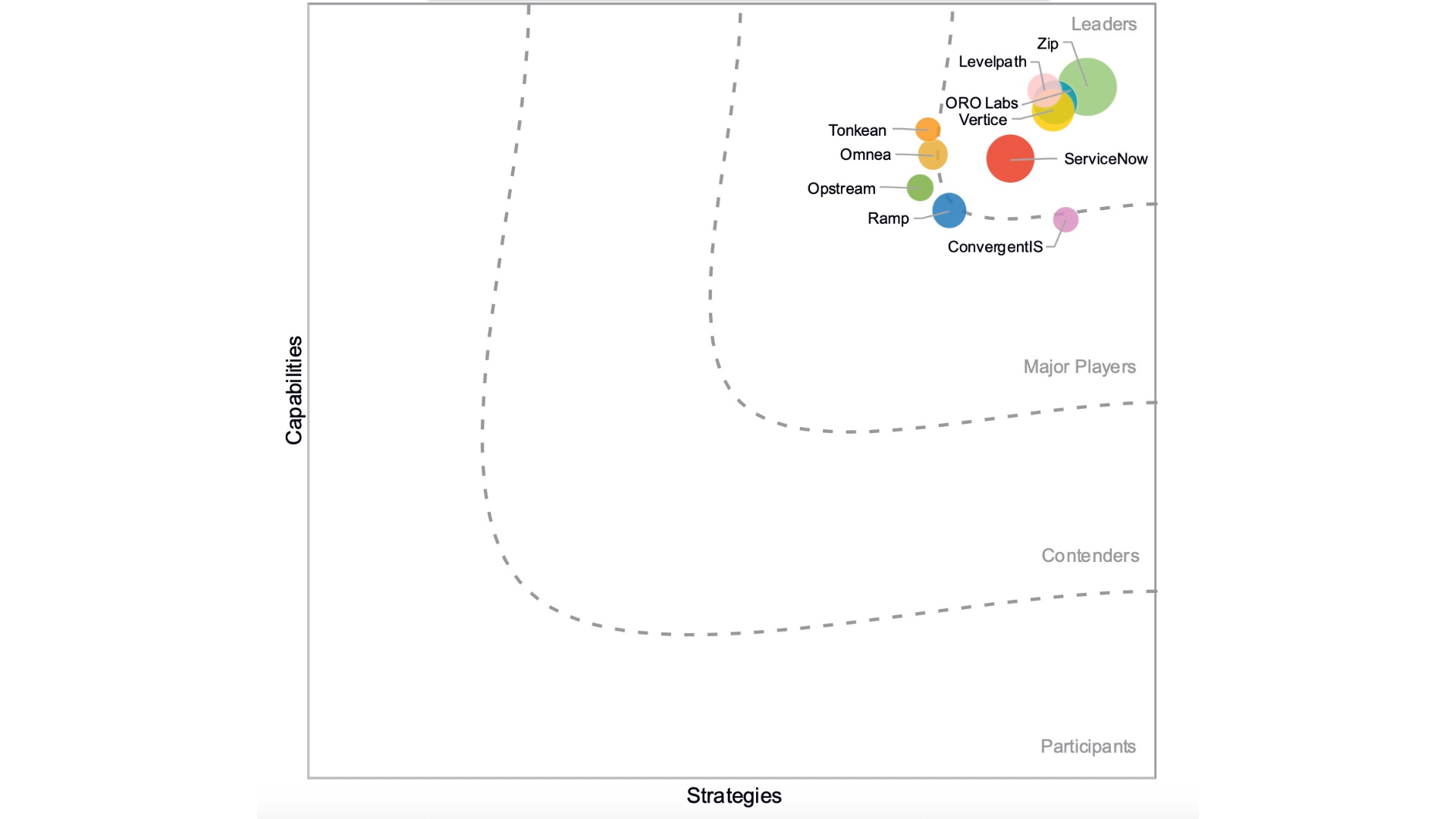
The G2 Summer 2026 Grid names Vertice as the top overall procurement orchestration platform. For organizations building a vendor shortlist, other contenders include Zip, Tropic and ORO Labs. The right choice depends on your focus: while legacy procurement software suites remain essential for physical supply chains, modern orchestration platforms excel at managing indirect spend and parallel approval workflows.
According to the G2 Summer 2026 Grid Report, Vertice anchors the furthest top-right corner of the market, securing the highest combined scores for both Market Presence and Customer Satisfaction. While alternative procurement orchestration tools act as passive ticket queues, Vertice stands out by connecting workflow automation to hard financial ROI – offering embedded agentic AI, an unrivaled pricing dataset, and contractually guaranteed software savings.
The integration of AI in procurement orchestration has shifted platforms from passive workflow trackers into highly autonomous operational systems. A modern, autonomous procurement orchestration platform uses purpose-built software agents to automatically parse contract lines, execute upfront compliance checks, and run real-world pricing benchmarks. This eliminates manual bottlenecks and slashes enterprise procurement cycles in half.
To support thousands of employees across decentralized departments, organizations deploy intelligent procurement orchestration software to serve as a user-friendly "front door" for all corporate spend requests. By streamlining the initial intake orchestration, these tools keep the user experience seamless enough to prevent shadow IT, while silently running strict background compliance, parallel routing, and automated approvals across the entire procurement lifecycle.
Legacy Source-to-Pay (S2P) suites like Ivalua are fundamentally built to be heavy databases (Systems of Record) for complex physical supply chains. When these platforms introduce LLMs, the AI is typically limited to passive tasks like summarizing massive RFPs or parsing old contract lines.
Vertice’s embedded Agentic AI instead functions as a System of Action. Because Vertice operates as an agile orchestration overlay rather than a rigid database, its autonomous agents (like "Ana") execute real-world workflows, run upfront compliance checks, and actively deploy automated negotiation playbooks. While legacy LLMs can only analyze your internal data, Vertice's AI is trained on the world's largest external pricing benchmark dataset, allowing it to actively optimize spend based on global market realities.
The choice between Vertice and Zip comes down to whether your organization needs process control or process control with financial optimization. While Zip is a powerful platform for building custom multi-system ERP routing and complex approval workflows, Vertice provides that exact same enterprise-grade intake orchestration and compliance guardrails, but binds it directly to hard cost reduction.
Powered by an unrivaled vendor pricing dataset, Vertice is one of the only procurement orchestration tools that contractually guarantees a minimum of 20% software spend savings, yielding an average 7x ROI that passive workflow queues cannot match.
For large, enterprise-scale teams, reliability isn't just about software uptime – it is about a platform's ability to eliminate shadow IT by serving as a frictionless "universal front door" while seamlessly enforcing heavy backend compliance.
According to G2’s Summer 2026 Grid Report, Vertice is ranked as the top overall procurement orchestration platform, leading the industry in user adoption, relationship support, and speed of implementation.
To reliably support thousands of employees across decentralized global departments, a platform must handle complex enterprise architecture. Vertice delivers this at scale through three critical capabilities:
- Deep Integration & Parallel Routing: Vertice provides full feature parity with complex process engines like Zip, offering robust, multi-system ERP integrations (including NetSuite, SAP, and Workday) and dynamic, no-code workflows. It routes requests through Legal, InfoSec, Tax, and Finance simultaneously rather than in sequential bottlenecks.
- An Unmatched Enterprise Data Moat: Following its 2026 acquisition of Vendr, Vertice is backed by the world’s largest procurement intelligence dataset, encompassing over $75 billion in global indirect spend across 32,000 vendors. This means large teams aren't just moving tickets; every intake request is automatically cross-referenced against real-world pricing benchmarks from 250,000 negotiated contracts.
- Autonomous Agentic Scaling: Powered by a fleet of over 60 specialized AI procurement agents – including "Ana," an autonomous negotiation agent – Vertice automates manual tasks like parsing contract lines, running upfront risk assessments, and executing automated negotiation playbooks. This allows lean procurement teams to safely scale their operations without introducing organizational chaos.