



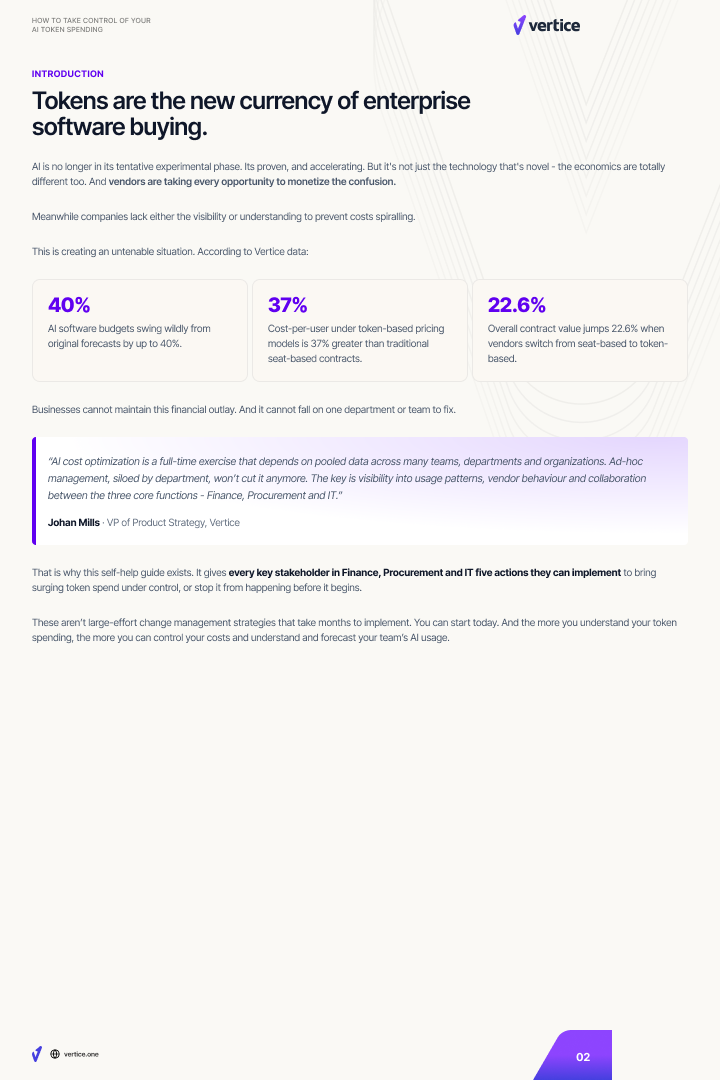
Software vendors are switching their payment models away from seat/user-based pricing to consumption-based as more AI capabilities are added and various, selectable AI models that conduct tasks of different complexity are rolled out.
These new payment models better reflect the costs born by the vendor - but are they better for the customer too?
This report is an in-depth investigation into the growing trend towards consumption-based pricing and its impacts.
Spoiler - software spend is about to get 40% more variable.
Seat-based / user-based pricing - cost is determined by the number of individual users who have access to it.
Consumption / usage-based pricing - cost is determined by how a product is used, e.g per credit or token used to perform an action.
Hybrid pricing - customers are charged in part by the number of seats, with usage rates charged on top.
Finance teams have always struggled with accurately forecasting seat-based pricing models, with both overspend on unused licences and unexpected charges for overuse being far too common.
Only paying for what you use therefore becomes a very attractive proposition.
Pricing model adoption trends & predictions
.avif)
Since June 2024, the seat-based payment model has seen its dominance drop dramatically. Only 35% of companies now use purely seat-based payment models, a decrease in share of 24% in only two years.
As expected, pure consumption-based pricing models have increased over time - growing by 10% in the same time period.
Yet hybrid models have seen the biggest surge in popularity, growing by nearly 35% - though still the smallest in terms of pure adoption numbers.
Why?
Hybrid pricing models enable a vendor to monetize additional AI features to their SaaS platforms while maintaining payment structures that better fit traditional software tools, or that their existing customer base has grown used to.
Plus, they offer customers the security of the old while testing the new - enabling them to assess the efficacy of a consumption-based pricing model without throwing out their forecasting models.
But as more AI-native vendors enter the market, and established SaaS vendors make AI more central to their platforms, it will gradually become the norm.
But the bottom line is that consumption-based pricing extracts more revenue.
Impact of switching from user-based to consumption-based
(Top 10 ACV increases for established SaaS vendors - excl. AI-Native tools)










In the past 24 months, 23% of software vendors have changed their dominant pricing model - driven by the introduction of new AI features / tools to their product sets.
The top vendors that have switched their primary pricing model to consumption-based this year have increased their ACV by over 50%.
It may be marketed as a better financial choice with more control for buyers, but in reality this is a vendor-enforced switch to capitalize on AI hype and premiums.
The headline to buyers is that the current data shows consumption or hybrid pricing models cost businesses more than their previous models - up to 22.6% more.
It may feel like better cost control, but it's actually simply more cost.
Average increase in contract cost (when switching from seat-based)
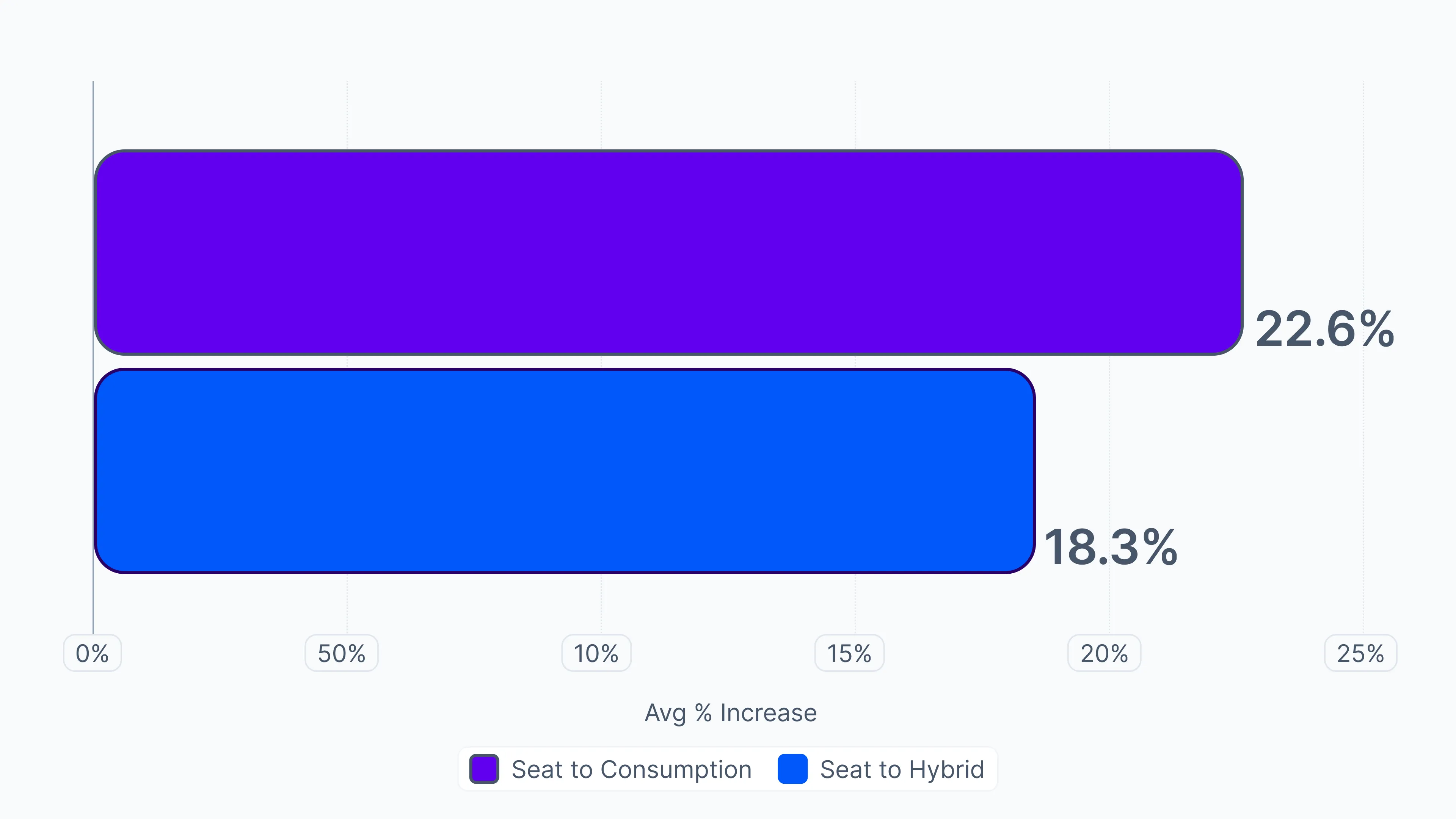
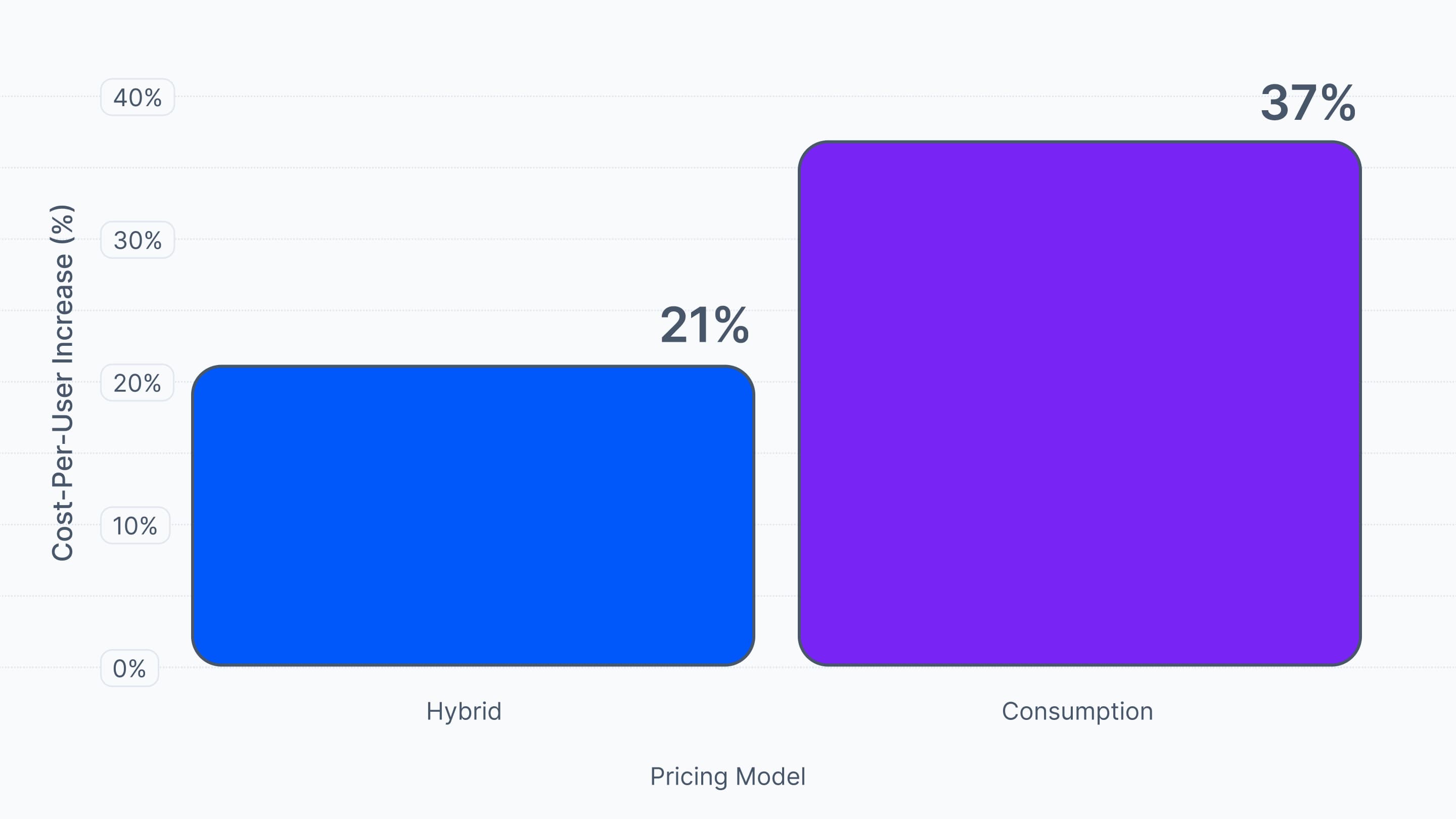
Ironically, when switching away from a user-focused pricing model to consumption-based, the cost-per-user actually increases by up to 37% per user.
While seat-based pricing is a flat 'all-you-can-eat' model, usage-based models charge for every action. This leads to higher costs - especially when 'power users' are testing new features, and typical users are being encouraged to experiment more.
Average cost per user increase (compared to seat-based pricing)
With a higher cost-per-user, the need for contractual discounts is more pressing. However, achieving discounts in the new pricing models is far trickier.
Average discount achieved per pricing model
Vendors are less willing to grant concessions because:
This backs buyers into a corner, as no business wants to reduce the usage of their tech stack in order to cut costs or meet a financial redline.
Uber’s CTO admitted recently that the company burned through its entire 2026 AI budget in 4 months.
Why? Developers chewing through tokens, experimenting with AI tools and functions.
With such high spend linked to necessary AI experimentation, it's not in the vendor’s interest to offer significant discounts - why kill the cash cow?
Usage rates are calculated by how many tokens (or 'credits') are used to perform tasks.
Every task has a cost - whether recalling data, an API call, or an LLM analyzing text.
While each token costs a microscopic amount, it doesn't take long for it to all add up.
According to Nexthink, one AI user will perform up to 50 tasks a day - knowingly or not. For those rolling out AI across their entire company, and expecting high levels of adoption, costs can explode.
It's the growing practice of counting token usage as a measure of productivity.
And it's fairly controversial - with many saying it just incentivizes unproductive work over true business gains.
But with many departments being pressured to show that they are using AI, highlighting spend is one of the easiest ways to do so - despite it arguably being fiscally inefficient.
Until now, we’ve considered “consumption” as employees' deliberate use. But what about:
These unknown, shadow costs can significantly increase platform usage without you even knowing.
Idle consumption accounts for 34.8% of total consumption
Types of idle consumption as %'s of total consumption
.avif)
And this will only increase. According to Gartner, by 2028 over half of all enterprises will move from 'AI as a copilot' (human-prompted AI) to agentic AI (autonomous task execution).
Vendors are unwilling to discount due to their “you only pay for what you use” argument. Which means many businesses end up not able to afford larger usage caps.
Which means overage charges are almost inevitable.
% of businesses hitting overages (per pricing model)
.avif)
The need to purchase extra tokens becomes a significant, unpredicted additional cost in consumption-based spending - far above other overages such as extra support costs or data allowances.
Accurately predicting token usage relies on having clear visibility of internal usage rates - something businesses generally lack.
Extra tokens as a % of total overage spend (per pricing model)
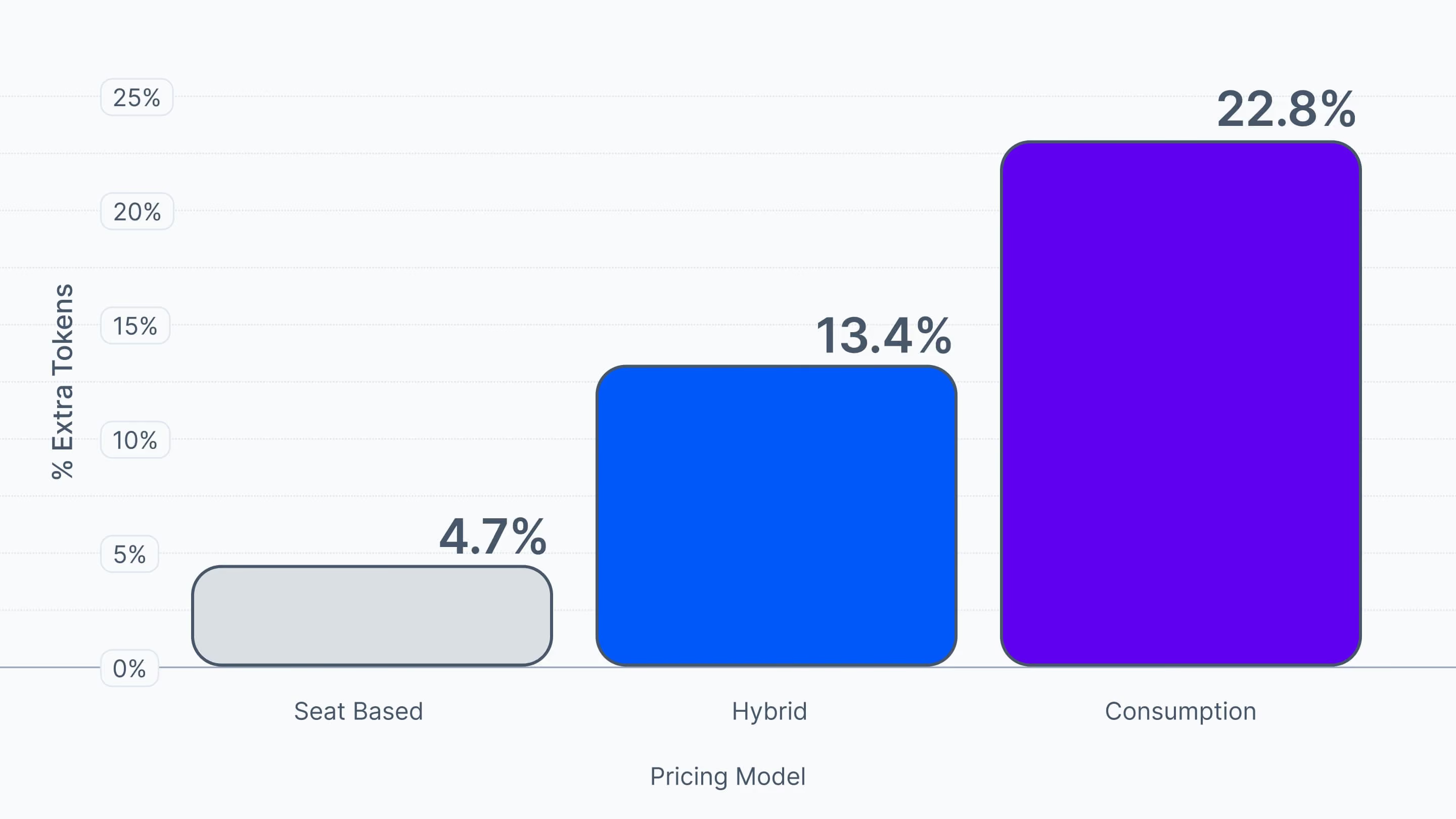
Consumption-based pricing models don’t just increase costs - they completely wreck accurate financial tracking and forecasting.
On average, costs can vary on a balance sheet by 4% for user-priced software YoY.
This becomes an intolerable 38% for consumption-priced software.
Average monthly budget variance rate (per pricing model)
.avif)
And what’s worse - it takes less than 6 months for consumption-priced contracts to diverge from their original forecasted spend by more than 15%.
This isn’t control - this is chaos.
Vendors will make these new pricing models the default. You need to start mitigating their impact now.
Current procurement strategies won’t work. The answer lies in new negotiation strategies, more data, and new processes.
But first... understand your ‘cost per task’:
This is all crucial foundational information that will feed these four tactics for mitigating runaway consumption spend:
- Set overage limits and enforce notifications from the vendor when close.
- Reviewing contracts is different now - new T&Cs that didn't exist in previous SaaS contracts hold new risks. Use AI to identify and flag key contract terms that don’t align to any of your policies and require extra scrutiny.
- Negotiate tiered pricing based on token volume.
Most buyers lack the intel to know if their usage (and overage) rates are competitive, or whether usage is better measured by API call, per compute hour, or per active user.
Accurate, real-time pricing benchmarks have been notoriously hard to secure for established vendors on seat-based models - it's even harder now with new models and new AI-native vendors.
But they do exist. Those negotiating with these vendors dozens of times a week have crucial up-to-date intelligence on sales tactics, priorities and pricing benchmarks.
Customize your intake forms to check for consumption-based pricing models, and use the answers to trigger new processes and checks within the approval workflows that ensure the inital contract is suitable, and that usage is tracked:
- What tasks will the tool be used for, who by, and how often?
- What triggers overages?
- Who owns usage governance post-signature?
Usage patterns drift throughout the life of a contract.
A team onboards a tool for one use case, it gets adopted laterally, consumption climbs, and by the time the renewal arrives the organisation is locked into a much higher tier than originally scoped.
This continuous monitoring must become a routine part of vendor management - and your procurement platform needs to be able to help you.
Not having these tactics isn't a policy problem - it's a visibility problem.
Most finance and procurement teams lack a single viewpoint that encompasses all their providers. Without such, it's extremely difficult to act effectively.
And even if you do have that, keeping up with how quickly consumption-based pricing can accelerate costs is nearly impossible without real-time usage tracking with linked spend and commitment information
Vertice's AI Cost Optimization tool is the dedicated answer to AI's uncontrollable consumption-based pricing.
Implementing an AI-driven cost optimization tool to fight AI-driven consumption-based pricing seems meta, but by doing so means organizations can gain total transparency into their multi-modal environments. And this scales as you do, meaning you're never left behind as you adopt more AI to power your business further.
Take control of your AI spend.
Even when changing pricing models seem to causing financial havoc.
See how Vertice AI Cost Optimization tracks spend, usage and commitments across every provider in a single unified view.


.png)
.png)

.png)
.webp)