
Supplier compliance rates
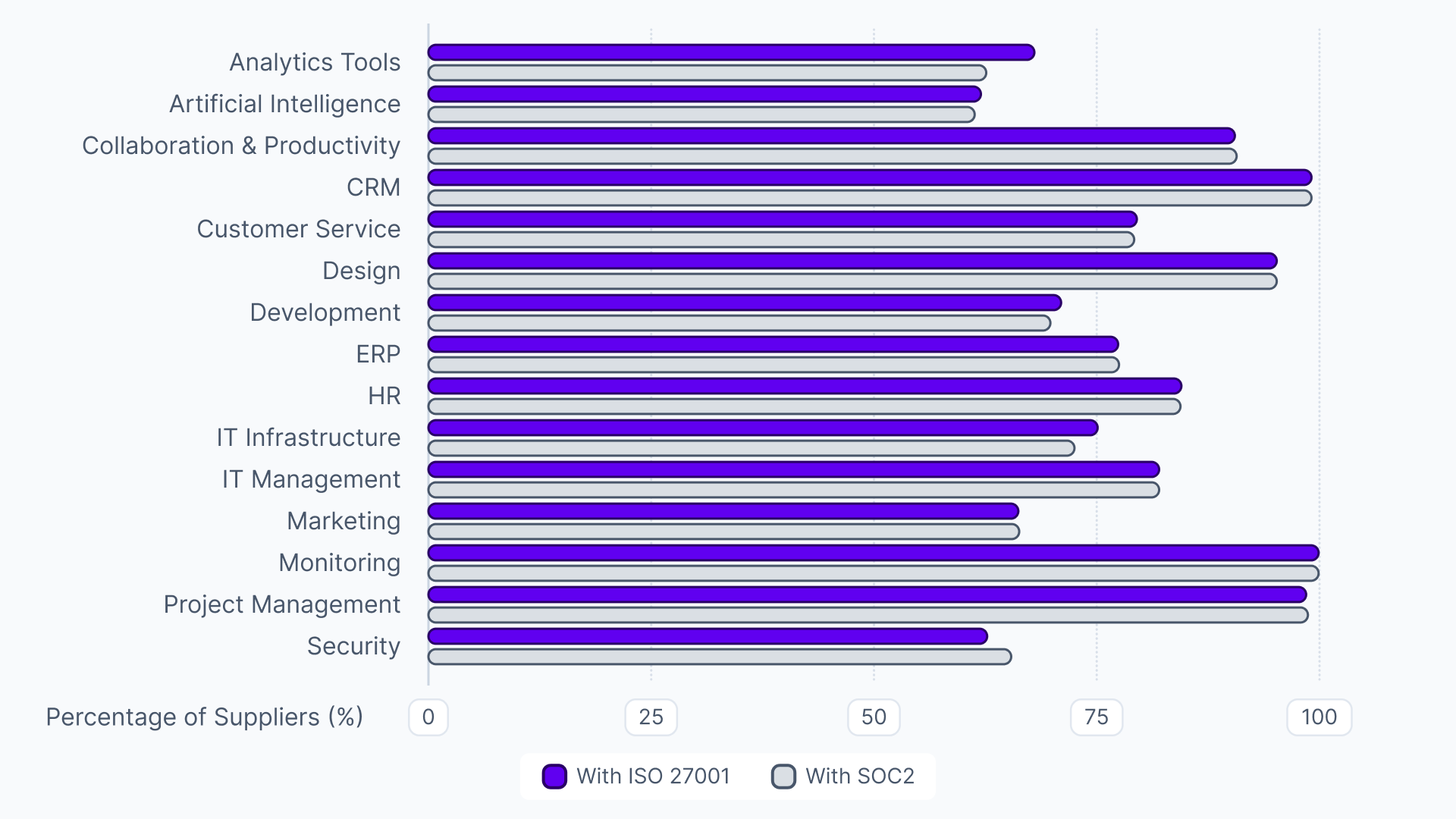

What percentage of SaaS vendors hold ISO 27001 and SOC2 certification? 2026 compliance benchmarks
Compliance certification varies dramatically by category – and not always in the direction you'd expect. Monitoring and CRM vendors are almost universally certified, while Artificial Intelligence and, notably, Security itself rank among the lowest-certified categories tracked.
- The "Security paradox": Security vendors themselves rank among the least-certified categories tracked, at just 62.7% (ISO 27001) and 65.4% (SOC2). For a category built around protecting sensitive data, this gap between what Security tools are meant to do and their own certification rates is a meaningful blind spot for buyers who assume the category name implies the vendor is automatically well-vetted.
- Artificial Intelligence has the lowest certification rate of any category: At 62.0% (ISO 27001) and 61.3% (SOC2), AI vendors are the least likely to hold either certification, consistent with a market still dominated by newer, fast-growing companies that haven't yet built out formal compliance programs.
- "System of record" categories are almost universally certified: Monitoring (99.9%), CRM (99.1%) and Project Management (98.5-98.7%) show near-total certification, reflecting the scrutiny that comes with holding large volumes of sensitive operational and customer data.
- ISO 27001 and SOC2 rates track closely within most categories: Vendors that hold one certification are highly likely to hold the other across nearly every category, with IT Infrastructure and Analytics Tools showing the largest gaps between the two certifications.
Which types of SaaS vendors are actually the most compliant?
Security vendors, the category most people would expect to be the most rigorously vetted, are actually among the least certified in the entire dataset. Artificial Intelligence's low certification rate is less surprising, given how many AI vendors are newer companies that haven't yet built out formal compliance programs, but Security's position on this list should give any buyer pause.
A procurement team that skips verification because of the perception that it will be secure is operating on an assumption the data directly contradicts. The cost of getting this wrong isn't abstract: onboarding an uncertified vendor into a workflow that touches sensitive data can mean inheriting real security and compliance risk, often without anyone noticing until an audit, a breach or a customer contract review forces the question.
This is exactly why SaaS procurement software with robust third-party risk management (TPRM) capabilities matters, and why verification can't stop at onboarding. Certifications aren't permanent: a vendor can lose SOC2 accreditation after a failed audit, let ISO 27001 lapse on renewal or change its risk profile entirely after an acquisition or infrastructure migration, none of which a one-time check at signing would ever catch.
Supplier risk management software verifies certification status directly during vendor onboarding rather than relying on category assumptions and continuous vendor monitoring keeps checking after the contract is signed, flagging any change in a vendor's compliance status for the lifetime of the relationship rather than treating a single point-in-time check as sufficient.
Data source: These insights are derived from over $75bn of global processed spend managed by Vertice in 2026.
Are you overpaying for SaaS?
Are you overpaying for SaaS?

Related insights

Join the community
.webp)
The need-to-knows about Vertice
In 2026, 45% of SaaS vendors still fail to meet the dual-certification benchmark (holding both ISO 27001 and SOC2). This creates a significant risk profile during procurement, particularly in categories like Sales Tools, where only 41% of suppliers are dual-certified. Vertice’s Native TPRM addresses this by integrating security vetting directly into the start of the buying process rather than treating it as a final hurdle.
By utilizing Agentic AI and third-party risk management (TPRM) to monitor vendor compliance in real-time, Vertice identifies these "Security Laggards" during the intake phase. This automated orchestration provides Diligence Insights upfront, allowing your team to reduce the manual 14-day Legal bottleneck often seen with enterprises. By moving risk assessments to the beginning of the journey, Vertice ensures that 100% of vendor decisions are pre-vetted against your compliance guardrails.