
Procurement approval times by function
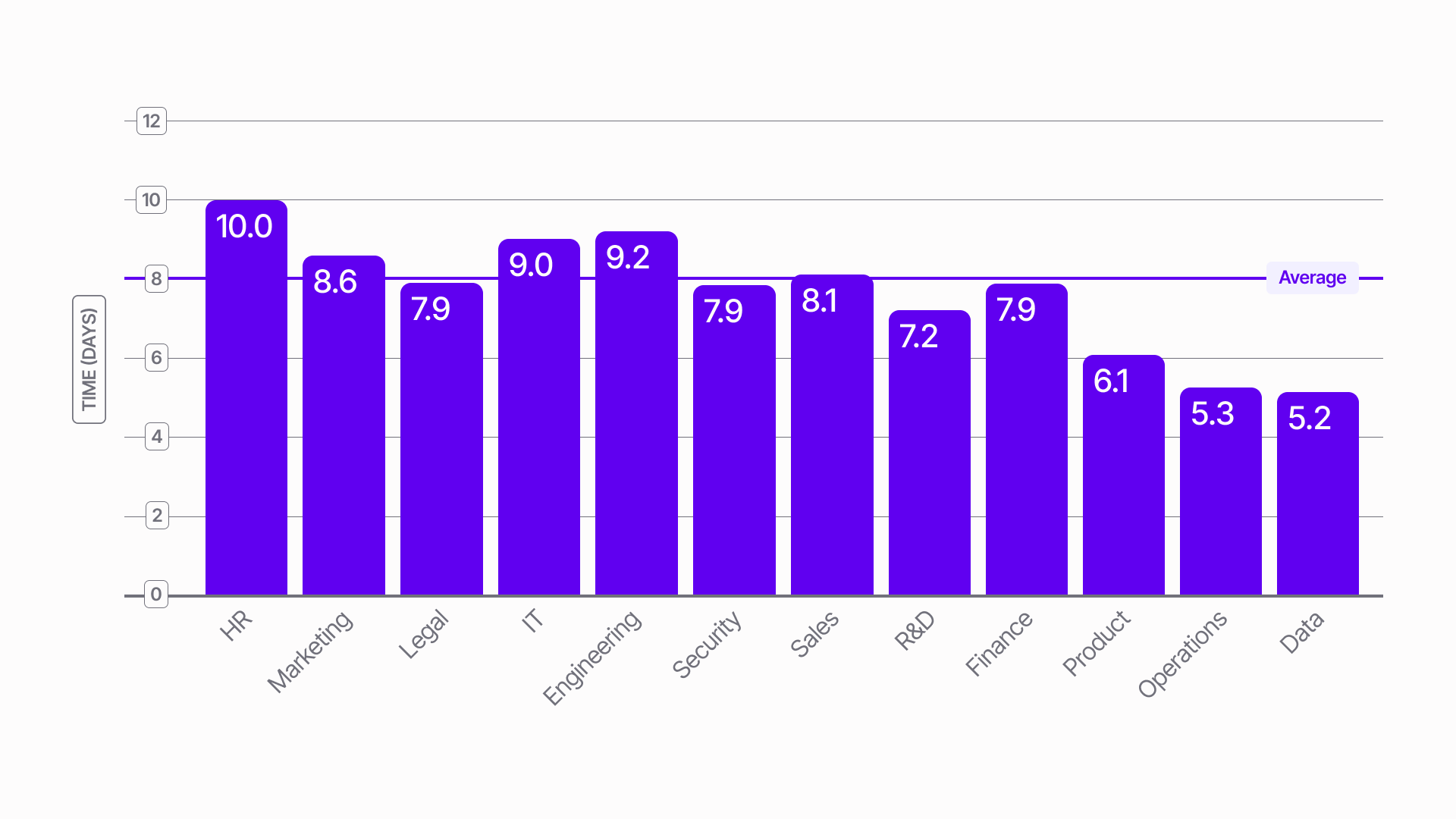

2026 benchmarks: Which types of software requests face the most approval friction?
After edging up across the board in Q2 2026, approval times fell in Q3 for most software categories. The average across all functions dropped from around 9.1 days in Q2 to 7.7 days in Q3, below the Q1 average of roughly 8.5 days. Nine of the twelve categories got faster, and the categories that slowed most in Q2 showed some of the sharpest recoveries.
Operations software saw the biggest improvement, with approval times falling 35% from 8.2 days to 5.3 days. Finance followed, down 28% from 11 days to 7.9 days, and IT dropped 25% from 12 days to 9 days. Marketing and Legal each fell around 22%, to 8.6 and 7.9 days respectively. HR remains the slowest category to approve at 10 days, but even here times fell 19% from 12.3 days last quarter.
The exceptions were Data, Sales and Security. Data software is still among the fastest categories to approve, but its approval time rose 39% from 3.7 days to 5.2 days, the largest increase of any category. Sales approvals slowed 16% from 7 days to 8.1 days, reversing last quarter's improvement, while Security was essentially flat at 7.9 days.
Why the gap between SaaS categories matters
The gap between the fastest category to approve (Data) and the slowest (HR) has narrowed to 4.9 days, down from 8.6 days last quarter. Operations is now close behind Data at 5.3 days. This convergence suggests approval workflows are becoming more consistent across categories. Friction is being shaped less by which team is requesting the software, and more by common factors such as the number of stakeholders involved, the sensitivity of the data the software touches and the governance layers a purchase has to pass through.
Still, internal approvals are only one component of the end-to-end procurement cycle, which is currently averaging 77 days. HR and Engineering (9.2 days) still sit well above the average. Reducing variability at this stage, particularly for these higher-friction categories, would help streamline workflows and support overall cycle time reduction.
Keeping approvals fast and consistent requires structured approval workflows that route requests to the right stakeholders early and surface diligence insights upfront. Procurement orchestration software enables faster, more consistent approvals while maintaining rigorous risk and governance controls.
Data source: These insights are derived from over $75bn of global processed spend managed by Vertice in 2026. Q3 2026 figures are preliminary and based on data processed to date.
Are you overpaying for SaaS?
Are you overpaying for SaaS?
Related materials

Related insights

Join the community

The need-to-knows about Vertice
HR software currently has the longest approval time at 10 days, followed by Engineering (9.2 days), IT (9 days), Marketing (8.6 days) and Sales (8.1 days), as of Q3 2026. Data software is the fastest to approve at 5.2 days, with Operations close behind at 5.3 days. The average across all functions fell from around 9.1 days in Q2 to 7.7 days in Q3.
Approval time differences generally come down to how many stakeholders a request needs to pass through, how sensitive the data involved is and how mature the governance process is for that category. Categories like HR and Legal often require additional data privacy or compliance review, while categories like Data or Operations tools may follow a more streamlined path. The gap is narrowing, though: the difference between the fastest and slowest categories fell from 8.6 days in Q2 to 4.9 days in Q3 2026. Procurement orchestration software can help standardize these workflows so approval time depends less on which category a request falls into.