.webp)

The 9 Best Procurement Software Platforms for 2026



What is the best procurement software for managing indirect spend in 2026? As the Intake-to-Procure (I2P) market is projected to grow 15% by 2030, the focus has shifted. It’s no longer just about processing payments; it’s about intelligently orchestrating the entire journey from intake to realized savings.
To help organizations navigate this shift, Lionfish Tech Advisors has released their 2026 Evaluation of Intake-to-Procure Platforms. In this independent report, Vertice was recognized as a category leader, cited for its ability to unify complex workflows with actionable market intelligence
We’ve distilled the report’s key findings to bring you this definitive list of the 9 best procurement software platforms. Whether you are focused on process efficiency, risk mitigation or capturing maximum value from your I2P journey, these are the top-rated solutions for 2026.
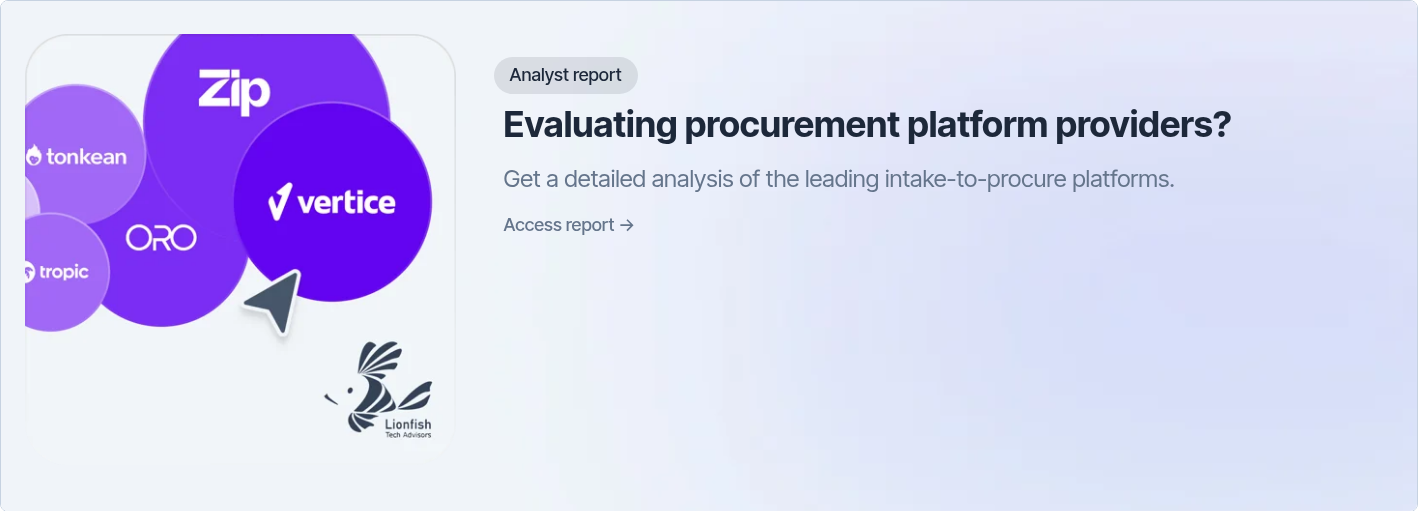
A list of the top procurement software platforms (I2P) in 2026
1. Vertice
Vertice is positioned as the category front-runner because it addresses the one thing many other intake-to-procure tools often miss: actionable intelligence.
While many platforms focus on moving a request from point A to point B, Vertice ensures that the request is informed by market reality and results in a realized financial outcome.
Not only that, but the platform also combines AI-powered conversational intake and customizable workflows with benchmarking data and a service proposition that guarantees savings.
What makes Vertice different?
Vertice unifies intelligent orchestration with independent, real-time pricing benchmarks from a proprietary database of 32,000+ global suppliers, peer comparison data and vendor intelligence. This ensures that every stakeholder has the necessary context to make informed decisions before a contract is signed.
What are Vertice’s strengths?
- AI-driven procurement: Vertice’s Agentic AI, trained on 32K+ vendor benchmarks, 35K+ contracts and 1M+ human vendor interactions, powers 70+ procurement agents and transforms the intake process into a strategic value generator.
- Embedded Third-Party Risk Management (TPRM): Vertice features a proprietary TPRM solution with continuous monitoring of vendor profiles and risk ratings. This enables risk-based routing embedded directly in workflows, ensuring high-risk vendors are identified before contracts are signed
- Realized outcomes: Vertice doesn’t just drive efficiency gains such as by halving procurement cycles, it also drives actual cost reductions guaranteeing bottom-line impact.
- Global orchestration: With a presence across the US, EMEA and APAC, Vertice provides high-quality data and support for multinational procurement teams.
The types of companies Vertice is best suited for:
Vertice is best suited for mid-market and enterprise organizations seeking intelligent, AI-driven procurement orchestration, measurable cost savings and alignment of procurement decisions with broader financial outcomes.

2. Zip
Zip is a good choice for organizations seeking operational speed and a wide breadth of features. They have successfully expanded their scope beyond intake into a broader payment ecosystem.
What are Zip’s strengths?
- Innovative product: A pioneer in procurement orchestration and workflow platforms, with strong product development and innovation.
- Comprehensive procurement workflows: Offers robust intake-to-procure functionality with procure-to-pay capabilities.
- Payment integration: Zip’s partnership with Brex adds a virtual card option, allowing users to make and track payments directly within the platform, enhancing existing procure-to-pay features.
The types of companies Zip is best suited for:
Zip is a good fit for enterprises looking for a standardized, end-to-end suite that handles everything from the initial request to the final payment (P2P), but that are less concerned about quantifying the financial impact.
3. ORO Labs
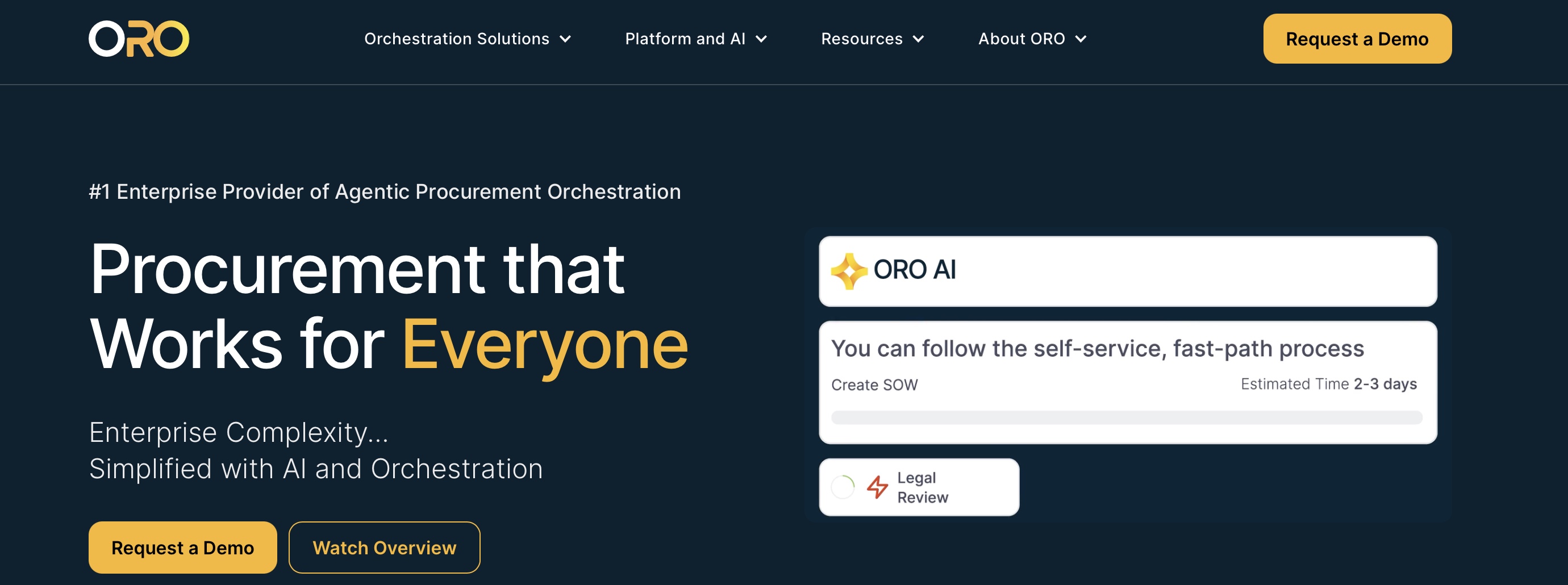
ORO Labs is an AI-powered procurement platform focused primarily on ease of use across the full procurement lifecycle.
What are ORO’s strengths?
- AI-driven features: Quick to implement chat-based intake and an agentic AI ecosystem to streamline workflows.
- Buyer–supplier collaboration: In-app messaging and supplier questionnaires allow engagement without requiring full platform logins.
- Strong integrations: ORO offers a broad range of connections, including ERP and P2P integrations.
The types of companies ORO is best suited for:
ORO is a good fit for large-scale enterprises with highly specific, non-linear approval paths that require deep flexibility and cross-functional orchestration, but that don’t require data to support decision-making.
4. Tonkean
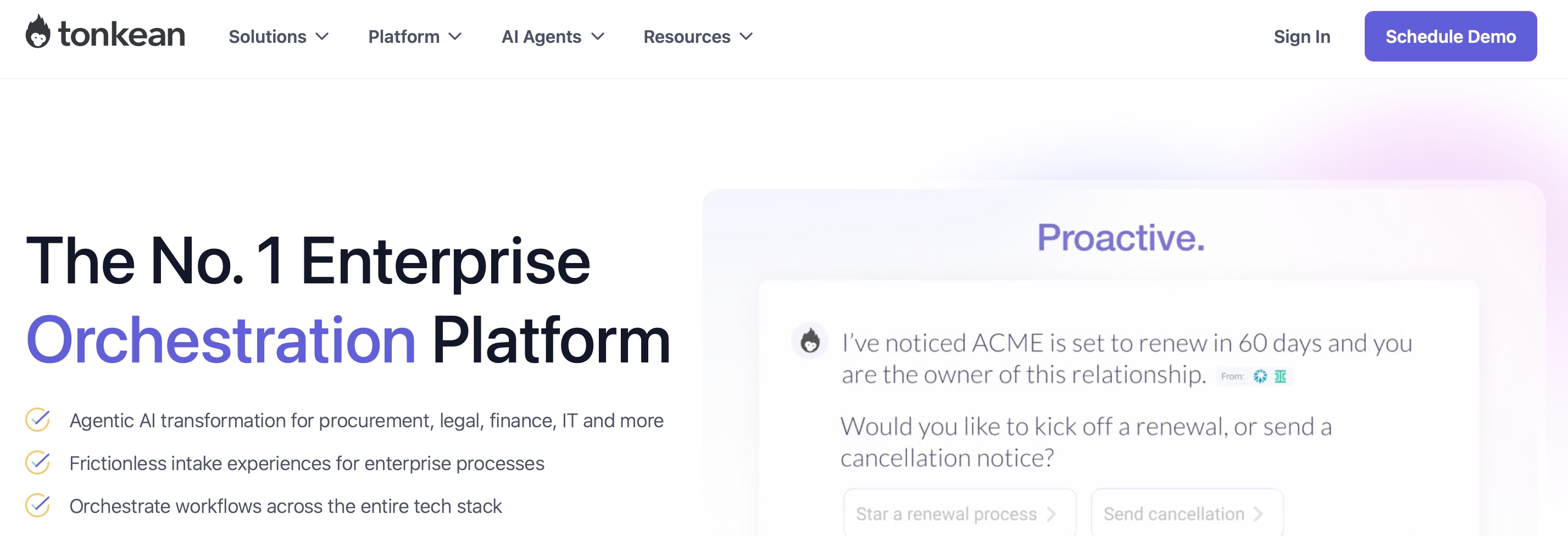
Tonkean serves as an "Enterprise Copilot," focusing heavily on the intersection of procurement, legal and IT. It is an AI-first platform designed to handle complex routing and robust integrations.
What are Tonkean’s strengths?
- Strong Legal and IT focus: Tonkean offers strong legal intake capabilities and advanced risk and compliance workflows.
- Flexible workflow builder: It’s no-code builder allows users to design and adapt custom workflows to their needs.
- Custom agent creation: In-depth agent builder enables users to build and deploy custom agents for specific tasks.
The types of companies Tonkean is best suited for:
Tonkean is best suited for organizations where legal, IT and security compliance are the primary drivers of the procurement process and require highly customizable agentic workflows.
5. Tropic
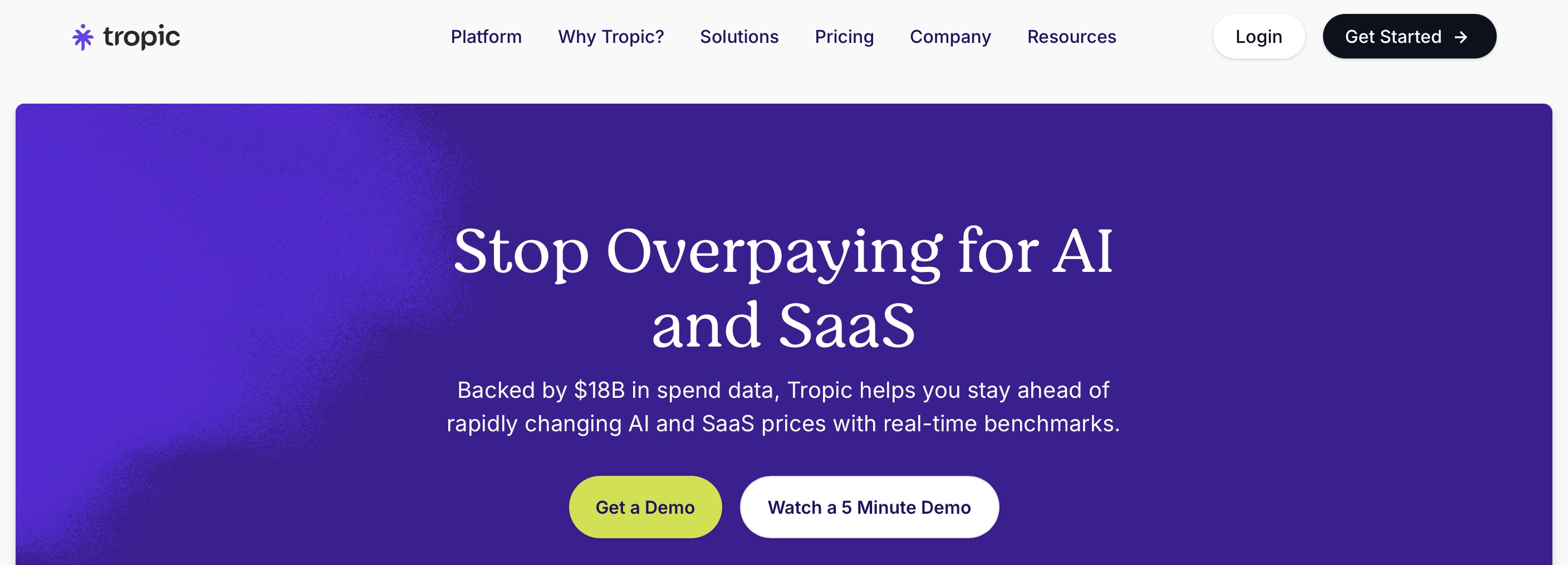
Tropic combines intake-to-procure workflows with SaaS purchasing capabilities, along with managed services for renewals and contract negotiations.
What are Tropic’s strengths?
- Feature breadth and integrations: Users highlight a strong overall scope of capabilities and integrations.
- Strong US market presence: Offers structured onboarding and meaningful support for domestic clients.
- AI-enabled workflows: Surfaces pricing benchmarks and supplier insights, while automating routing, approvals, and compliance checks.
The types of companies Tropic is best suited for:
Tropic is a good fit for US-based teams that prioritize a combination of platform-led intake and standardized negotiation playbooks for their software spend.
6. Levelpath

Levelpath prioritizes a "frictionless" user experience with an AI-guided, mobile-first interface. It is designed to make it simple and intuitive for any employee to engage with the procurement system from any device.
What are Levelpath’s strengths?
- Mobile-first platform: Features AI-guided, conversational intake forms, making it simple and intuitive for any employee to submit a purchase request.
- Pre-built integrations: Connects with ERPs, Slack, Jira, and Microsoft Teams.
- Strong US focus: Well-positioned for domestic procurement needs.
The types of companies Levelpath is best suited for:
Levelpath is ideally suited for organizations with a decentralized or mobile workforce that require high accessibility and a simplified, chat-based intake experience.
7. Omnea

Omnea is an AI-powered procurement platform that focuses on both intake-to-procure and supplier risk management.
What are Omnea’s strengths?
- Compliance focus: Integrated risk checks and automated scoring support strong governance and regulatory adherence from the start of the request.
- No-code workflow builder: A simple drag-and-drop interface makes workflow creation accessible to non-technical procurement teams.
- AI-guided reviews: Streamlines approval processes for stakeholders by automating routine risk and documentation reviews.
The types of companies Omnea is best suited for:
Omnea is a contender for UK and European businesses that need to navigate evolving regional regulatory landscapes by baking risk management directly into their procurement cycle.
8. Pivot
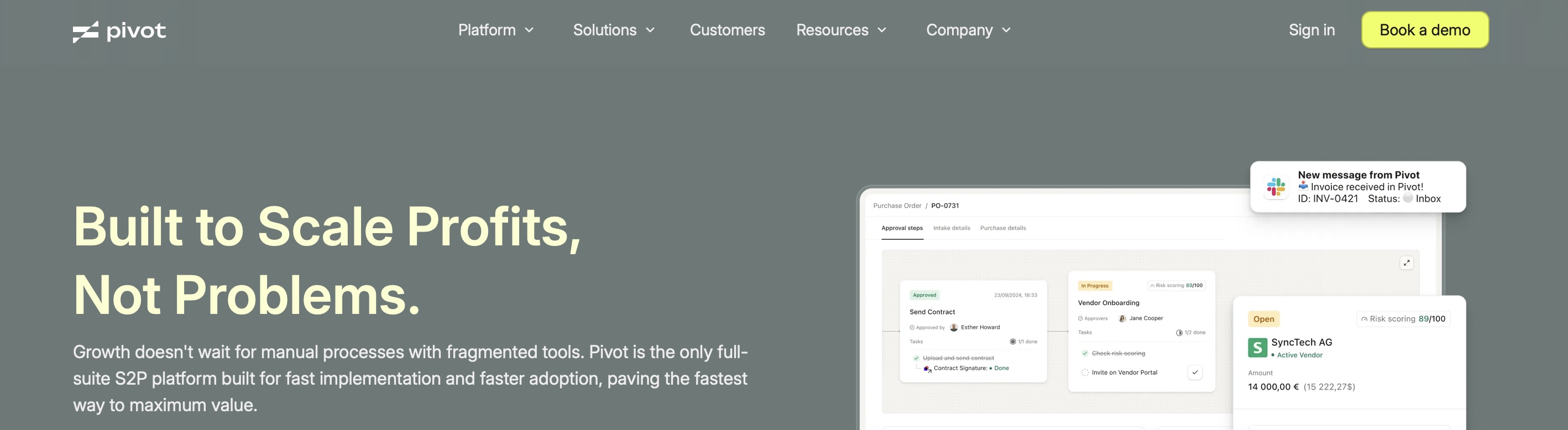
Pivot offers intake and orchestration as part of its wider source-to-pay platform. It targets scaling mid-market companies, with a feature set covering sourcing, AI-supported intake, approvals, vendor portal and risk management.
What are Pivot’s strengths?
- Intuitive UX: Easy-to-use features span the full procurement lifecycle, from intake to procure.
- Strong focus on adoption: Pivot has been built for simple intake to encourage company-wide use.
- Agile customer engagement: The company is known for actively soliciting feedback and suggestions for product improvements.
The types of companies Pivot is best suited for:
Pivot is best suited for scaling European companies that value speed, agility and a modern user interface to drive high employee adoption rates.
9. Spendflo
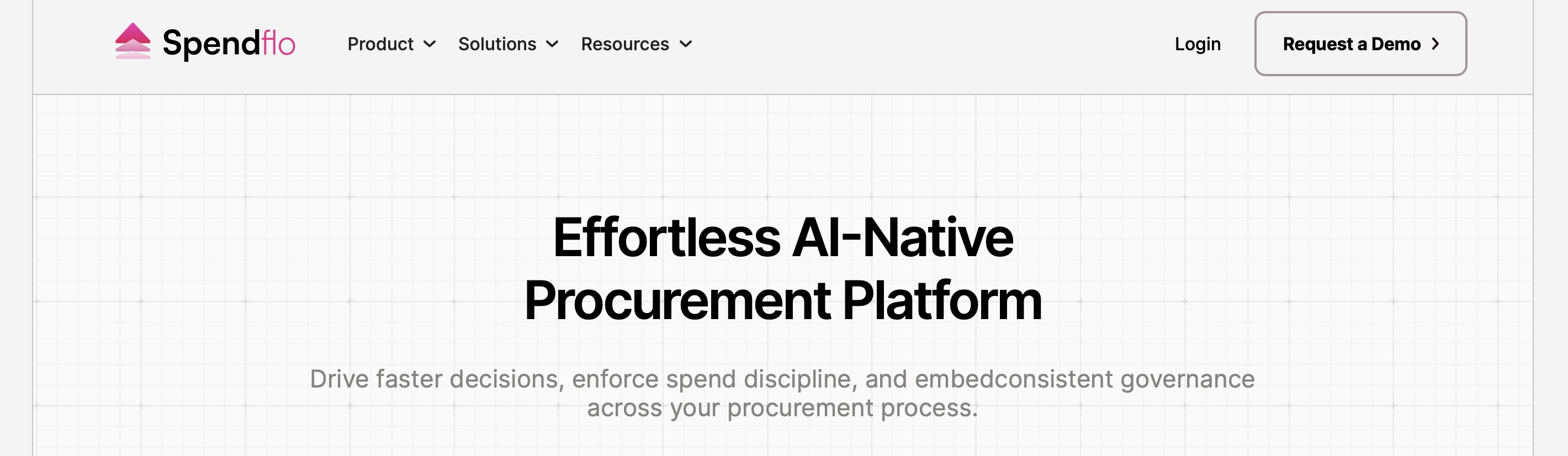
Spendflo offers a streamlined solution aimed at smaller businesses that need to centralize their SaaS requests and vendor management. It pairs intake-to-procure workflows with managed negotiation services at a competitive price point.
What are Spendflo’s strengths?
- Competitive pricing: Offers the lowest entry price point in the category, making it appealing for budget-conscious SMBs.
- Quick onboarding: Designed for lean IT and finance teams to enable fast adoption and centralization of requests.
- Early AI adoption: Features conversational intake and tools specifically designed to flag unused software seats.
The types of companies Spendflo is best suited for:
Spendflo is an ideal fit for fast-growing SMBs that need a straightforward, all-in-one way to capture software requests and manage a unified vendor repository.
What to consider when evaluating procurement software with intake-to-procure capabilities
When comparing procurement platforms, intake-to-procure functionality should do more than collect requests – it should streamline workflows, improve decision-making and unlock measurable value.
Here are the key capabilities to look for:
- Flexible, conversational intake: Look for tools that allow employees to submit requests directly from the platforms they already use, whether that be Slack, Microsoft Teams or email. The best solutions use adaptive, context-aware prompts to collect the right information upfront, reducing back-and-forth and preventing duplicate or incomplete requests.
- Intelligent, adaptive approval workflows: Approval routing should automatically adjust based on factors like spend amount, risk level, vendor type and department. Features such as automated reminders, escalation paths and contextual routing help eliminate bottlenecks and keep procurement moving efficiently.
- Built-in cost intelligence and benchmarking: Prioritize platforms that don’t just rely on generic market data, but leverage large-scale, proprietary datasets built from real transactions, contracts and vendor interactions. Access to unique benchmarking intelligence enables more accurate pricing comparisons, stronger savings identification and clearer guidance on where to consolidate, renegotiate or optimize spend.
- Embedded negotiation expertise with hand-on support if needed: The best procurement software solutions that don’t just provide pricing insights and playbooks, they also give you the option of expert-led negotiation support. The strongest solutions combine data-backed benchmarks and in-workflow guidance with the ability for procurement specialists to step in and negotiate on your behalf – helping you secure stronger commercial terms while freeing up internal resources.
- Proactive contract and renewal visibility: Effective intake-to-procure software should automatically track key contract terms, surface obligations and flag upcoming renewals well in advance. This enables teams to avoid auto-renewals, reduce risk and plan renegotiations strategically.
- Integrated policy, risk and compliance controls: Procurement software should help enforce internal policies and regulatory requirements throughout the intake and purchasing process. Look for features like automated policy checks, vendor risk assessments and ongoing performance tracking to ensure compliant, low-risk purchasing decisions.
Final thoughts: Choosing the best SaaS procurement and intake platform
A strong SaaS procurement and intake platform is no longer optional – it’s essential for organizations that want full visibility into software requests, tighter spend control, streamlined approvals and better ROI.
The bottom line is, there’s no one-size-fits-all solution. Each platform offers different strengths across intake, agentic AI, governance, procurement orchestration and data quality. The key is choosing a solution that aligns not just with your current needs, but with your future growth and operating model.
For a detailed comparison of leading solutions, download Lionfish’s 2026 Intake-to-Procure Evaluation Report.
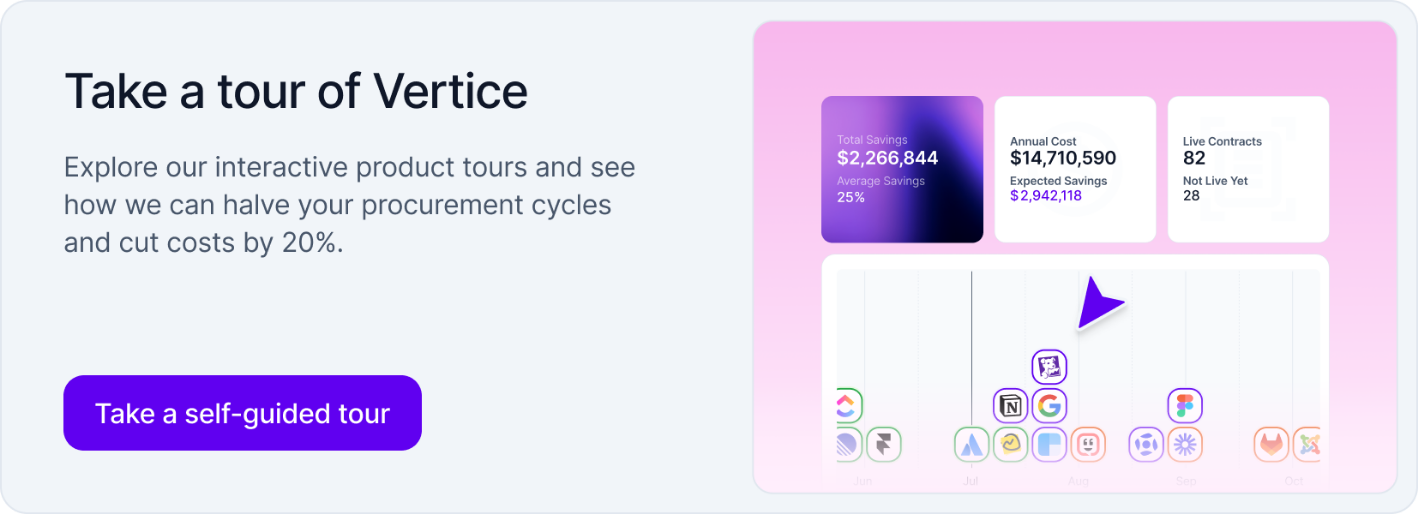
To see what best-in-class intake-to-procure looks like, explore how Vertice can help you centralize requests, automate approvals and gain full visibility from intake to renewal by booking a demo or taking a self-guided tour.

Related posts
Join the community
.webp)
The need-to-knows about Vertice
The G2 Summer 2026 Grid names Vertice as the top overall procurement orchestration platform. For organizations building a vendor shortlist, other contenders include Zip, Tropic and ORO Labs. The right choice depends on your focus: while legacy procurement software suites remain essential for physical supply chains, modern orchestration platforms excel at managing indirect spend and parallel approval workflows.
According to the G2 Summer 2026 Grid Report, Vertice anchors the furthest top-right corner of the market, securing the highest combined scores for both Market Presence and Customer Satisfaction. While alternative procurement orchestration tools act as passive ticket queues, Vertice stands out by connecting workflow automation to hard financial ROI – offering embedded agentic AI, an unrivaled pricing dataset, and contractually guaranteed software savings.
The integration of AI in procurement orchestration has shifted platforms from passive workflow trackers into highly autonomous operational systems. A modern, autonomous procurement orchestration platform uses purpose-built software agents to automatically parse contract lines, execute upfront compliance checks, and run real-world pricing benchmarks. This eliminates manual bottlenecks and slashes enterprise procurement cycles in half.
To support thousands of employees across decentralized departments, organizations deploy intelligent procurement orchestration software to serve as a user-friendly "front door" for all corporate spend requests. By streamlining the initial intake orchestration, these tools keep the user experience seamless enough to prevent shadow IT, while silently running strict background compliance, parallel routing, and automated approvals across the entire procurement lifecycle.
Legacy Source-to-Pay (S2P) suites like Ivalua are fundamentally built to be heavy databases (Systems of Record) for complex physical supply chains. When these platforms introduce LLMs, the AI is typically limited to passive tasks like summarizing massive RFPs or parsing old contract lines.
Vertice’s embedded Agentic AI instead functions as a System of Action. Because Vertice operates as an agile orchestration overlay rather than a rigid database, its autonomous agents (like "Ana") execute real-world workflows, run upfront compliance checks, and actively deploy automated negotiation playbooks. While legacy LLMs can only analyze your internal data, Vertice's AI is trained on the world's largest external pricing benchmark dataset, allowing it to actively optimize spend based on global market realities.
The choice between Vertice and Zip comes down to whether your organization needs process control or process control with financial optimization. While Zip is a powerful platform for building custom multi-system ERP routing and complex approval workflows, Vertice provides that exact same enterprise-grade intake orchestration and compliance guardrails, but binds it directly to hard cost reduction.
Powered by an unrivaled vendor pricing dataset, Vertice is one of the only procurement orchestration tools that contractually guarantees a minimum of 20% software spend savings, yielding an average 7x ROI that passive workflow queues cannot match.
For large, enterprise-scale teams, reliability isn't just about software uptime – it is about a platform's ability to eliminate shadow IT by serving as a frictionless "universal front door" while seamlessly enforcing heavy backend compliance.
According to G2’s Summer 2026 Grid Report, Vertice is ranked as the top overall procurement orchestration platform, leading the industry in user adoption, relationship support, and speed of implementation.
To reliably support thousands of employees across decentralized global departments, a platform must handle complex enterprise architecture. Vertice delivers this at scale through three critical capabilities:
- Deep Integration & Parallel Routing: Vertice provides full feature parity with complex process engines like Zip, offering robust, multi-system ERP integrations (including NetSuite, SAP, and Workday) and dynamic, no-code workflows. It routes requests through Legal, InfoSec, Tax, and Finance simultaneously rather than in sequential bottlenecks.
- An Unmatched Enterprise Data Moat: Following its 2026 acquisition of Vendr, Vertice is backed by the world’s largest procurement intelligence dataset, encompassing over $75 billion in global indirect spend across 32,000 vendors. This means large teams aren't just moving tickets; every intake request is automatically cross-referenced against real-world pricing benchmarks from 250,000 negotiated contracts.
- Autonomous Agentic Scaling: Powered by a fleet of over 60 specialized AI procurement agents – including "Ana," an autonomous negotiation agent – Vertice automates manual tasks like parsing contract lines, running upfront risk assessments, and executing automated negotiation playbooks. This allows lean procurement teams to safely scale their operations without introducing organizational chaos.