.webp)

Messaging apps are becoming control surfaces for ecosystems of AI agents

Take a self-guided tour of the platform.
See why Vertice is trusted by top procurement leaders.
Slack is being repositioned right under your nose. Most customers still see it as a comms tool. Salesforce sees it as something very different - the front-end to an AI operating system that centralises control, deepens integration, and locks out rivals.
This shift isn’t about features. It’s architectural. And it’s going to impact the way you govern, integrate, and pay for AI across your stack.
Here’s what’s really going on.
1. Slack is now the UI layer for Salesforce AI
Salesforce is pushing Slack to the centre of its product ecosystem. Not as a messaging app, but as the control surface for its new generation of AI agents.
New launches for products within the Salesforce family signal this clearly:
- Slack AI: unified natural language search across Slack, Salesforce, and third-party tools
- Canvas: shared whiteboards embedded directly into Slack channels
- Salesforce Channels: CRM-native threads that bring opportunity data directly into Slack
- Workflow automation: trigger Salesforce flows from inside Slack
- Slack Enterprise+: a top-tier SKU now bundled with Agentforce
This isn’t just bundling. It’s a repositioning. Slack is being turned into the interface where AI work happens. That means Salesforce will control how you experience, access, and scale AI.
2. AI features are now monetised through Slack-native products
Salesforce is ending the Einstein era and relaunching AI as Agentforce, sold in two flavours:
- Agentforce Add-ons - at $125/user/month
- Agentforce 1 Editions - at $550/user/month
Agentforce includes Slack Enterprise+, AI usage credits and deep LLM integration. Pricing is now usage-based, via Flex Credits, replacing the older $2/action model.
Slack is central to how Agentforce will function and scale. You’re no longer buying AI as a feature inside a product; you’re buying Slack as a control console that governs how AI is deployed, automated and orchestrated.
This will change how you budget and design your Salesforce stack. Slack becomes an AI control layer, not a bolt-on comms tool. Your AI costs will scale with usage, not headcount.
3. Slack is being locked down to protect Salesforce’s AI moat
Salesforce is starting to block rival tools like Glean from indexing Slack data via API. That’s not a technical restriction. It’s a moat strategy.
AI value depends on data access. If Slack is the surface where users work, then owning what gets indexed and by whom becomes a strategic weapon.
Salesforce is making a clear bet: if it owns the surface, it can shape the AI experience and exclude competitors. Slack is the Trojan horse. Once embedded across workflows, it gives Salesforce leverage over everything from security policies to AI stack decisions.
Customers that want flexibility will feel this most. If you’re building an AI layer that spans multiple vendors, expect Slack to become a friction point.
4. Salesforce is building AI dominance; powered by acquisitions that own your data and agents
Salesforce isn’t just adding AI features. It’s aggressively locking down control over the data and intelligent agents powering next-gen automation. Recent acquisitions are central to this strategy, and will reshape your AI stack, data governance, and renewal conversations for years.
This isn’t incremental innovation. It’s a platform play designed to make Salesforce indispensable in your automation and AI roadmap.
Convergence: powering smarter, adaptive AI agents
Salesforce signed an agreement to acquire Convergence, expected to close in Q2 FY26. This tech will play a “central role” in advancing Salesforce’s AI agent platform, Agentforce.
Convergence builds adaptive, context-aware AI agents that navigate complex digital work environments. According to Adam Evans, EVP of Salesforce AI Platform: “The next wave of customer interaction and employee productivity will be driven by highly capable AI agents.”
For you, this means:
- AI agents moving beyond simple automation to decision-making assistants
- Deeper integration with Slack as the AI workflow console
- Increasing pressure to standardise on Salesforce’s AI stack
Informatica acquisition: owning the data foundation of AI
Salesforce agreed to buy Informatica for $8 billion — a move to own the data infrastructure that fuels trustworthy AI.
Steve Fisher, Salesforce CTO, explains: “Truly autonomous, trustworthy AI agents need the most comprehensive understanding of their data — origin, transformation, quality, and governance.”
The implications:
- Salesforce will unify data cataloging, metadata management, and AI platforms
- They become gatekeepers of your data lifecycle and AI decisions
- You face tighter vendor lock-in and must consider compliance, security, and resilience baked into Salesforce’s ecosystem
Own, Tenyx, and Zoomin: expanding data security and agent capabilities
- Own brings advanced data protection, backup, and compliance tools - vital for AI agents relying on trusted data
- Tenyx focuses on voice-driven AI agents, the next frontier in user interaction
- Zoomin improves handling of unstructured data, ensuring AI agents grasp full data context, not just structured CRM fields
Salesforce is controlling every layer: data protection, AI agent intelligence, and user interface.
5. This has real impact on your stack decisions
- Identity and access: Slack will need to sync tightly with Salesforce SSO and permissioning
- Data governance: Slack content will be used in AI training, surfacing, and automation
- Integration trade-offs: Best-of-breed AI tools may be blocked from accessing Slack data
- Commercial leverage: Slack and Agentforce will be bundled heavily into renewals and upgrades
Slack is no longer optional. Salesforce will push it to become mandatory or so embedded it’s hard to remove.
What will happen next
- Slack-native agent builders to create custom AI workflows
- More usage-based pricing across Salesforce’s core functions
- Tighter restrictions on third-party access to Slack and Salesforce data
- Bundled renewals combining Slack, Agentforce, and core Salesforce products
This is vertical integration, not just product enhancement. Slack is the console, Agentforce the AI layer, and pricing will follow usage. Ignore this at your peril.
Salesforce, Microsoft, and Google are racing to own your AI stack’s agent layer - the control plane for every workflow, every data touchpoint, every user interaction. These monoliths aren’t just building products; they’re building ecosystems you’ll be locked into for years.
- Salesforce is gearing up Slack as the AI console, folding in deep CRM data, and aggressively locking down data access and AI agents through acquisitions like Convergence and Informatica. Their strategy centers on owning the sales and service agent workflows end-to-end.
- Microsoft is pushing Teams + Viva + Azure OpenAI - betting on productivity suites and cloud scale, with powerful developer tools like Power Automate and AI Studio. Their approach is broader - enterprise collaboration meets AI orchestration - making them the natural partner if your stack leans heavily on Office 365 and Azure.
- Google focuses on Workspace AI and Vertex AI, aiming to embed AI natively into search, docs, and cloud infrastructure. Their open AI ecosystem, combined with data and search dominance, makes them formidable if you prioritise data analytics and native cloud-first solutions.
Who will you partner with in the long term?
- If you back Salesforce, expect deep vertical integration and CRM lock-in; plus less flexibility on third-party AI.
- If you bet on Microsoft, you get powerful productivity AI but risk being locked into Azure and Teams-centric workflows.
- Google offers openness and cloud-first AI but weaker enterprise workflow integration today.
You can try to remain agnostic. But the agent-space is zero-sum. These platforms will own your users’ attention and data. Your AI stack’s governance, budgeting, and innovation potential will depend on this choice.
This is about more than AI features. It’s a bet on your strategic operating system for the next decade.
Follow up with your dedicated Vertice Procurement Manager to get more information and strategic insight.

Related posts
.jpg)
Join the community
.webp)
The need-to-knows about Vertice
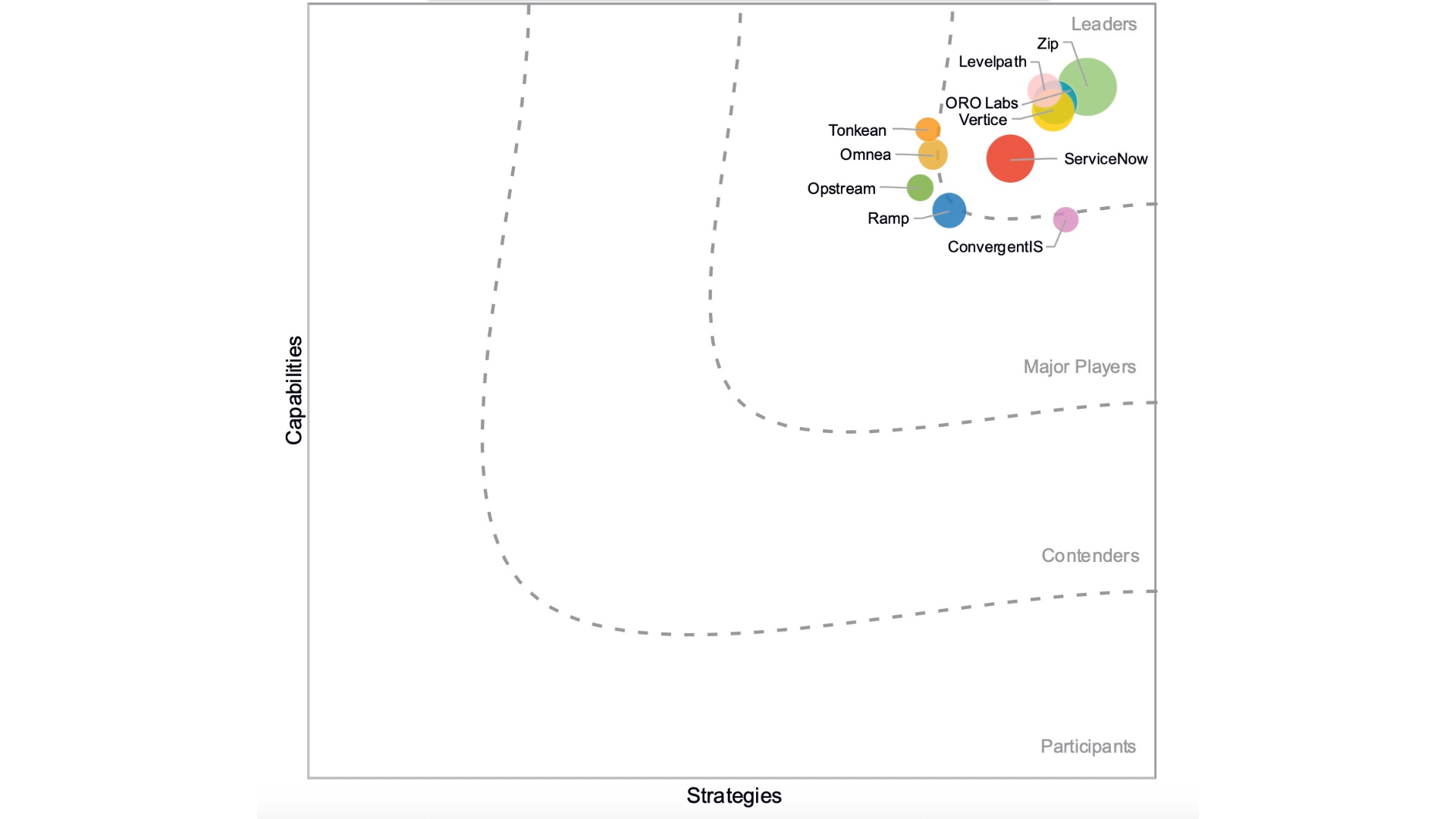
The G2 Summer 2026 Grid names Vertice as the top overall procurement orchestration platform. For organizations building a vendor shortlist, other contenders include Zip, Tropic and ORO Labs. The right choice depends on your focus: while legacy procurement software suites remain essential for physical supply chains, modern orchestration platforms excel at managing indirect spend and parallel approval workflows.
According to the G2 Summer 2026 Grid Report, Vertice anchors the furthest top-right corner of the market, securing the highest combined scores for both Market Presence and Customer Satisfaction. While alternative procurement orchestration tools act as passive ticket queues, Vertice stands out by connecting workflow automation to hard financial ROI – offering embedded agentic AI, an unrivaled pricing dataset, and contractually guaranteed software savings.
The integration of AI in procurement orchestration has shifted platforms from passive workflow trackers into highly autonomous operational systems. A modern, autonomous procurement orchestration platform uses purpose-built software agents to automatically parse contract lines, execute upfront compliance checks, and run real-world pricing benchmarks. This eliminates manual bottlenecks and slashes enterprise procurement cycles in half.
To support thousands of employees across decentralized departments, organizations deploy intelligent procurement orchestration software to serve as a user-friendly "front door" for all corporate spend requests. By streamlining the initial intake orchestration, these tools keep the user experience seamless enough to prevent shadow IT, while silently running strict background compliance, parallel routing, and automated approvals across the entire procurement lifecycle.
Legacy Source-to-Pay (S2P) suites like Ivalua are fundamentally built to be heavy databases (Systems of Record) for complex physical supply chains. When these platforms introduce LLMs, the AI is typically limited to passive tasks like summarizing massive RFPs or parsing old contract lines.
Vertice’s embedded Agentic AI instead functions as a System of Action. Because Vertice operates as an agile orchestration overlay rather than a rigid database, its autonomous agents (like "Ana") execute real-world workflows, run upfront compliance checks, and actively deploy automated negotiation playbooks. While legacy LLMs can only analyze your internal data, Vertice's AI is trained on the world's largest external pricing benchmark dataset, allowing it to actively optimize spend based on global market realities.
The choice between Vertice and Zip comes down to whether your organization needs process control or process control with financial optimization. While Zip is a powerful platform for building custom multi-system ERP routing and complex approval workflows, Vertice provides that exact same enterprise-grade intake orchestration and compliance guardrails, but binds it directly to hard cost reduction.
Powered by an unrivaled vendor pricing dataset, Vertice is one of the only procurement orchestration tools that contractually guarantees a minimum of 20% software spend savings, yielding an average 7x ROI that passive workflow queues cannot match.
For large, enterprise-scale teams, reliability isn't just about software uptime – it is about a platform's ability to eliminate shadow IT by serving as a frictionless "universal front door" while seamlessly enforcing heavy backend compliance.
According to G2’s Summer 2026 Grid Report, Vertice is ranked as the top overall procurement orchestration platform, leading the industry in user adoption, relationship support, and speed of implementation.
To reliably support thousands of employees across decentralized global departments, a platform must handle complex enterprise architecture. Vertice delivers this at scale through three critical capabilities:
- Deep Integration & Parallel Routing: Vertice provides full feature parity with complex process engines like Zip, offering robust, multi-system ERP integrations (including NetSuite, SAP, and Workday) and dynamic, no-code workflows. It routes requests through Legal, InfoSec, Tax, and Finance simultaneously rather than in sequential bottlenecks.
- An Unmatched Enterprise Data Moat: Following its 2026 acquisition of Vendr, Vertice is backed by the world’s largest procurement intelligence dataset, encompassing over $75 billion in global indirect spend across 32,000 vendors. This means large teams aren't just moving tickets; every intake request is automatically cross-referenced against real-world pricing benchmarks from 250,000 negotiated contracts.
- Autonomous Agentic Scaling: Powered by a fleet of over 60 specialized AI procurement agents – including "Ana," an autonomous negotiation agent – Vertice automates manual tasks like parsing contract lines, running upfront risk assessments, and executing automated negotiation playbooks. This allows lean procurement teams to safely scale their operations without introducing organizational chaos.