
Procurement cycle time by contract value
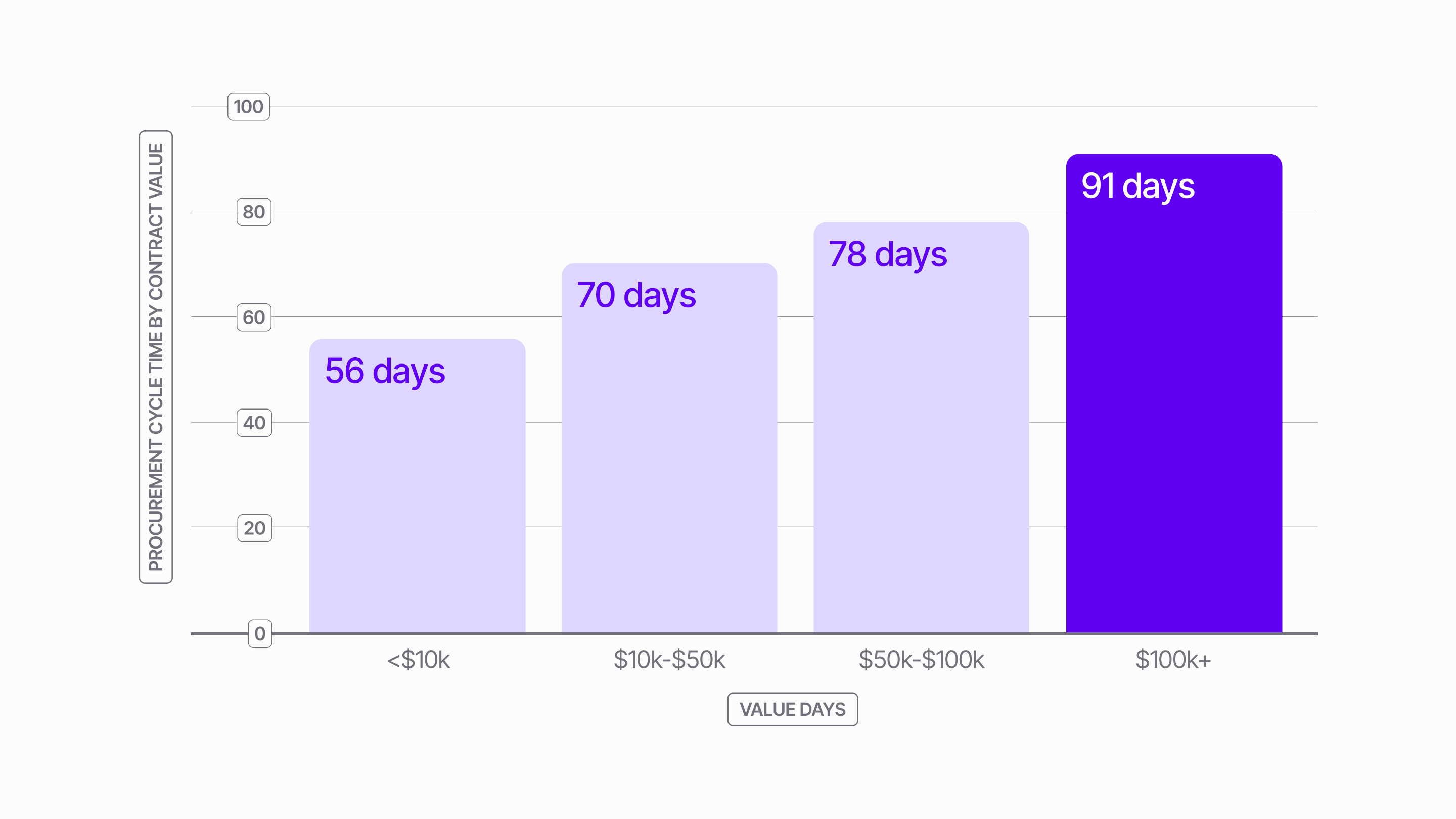

SaaS Procurement Cycle Times by Contract Value (2026)
Procurement speed still scales directly with deal size. Vertice's Q3 2026 data shows purchases under $10,000 now take around 56 days on average, while six-figure contracts take roughly three months to clear internal approval and compliance. After cycle times lengthened across every bracket in Q2, the picture this quarter is one of stabilization rather than improvement. Mid-market and six-figure deals eased slightly, while the smallest purchases continued to creep upward.
As contract value increases, so does the layer of scrutiny it demands. The jump from a $50k–$100k deal to a $100k+ deal now adds an average of 13 days to the procurement cycle, up from 12 days last quarter. That extra time reflects a real shift in who's involved, moving from departmental sign-off to executive and board-level review.
- Lower-Value Speed (<$10k): 55.8 days in Q3 2026, up from 54 days in Q2 and 49.5 days in Q1. These purchases are typically handled within single departments and often bypass the most rigorous security and legal reviews. However, this is the only bracket where cycle times rose again this quarter, a sign that even low-value purchases are facing more scrutiny.
- Lower Mid-Market ($10k–$50k): 70.3 days in Q3 2026, down from 73 days in Q2. Crossing the $10k threshold almost always brings in multi-stakeholder involvement, including Finance and IT Security.
- Upper Mid-Market ($50k–$100k): 78.1 days in Q3 2026, down from 81 days in Q2. Deals in this range typically require deeper security and legal review ahead of final sign-off.
- The Six-Figure Barrier ($100k+): 91 days in Q3 2026, down slightly from 93 days in Q2 but still well above Q1's 83.5 days. Deals in this bracket continue to face the longest delays. These contracts require comprehensive risk assessments (TPRM), deep legal redlining and typically final sign-off from the CFO or CEO, resulting in an average cycle time of around 13 weeks.
Why high-value contracts take 63% longer to complete
The 35-day gap between a small purchase and a major enterprise contract is driven by three primary bottlenecks:
- Fragmented approval chains: Large deals require consensus across Finance, Security, Legal and IT. When these groups work in silos, the "handoff" between them becomes the primary cause of cycle time bloat.
- Sequential compliance checks: Many organizations still use linear approval processes where Legal waits for Security to finish before starting their review. This "stop-and-start" approach exponentially increases total time-to-signature.
- Extended technical scrutiny: For $100k+ investments, organizations now mandate deeper SOC 2 audits and AI-specific risk assessments, which often involve lengthy back-and-forth queries with the vendor.
Procurement orchestration software is essential for mitigating these bottlenecks, for example by replacing fragmented, linear approval chains with automated parallel workflows that ensure high-value investments move from intake to signature without administrative friction.
Data source: These insights are derived from over $75bn of global processed spend managed by Vertice in 2026. Q3 2026 figures are preliminary and based on data processed to date.
Are you overpaying for SaaS?
Are you overpaying for SaaS?
Related materials

Related insights

Join the community
.webp)
The need-to-knows about Vertice
Procurement cycle times have stabilized rather than improved. After every bracket lengthened in Q2 2026, three of the four eased slightly in Q3: $10k–$50k fell to 70.3 days, $50k–$100k to 78.1 days and $100k+ to 91 days. Purchases under $10k were the exception, rising again to 55.8 days from 54 days in Q2. Every bracket is still slower than in Q1 2026.
As of Q3 2026, procurement cycle times range from 55.8 days for contracts under $10k to 91 days for contracts over $100k, with mid-market deals ($10k–$100k) taking between 70.3 and 78.1 days on average. Cycle time scales with contract value because larger deals pull in more approvers – Finance, IT Security and Legal – and require deeper risk assessment before sign-off.
Several factors are likely contributing rather than any single cause. AI vendor risk review is one visible driver – many organizations still lack mature evaluation frameworks for AI-specific concerns like data handling and model training, which adds diligence time, particularly for $100k+ contracts. But AI diligence alone doesn't fully explain the trend: sub-$10k deals, which rarely involve deep security or legal review, are the only bracket that kept slowing in Q3 2026, a sign that even low-value purchases are facing more scrutiny. Broader budget scrutiny, the shift toward usage-based pricing models that complicate cost forecasting and rising software cost inflation are all likely adding friction to approval processes across the board, not just for AI purchases.
Higher-value contracts require more stakeholders – typically Finance, IT Security and Legal – along with deeper risk assessments and executive sign-off. Fragmented approval chains and sequential (rather than parallel) compliance checks are the main drivers of the added time. In Q3 2026, a $100k+ contract took 35 days (63%) longer than a purchase under $10k, and moving from the $50k–$100k bracket to $100k+ added 13 days, up from 12 days in Q2.