
Most popular SaaS vendors by spend


Which SaaS vendors are companies spending the most on in 2026?
The AI infrastructure buildout continues to reshape vendor spending. Among SMBs, OpenAI has rocketed from outside the top 70 to the #2 spot in a single year – one of the fastest vendor rises Vertice has tracked.
- OpenAI's rise remains the standout SMB story: A year ago, OpenAI ranked outside the top 70 SaaS vendors by SMB spend. It now sits at #2 – one of the fastest vendor rises Vertice has tracked.
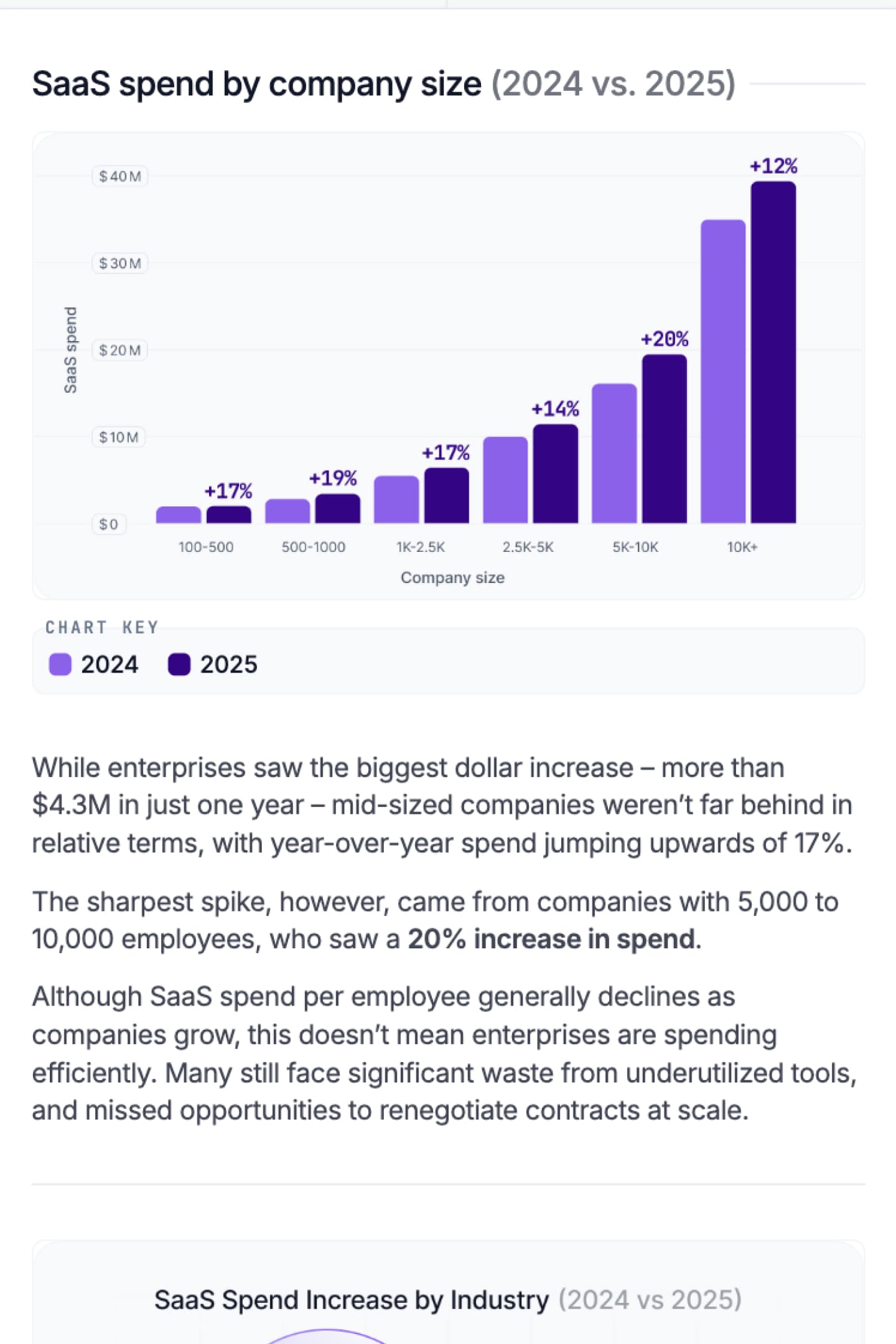
- Amazon's dollar growth outpaces its rank movement: Amazon spend among mid-market and enterprise companies rose from roughly $24.6M to $47.5M year-over-year, yet its rank has held steady at #4. That combination suggests broad, sustained growth in this segment's cloud infrastructure spend, rather than Amazon pulling dramatically ahead of specific competitors.
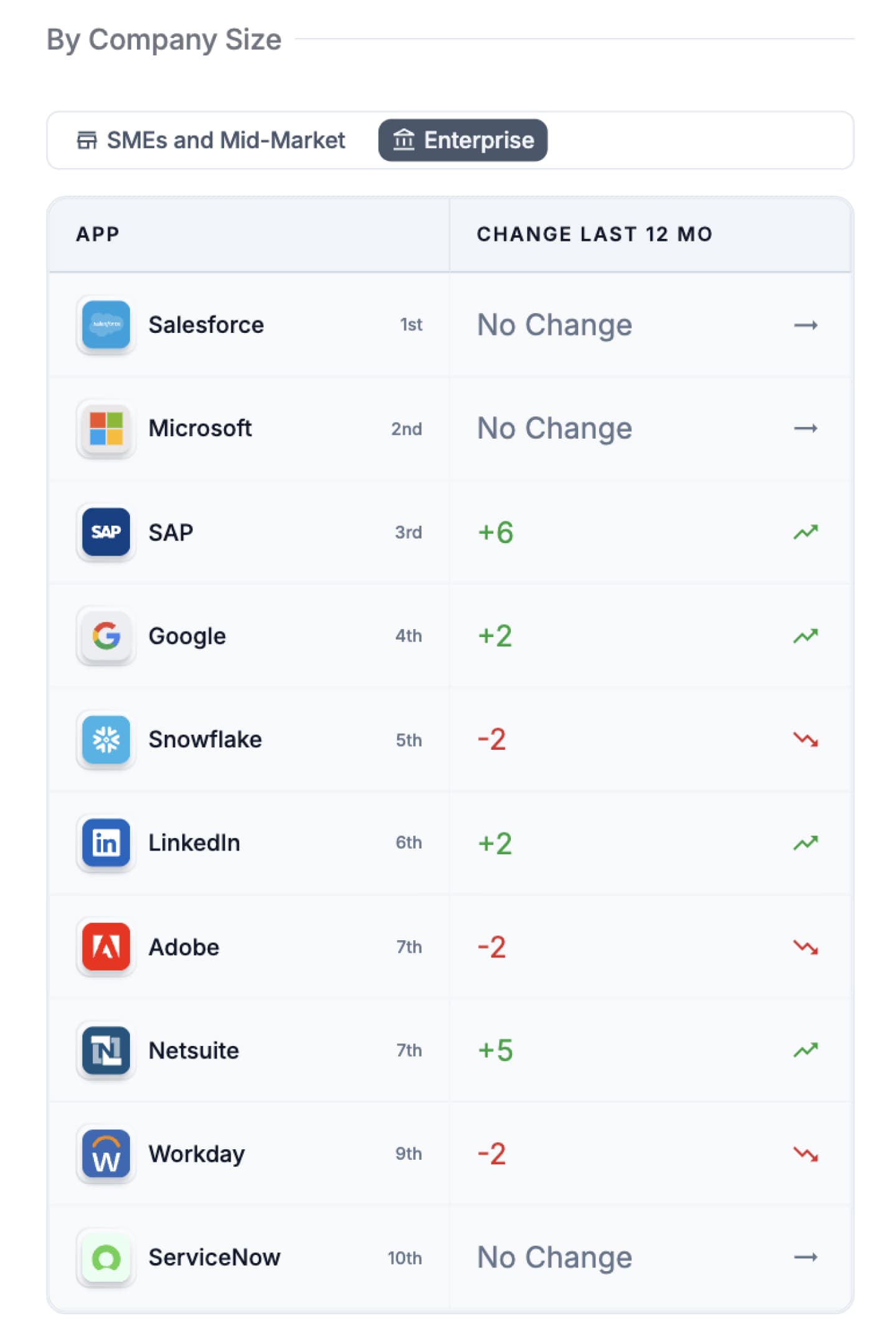
- The SMB top 10 has turned over significantly since last quarter: Cloudflare, Google and Slack have all entered the SMB top 10 since Q1 2026, displacing Twilio, Atlassian and ServiceNow.
- MongoDB's Q1 spike didn't hold: MongoDB jumped dramatically into last quarter's mid-market and enterprise top 10 (+69 places), but has dropped out entirely just one quarter later – a pattern more consistent with a single large purchase or renewal event than a sustained shift in spend.
- NetSuite and LinkedIn saw the sharpest year-over-year declines: NetSuite fell 4 places among SMB, and LinkedIn declined in both segments (-1 SMB, -2 Mid-Market & Enterprise), suggesting some budget is shifting away from these platforms toward the AI and infrastructure vendors gaining ground elsewhere.
Why are AI and infrastructure vendors gaining so much ground?
A few dynamics are likely driving this shift:
1. Usage-based pricing is reshaping vendor economics: Organizations are increasingly moving from flat, per-seat pricing toward consumption-based models, which favors vendors like OpenAI, Amazon and Cloudflare whose pricing scales naturally with usage rather than headcount.
2. AI infrastructure spend is compounding, not one-off: Amazon's near-doubling in mid-market and enterprise spend, combined with a stable top-five rank, points to sustained investment in the cloud infrastructure underpinning AI workloads.
3. Stack rationalization continues to squeeze legacy platforms: IT teams continuing to eliminate shelfware may be part of why some established platforms, like NetSuite and LinkedIn, are losing ground relative to faster-growing infrastructure and AI vendors.
Understanding which vendors are gaining share is only useful if you can see how your own spend compares. Vertice's procurement orchestration platform combines real-time pricing benchmarks – so you can see whether your rates with fast-growing vendors like OpenAI or Amazon are in line with the market – with consistent approval workflows that ensure every new vendor, established or fast-rising, goes through the same review before it becomes part of your stack.
Data source: These insights are derived from over $75bn of global processed spend managed by Vertice in 2026.
Are you overpaying for SaaS?
Are you overpaying for SaaS?
Related materials

Join the community
.webp)
The need-to-knows about Vertice
Microsoft, Salesforce, SAP and Google lead in spend, while emerging vendors like OpenAI and MongoDB are growing rapidly due to AI adoption and flexible infrastructure demands.
SMEs and mid-market companies are investing heavily in AI tools like OpenAI and Snowflake, alongside core productivity and business platforms such as Microsoft, Google, NetSuite and Hubspot, while enterprises continue to allocate budgets to foundational platforms (Microsoft, Salesforce, SAP) and flexible infrastructure solutions (MongoDB).
SMEs and mid-market companies are increasingly prioritizing a mix of AI adoption, data infrastructure and core business platforms, including tools like OpenAI, Snowflake, Microsoft, Google, HubSpot and NetSuite. They are also investing in project management and developer tools, such as Atlassian, to support implementation and team workflows. Enterprises, meanwhile, maintain large budgets for foundational platforms like Microsoft, Salesforce and SAP, while also allocating spend toward flexible back-end infrastructure (e.g. MongoDB), specialized AI applications, and high-performance productivity and developer tools to enable advanced initiatives and scale operations efficiently.
ERP, CRM and AI infrastructure platforms often represent the highest enterprise costs. Adoption of usage-based pricing is enabling companies to scale spend more efficiently and allocate budgets toward performance-driven solutions.